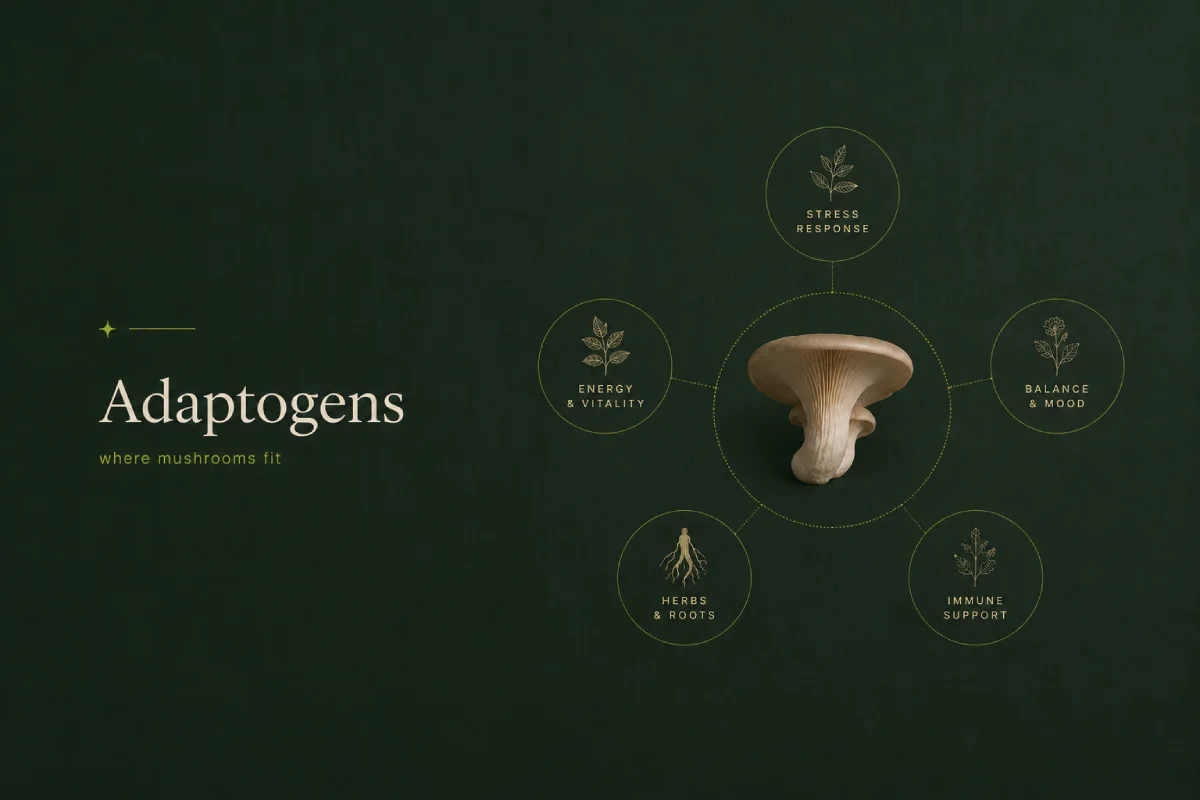
An adaptogen is a substance — plant, fungus, or other natural compound — that helps the body non-specifically resist physical and psychological stress while supporting normal physiological function. The term was coined by Soviet pharmacologist Nikolai Lazarev in 1947 and describes herbs and fungi that work with the body’s stress response systems rather than targeting a single condition. Several functional mushrooms, including Reishi, Lion’s Mane, and Turkey Tail, are widely recognized in the research and traditional medicine literature as belonging to this category.
At Foxfire Mushrooms in Longmont, Colorado, we work with growers and wellness-curious adults who want to understand the science behind what they’re growing and consuming. This guide unpacks the adaptogen concept from first principles — what qualifies something as an adaptogen, how they’re thought to work, and exactly where mushrooms fit into the picture.
The word “adaptogen” entered the scientific vocabulary in 1947, when Soviet pharmacologist Nikolai Lazarev used it to describe substances that help an organism adapt to stress without causing harm. The concept was further refined in the 1960s by researchers Israel Brekhman and I.V. Dardymov, who published formal criteria for what qualifies a substance as an adaptogen and studied several plants — particularly Eleuthero (Siberian ginseng) — in depth.
The definition has since evolved, but the core idea remains consistent: an adaptogen is a natural substance that helps the body maintain balance under stress, working across multiple physiological systems rather than targeting one specific pathway. This non-specificity is part of what distinguishes adaptogens from many conventional compounds, which typically act on a single receptor or mechanism.
The category includes well-known herbs like Ashwagandha (Withania somnifera), Rhodiola rosea, and Panax ginseng, as well as a growing group of functional mushrooms. Research published in journals including the Journal of Ethnopharmacology, Phytomedicine, and Frontiers in Pharmacology has explored the adaptogenic properties of several fungal species.
Brekhman and Dardymov’s three-part framework — often called “Brekhman’s criteria” — is still used as a benchmark for evaluating whether a substance qualifies as a true adaptogen. Here’s what each criterion means in plain language:
1. Non-toxic at normal doses
The substance should not cause significant harm at the doses a person would normally consume. This distinguishes adaptogens from stimulants or synthetic compounds that produce results by stressing the body in a different direction.
2. Non-specific response
The substance should help the body handle multiple types of stress — physical exertion, emotional pressure, environmental stressors — rather than addressing just one. This broad action is central to the adaptogen concept.
3. Normalizing effect
This is the most nuanced criterion: an adaptogen should bring the body toward balance, not simply push it in one direction. If the body’s stress response is overactive, an adaptogen may help modulate it downward; if the body is depleted, it may help restore resources. The direction of effect adapts to what the organism needs.
Reishi, Lion’s Mane, and Turkey Tail are the three functional mushrooms most consistently discussed in the context of these criteria in the scientific literature. Cordyceps and Chaga are also frequently included in adaptogen discussions, though the research base varies by species.
The primary proposed mechanism involves the hypothalamic-pituitary-adrenal (HPA) axis — the body’s central command system for stress response.
Here’s how the cascade works in plain terms:
This is a healthy, necessary system — but chronic activation can contribute to fatigue, poor recovery, and disrupted sleep patterns. Adaptogens are thought to help calibrate this response: they may support the HPA axis in mounting an appropriate stress reaction without tipping into prolonged dysregulation.
Research has also explored the role of adaptogens in the sympatho-adrenal system (SAS) — the branch of the nervous system responsible for the rapid “fight or flight” response — and in the activity of stress-response proteins (including heat shock proteins such as HSP70 and HSP90), which help protect cells under conditions of heat, oxidative stress, and other challenges.
It’s important to note that mechanisms are still being studied. The evidence is growing but is not uniformly conclusive for every mushroom species across every type of stress. Researchers continue to investigate which compounds are responsible for adaptogenic activity and how they interact with specific physiological systems.
| Adaptogen | Type | Key Compounds | Traditionally Associated With | Research Status |
| Ashwagandha | Herbal root | Withanolides | Calm energy, stress resilience | Well-studied; multiple human trials |
| Rhodiola rosea | Herbal root | Rosavins, salidroside | Mental endurance, fatigue | Studied; European regulatory recognition |
| Eleuthero | Herbal root | Eleutherosides | Physical stamina, resilience | Extensive Soviet-era + modern research |
| Panax ginseng | Herbal root | Ginsenosides | Vitality, cognitive function | Long-studied; complex compound profile |
| Reishi | Functional mushroom | Triterpenes, beta-glucans | Calm, longevity, immunity | Growing body of preclinical + some clinical research |
| Lion’s Mane | Functional mushroom | Hericenones, erinacines | Cognitive support, nerve health | Active area of study |
| Turkey Tail | Functional mushroom | PSK, PSP (beta-glucan compounds) | Immune function, gut health | Among the most-researched mushrooms globally |
| Cordyceps | Functional mushroom | Cordycepin, adenosine | Energy, endurance | Studied preclinically; growing clinical interest |
Mushroom adaptogens differ from herbal adaptogens primarily in their compound profile. Where herbs often rely on alkaloids, glycosides, or phenolics, functional mushrooms deliver their effects largely through polysaccharides (particularly beta-glucans) and, in some species, unique secondary metabolites like triterpenes or cyathane diterpenoids.
Reishi — known as Lingzhi in Traditional Chinese Medicine, literally “mushroom of immortality” — has one of the longest documented histories of any adaptogenic substance. Used for more than 2,000 years in East Asian medicine, it was traditionally associated with calm, longevity, and immune resilience.
Its two primary compound classes are ganoderic acids (a family of triterpenes) and beta-glucans (branched polysaccharides). Research published in journals including Phytomedicine and the Journal of Ethnopharmacology has explored how these compounds may interact with stress response pathways and immune signaling. Reishi is one of the most studied functional mushrooms in the world.
Research has explored the role of Reishi in supporting normal stress response and immune function. These statements have not been evaluated by the Food and Drug Administration. This product is not intended to diagnose, treat, cure, or prevent any disease.
For more on cultivating your own Reishi, see our Reishi mushroom growing guide. For a deeper look at the functional research, see our upcoming guide on Reishi, stress, and sleep.
Lion’s Mane is unique in the adaptogen landscape because its primary research focus is neuroprotective and neurotropic — relating to the nervous system and brain health — rather than the more generalized stress-modulation profile of Reishi or Turkey Tail.
Its most distinctive compounds — hericenones (found in the fruiting body) and erinacines (found in the mycelium) — are not found in any other mushroom. Studies published in journals including Biomedical Research and the International Journal of Medicinal Mushrooms have explored how these compounds may interact with nerve growth factor (NGF) pathways. While Lion’s Mane meets the general adaptogen criteria of being non-toxic, non-specific, and normalizing, its specific compound profile makes it a subject of particular interest for cognitive and neurological wellness research.
See our Lion’s Mane mushroom guide for cultivation details, and watch for our forthcoming deep-dive on Lion’s Mane and cognitive function.
Turkey Tail is arguably the most-studied medicinal mushroom globally, largely because of two specific compounds derived from its polysaccharide content: PSK (polysaccharide-K, also called krestin) and PSP (polysaccharide-peptide). Both are beta-glucan-derived compounds that have been the subject of extensive research, particularly in Japan and China.
Turkey Tail has a long history of use in traditional medicine in East Asia, and its research profile is among the deepest of any fungal species. It meets all three Brekhman criteria and is widely recognized in the functional mushroom community as a foundational adaptogenic species.
Explore Turkey Tail cultivation in our Turkey Tail mushroom guide, and see our upcoming article on Turkey Tail and immune support.
Chaga (Inonotus obliquus) grows on birch trees in northern forests and contains betulinic acid, melanin, and beta-glucans. It is frequently discussed in the adaptogen context, with an active area of preclinical research. Foxfire does not currently carry Chaga spawn, as it requires a living birch host rather than conventional substrate cultivation.
Cordyceps (Ophiocordyceps sinensis and the cultivated Cordyceps militaris) is well-known for its association with energy and endurance. Cordycepin and adenosine are among its studied bioactive compounds. While not currently in the Foxfire functional product line, Cordyceps is worth noting as one of the most recognized adaptogen mushrooms globally — and we’re watching the research space closely.
Not all mushroom products are equivalent, and this matters when evaluating adaptogenic potential.
Whole fruiting body products — made from the actual mushroom, not the root-like mycelium — contain the full spectrum of compounds associated with adaptogenic activity: beta-glucans, triterpenes (in Reishi), hericenones (in Lion’s Mane), and other secondary metabolites. The fruiting body is where most of the biologically active compound research is concentrated.
Mycelium-on-grain products are made by growing mushroom mycelium on a grain substrate (typically rice or oats) and then drying and powdering the entire mass, including the undigested grain. The result often contains significantly more starch than active mushroom compounds. Beta-glucan concentrations in mycelium-on-grain products can be considerably lower than in fruiting body extracts.
When evaluating mushroom supplements for adaptogenic use, look for:
This distinction becomes especially relevant when Foxfire’s functional mushroom supplements launch — we’ll be transparent about extraction methods and compound profiles.
Adaptogenic mushrooms can be incorporated in several forms, each with different practical trade-offs:
Consistency over time is generally considered more important than dose in any single sitting, based on how the adaptogen framework conceives of these compounds working — gradually calibrating physiological systems rather than producing immediate acute effects.
Foxfire Mushrooms, based in Longmont, Colorado, currently carries Reishi, Turkey Tail, Lion’s Mane, and Shiitake spawn for home and commercial growers who want to cultivate their own source of functional mushrooms. Growing your own guarantees whole fruiting body material — you know exactly what substrate it grew on, when it was harvested, and how it was dried.
Our functional mushroom supplement line is in development. When it launches, you’ll find it at functional-mushrooms. In the meantime, explore the functional mushrooms and health benefits section of our blog, or dive into species-specific cultivation guides:
Whether you’re a curious newcomer to the world of adaptogenic mushrooms or a seasoned grower looking to expand your functional harvest, Foxfire Mushrooms in Longmont, Colorado is your starting point in the Rocky Mountain region.
Explore Functional Mushrooms →
For the science behind what makes functional mushrooms worth paying attention to, visit our functional mushrooms and health benefits resource hub — your guide to the research, the compounds, and the questions worth asking.
These statements have not been evaluated by the Food and Drug Administration. This product is not intended to diagnose, treat, cure, or prevent any disease.
No. The adaptogen label applies to a specific subset of functional mushrooms that meet defined criteria: non-toxicity at normal doses, a non-specific stress response, and a normalizing effect on physiological function. Common culinary mushrooms like button or portobello mushrooms are nutritious foods but are not classified as adaptogens. The species most commonly discussed as adaptogens are Reishi, Lion’s Mane, Turkey Tail, Cordyceps, and Chaga.
The functional mushrooms most commonly discussed as adaptogens — Reishi, Lion’s Mane, Turkey Tail — have long histories of traditional use and are generally considered non-toxic at normal dietary doses. That said, individual responses vary, and anyone with a mushroom allergy, a compromised immune system, or a pre-existing health condition should consult a qualified healthcare provider before adding any new supplement. Pregnancy and breastfeeding are also situations where professional guidance is important.
The adaptogen framework suggests that effects build over time rather than appearing acutely. Many people who incorporate adaptogenic mushrooms into their routine report noticing changes in how they feel over weeks to months of consistent use, rather than immediately. Because responses are highly individual, there is no universal timeline.
This is a question for your pharmacist or physician, not a blog. Reishi in particular has shown interaction potential with anticoagulant medications in some research, and anyone on prescription drugs should seek professional guidance before starting any new supplement, including functional mushrooms. This is especially important for immunosuppressive medications, given that several mushroom compounds have immune-modulatory properties under study.
“Supplement” is a broad regulatory category — anything sold as a dietary supplement in the United States falls under FDA oversight via DSHEA (the Dietary Supplement Health and Education Act). “Adaptogen” is a functional classification based on a substance’s proposed mechanism of action, not a legal category. All mushroom adaptogens sold in supplement form are dietary supplements, but not all supplements are adaptogens. The adaptogen concept helps describe how a substance may support the body, not the form it comes in.
There’s no single right answer, and starting with a species you’re also curious to grow can make the experience more meaningful. Reishi is often recommended as an entry point because it has the longest traditional history and one of the most established research profiles among mushroom adaptogens — and it’s one of the more rewarding species to cultivate at home. Lion’s Mane tends to attract people interested in cognitive wellness specifically, while Turkey Tail is often the choice for those focused on immune function. Our functional mushroom dosing guide (coming soon) will cover these considerations in more depth.
Share this article
Grab a beginner-friendly kit and apply what you just read —
or take the quiz and we’ll match you to the right
starting point.
