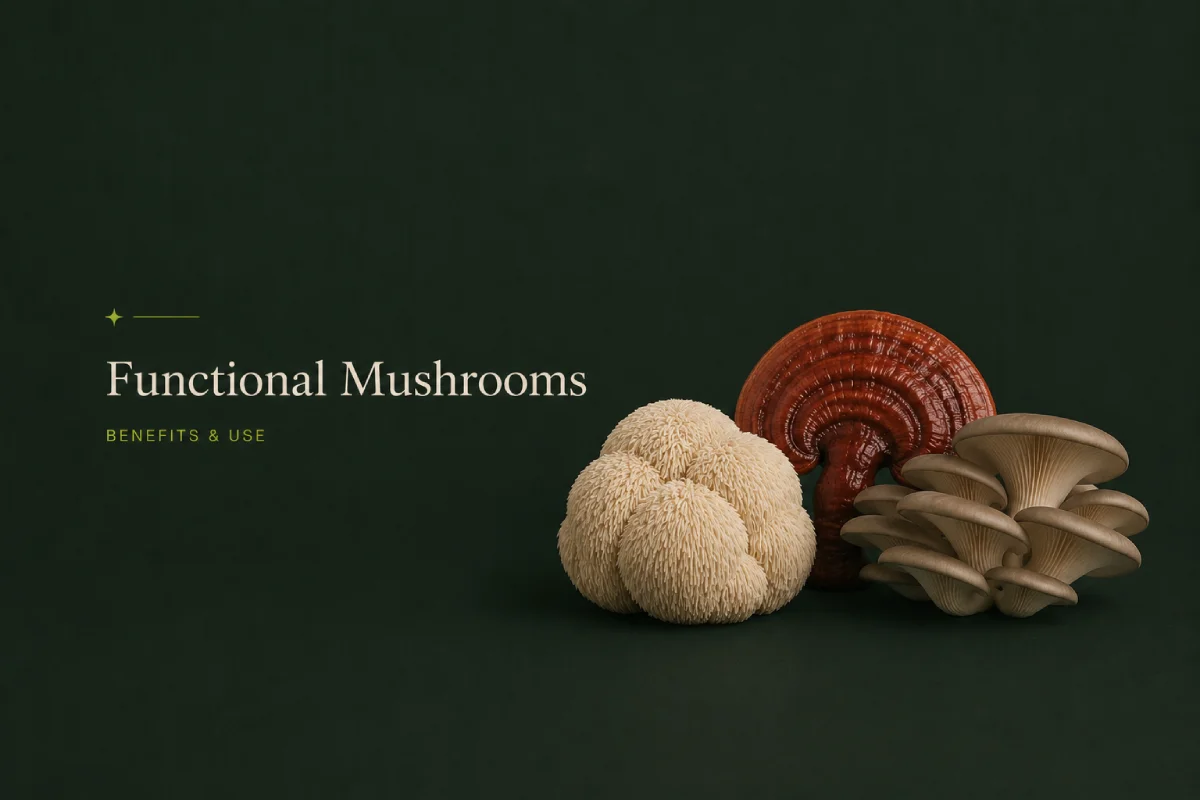
Functional mushrooms — a category of fungi including Reishi (Ganoderma lucidum), Lion’s Mane (Hericium erinaceus), Turkey Tail (Trametes versicolor), Chaga (Inonotus obliquus), and Cordyceps (Cordyceps militaris) — are studied for bioactive compounds such as beta-glucans, triterpenes, and polysaccharides that may support normal physiological function. They differ from culinary mushrooms in that they are typically consumed as dried preparations, concentrated extracts, tinctures, or supplements rather than simply cooked as food. Decades of laboratory, animal, and clinical research have examined how these compounds interact with immune, neurological, and stress-response systems in the body.
Here at Foxfire Mushrooms in Longmont, Colorado, we take the science seriously — without overstating what it shows. This guide covers what functional mushrooms are, the specific compounds behind the research, the major species you’ll encounter, how to use them practically, and what to look for when buying quality products.
These statements have not been evaluated by the Food and Drug Administration. This product is not intended to diagnose, treat, cure, or prevent any disease.
Table of Contents
The term “functional mushroom” doesn’t describe a single species — it describes an intention. These are fungi consumed not primarily for their culinary flavor, but for specific bioactive compounds they contain that researchers have studied in the context of human and animal physiology.
Functional mushrooms have been used in traditional medicine systems — particularly Traditional Chinese Medicine (TCM) and Ayurveda — for centuries. Reishi has been documented in Chinese pharmacopoeia dating back over 2,000 years. Lion’s Mane has a long history of use by Buddhist monks, who reportedly consumed it to support mental clarity during meditation. These traditional uses sparked the modern scientific interest that has produced hundreds of peer-reviewed studies over the past 40 years.
What distinguishes a functional mushroom from a culinary one comes down to compound concentration and consumption method. While culinary mushrooms like shiitake and oyster do contain beneficial compounds (including ergothioneine, an antioxidant amino acid found in all mushrooms), functional species are deliberately selected and prepared to preserve and concentrate specific active compounds — beta-glucans, triterpenes, hericenones, polysaccharopeptides — at levels meaningful for physiological support.
Functional mushrooms are not pharmaceuticals, and responsible discussion of the research requires drawing that distinction clearly. What the science shows is a collection of promising findings — some robust, some early-stage — suggesting that certain compounds in these fungi may support normal, healthy function across multiple body systems.
Understanding a few key compound families helps you read labels intelligently and evaluate quality claims. Here’s a plain-English overview of the major bioactives:
| Compound | Found In | Mechanism Studied | Primary Research Focus |
| Beta-glucans (beta-1,3/1,6-glucan) | All functional mushrooms; also culinary species | Bind to Dectin-1 receptors on immune cells; modulate immune cell signaling | Immune cell activity and response |
| Triterpenes (ganoderic acids) | Primarily Reishi; some Chaga | Lanostane-type structure; studied for HPA axis interaction, GABA receptor activity, adaptogenic effects | Stress response, relaxation, liver enzyme interaction |
| Hericenones | Lion’s Mane fruiting body only | Studied for stimulation of Nerve Growth Factor (NGF) synthesis in neurons | Cognitive support, neuronal health |
| Erinacines | Lion’s Mane mycelium only | Also studied for NGF and BDNF induction; cross blood-brain barrier more readily than hericenones | Cognitive support, neuroprotection |
| PSK / PSP (polysaccharopeptides) | Turkey Tail | Among the most studied mushroom compounds globally; immune cell modulation | Immune support; studied alongside conventional cancer care in Japan and China |
| Ergothioneine | All mushrooms, including culinary | Antioxidant amino acid; accumulated preferentially in certain human tissues | Cellular antioxidant defense, general wellness |
| Adenosine | Reishi, Cordyceps | Neuromodulatory effects; studied for potential sedative and anti-fatigue properties | Sleep support, energy metabolism |
For a deeper look at beta-glucans specifically — how they work and what the research shows — see our dedicated article on what are beta-glucans.
What it is: A striking white, pom-pom-shaped mushroom that grows on hardwood trees. Visually unmistakable — it truly resembles a lion’s mane. It is edible and genuinely delicious when cooked, but it’s consumed functionally for its unique cognitive-support compounds.
Key compounds: Hericenones (in the fruiting body) and erinacines (in the mycelium). These are unique to Hericium erinaceus — no other mushroom contains them. Both have been studied for their potential to stimulate the synthesis of Nerve Growth Factor (NGF) and Brain-Derived Neurotrophic Factor (BDNF), proteins that support neuron growth, maintenance, and survival.
Traditional use: Used in East Asian medicine and by Buddhist monks for mental clarity and focus.
What research explores: Laboratory studies have examined how hericenones and erinacines may stimulate NGF synthesis in neuronal cells. Small human clinical trials — including a randomized, placebo-controlled study by Mori et al. (2009) — have explored Lion’s Mane extract’s relationship to cognitive function scores in older adults. Research is ongoing. See our full breakdown in Lion’s Mane and cognitive function research.
Foxfire products: Lion’s Mane Tincture (dual extract, 10ml dropper), Dried Lion’s Mane (2oz), Brain Bears™ gummies.
These statements have not been evaluated by the Food and Drug Administration. This product is not intended to diagnose, treat, cure, or prevent any disease.
Store Brain Bears™ out of reach of children.
What it is: A glossy, kidney-shaped mushroom with a distinctive reddish-lacquered cap. Reishi grows on hardwood in temperate forests and has one of the longest documented histories of use of any functional species. It is typically too tough and bitter to eat whole; it’s almost always prepared as tea, extract, or tincture.
Key compounds: Over 100 identified triterpenes (ganoderic acids) — the largest diversity of triterpenoids of any functional mushroom. Also contains beta-glucans, polysaccharides, and adenosine.
Traditional use: Known in Chinese medicine as “Lingzhi” — sometimes translated as “mushroom of immortality” — and classified for centuries as a superior tonic for promoting calm, longevity, and vitality.
What research explores: Ganoderic acids have been studied for potential interaction with GABA receptors (associated with relaxation and calm) and the HPA axis (the body’s primary stress-response system). Research has also explored Reishi polysaccharides and their potential relationship to sleep duration in animal models. Reishi is widely discussed in the adaptogen literature. For the full research overview, see Reishi for stress and sleep.
Foxfire products: Reishi Tincture (dual extract, 10ml dropper), Dried Reishi (2oz).
These statements have not been evaluated by the Food and Drug Administration. This product is not intended to diagnose, treat, cure, or prevent any disease.
What it is: A flat, fan-shaped polypore mushroom with concentric bands of color — hence its common name. One of the most common wild mushrooms in North American forests, including here in Colorado. Turkey Tail is not typically consumed as food; it’s used as a functional preparation.
Key compounds: Polysaccharide-K (PSK) and Polysaccharide-Peptide (PSP) — collectively among the most extensively studied mushroom compounds in the world. PSK (commercial name: Krestin) has been studied in Japan since the 1970s and is used there as a licensed adjunct therapy alongside conventional cancer care.
Traditional use: Used in both Chinese and Japanese traditional medicine as an immune tonic.
What research explores: PSK and PSP have been studied for their potential to modulate immune cell activity, including natural killer (NK) cells and macrophages. Trametes versicolor also contains notable beta-glucan content. See our detailed article on Turkey Tail and immune support.
These statements have not been evaluated by the Food and Drug Administration. This product is not intended to diagnose, treat, cure, or prevent any disease.
What it is: Not technically a fruiting body — Chaga is a sterile conk (a mass of mycelium and hardened tree tissue) that forms on birch trees, primarily in cold northern climates. It’s harvested from wild trees and has a dark, charcoal-like exterior with a golden interior.
Key compounds: Betulinic acid (derived from birch), melanin complexes, beta-glucans, and triterpenoids. Chaga also contains ergothioneine and superoxide dismutase (SOD) — antioxidant compounds.
Traditional use: Used in Russian and Siberian folk medicine as a tea for overall vitality and wellness.
What research explores: Chaga’s antioxidant compounds have attracted attention in cell and animal studies. The betulinic acid content — derived partly from the birch host tree — has been studied separately in various biological contexts. Human clinical research on Chaga remains limited.
These statements have not been evaluated by the Food and Drug Administration. This product is not intended to diagnose, treat, cure, or prevent any disease.
What it is: The commercially available Cordyceps supplement almost always uses Cordyceps militaris, a cultivated species, rather than the wild Ophiocordyceps sinensis (which is rare, expensive, and ecologically sensitive to harvest). C. militaris can be grown on grain-based substrates and contains similar key compounds.
Key compounds: Cordycepin (3′-deoxyadenosine) — a naturally occurring adenosine analog; beta-glucans; and adenosine itself. Cordycepin has been studied for its potential effects on energy metabolism and cellular oxygen utilization.
Traditional use: High-altitude Tibetan and Chinese traditional medicine used Cordyceps as a tonic for endurance, vitality, and respiratory function.
What research explores: Cordyceps has attracted research interest around potential anti-fatigue effects and relationship to cellular ATP production. Studies have also explored its potential role in supporting normal respiratory function. Most human studies are small and preliminary.
These statements have not been evaluated by the Food and Drug Administration. This product is not intended to diagnose, treat, cure, or prevent any disease.
Functional mushrooms are available in several forms, each with practical trade-offs. Here’s a straightforward breakdown:
Dried mushroom / tea: The simplest, most traditional form. Whole dried fruiting bodies are simmered to extract water-soluble compounds (primarily beta-glucans and polysaccharides). Alcohol-insoluble triterpenes are less bioavailable from hot water alone. Great for Reishi, Turkey Tail, and Chaga. See our Reishi tea recipes for guidance.
Tincture / dual extract: A tincture uses alcohol and/or water extraction to concentrate and preserve bioactive compounds. A dual extract — using both hot water and alcohol — captures both the water-soluble polysaccharides and the alcohol-soluble triterpenes, hericenones, and other lipophilic compounds. This is generally the most complete extraction method. See our guide on how to make a mushroom tincture.
Powder / capsules: Dried mushroom ground to powder — either whole fruiting body or spray-dried extract. Capsules offer convenience and precise dosing. Quality varies significantly by source; look for fruiting body extract with stated beta-glucan percentages and low starch content (a sign of mycelium-on-grain products).
Gummies: A convenient and palatable delivery format, particularly for those new to functional mushrooms. Quality depends entirely on the extract used in formulation.
Infused honey: Raw honey combined with functional mushroom extracts — a traditional-meets-modern delivery format that can be stirred into tea, spread on toast, or taken by the spoonful.
For a side-by-side format comparison with dosing considerations, see our mushroom supplement comparison guide.
This is one of the most important quality distinctions in the functional mushroom supplement market, and it’s worth understanding clearly.
Whole fruiting body extract uses the actual mushroom — the recognizable cap-and-stem structure that most people picture. The fruiting body is where the highest concentrations of key bioactive compounds (beta-glucans, triterpenes, hericenones) are found. A quality fruiting body extract will typically list a beta-glucan percentage on the label.
Mycelium-on-grain (MOG) is a manufacturing method where mushroom mycelium is grown on a grain substrate (usually oats or brown rice) and then the entire mass — mycelium and grain — is dried and powdered. The resulting product can contain a high percentage of starch from the grain, which dilutes the active compound concentration. Some MOG products don’t clearly distinguish between starch and beta-glucan content.
What to look for:
For Lion’s Mane specifically, because hericenones are found in the fruiting body and erinacines are found in the mycelium, a quality dual-source extract capturing both can be valuable — provided the mycelium component is not heavily diluted by grain substrate.
These statements have not been evaluated by the Food and Drug Administration. This product is not intended to diagnose, treat, cure, or prevent any disease.
Foxfire Mushrooms presents information about functional mushrooms for educational purposes, drawing on available peer-reviewed research. The compounds discussed in this article — beta-glucans, triterpenes, hericenones, polysaccharopeptides — have been studied in laboratory, animal, and some clinical settings. That research is ongoing and evolving. Nothing on this page is medical advice. If you have a health condition, are pregnant or nursing, or are taking medications, please consult a qualified healthcare provider before adding functional mushroom supplements to your routine.
We’re proud to be bringing a carefully considered functional mushroom product line to Longmont, Colorado and beyond. Every product in our Phase 2 line is selected with the quality principles above in mind — fruiting body emphasis, dual extraction where applicable, and honest labeling.
Brain Bears™ Gummies
A delicious, approachable entry point into functional mushrooms. Brain Bears™ gummies use functional mushroom extracts in a convenient, great-tasting format — ideal for anyone who prefers not to deal with tincture droppers or tea brewing.
Store Brain Bears™ out of reach of children.
These statements have not been evaluated by the Food and Drug Administration. This product is not intended to diagnose, treat, cure, or prevent any disease.
Harmonic Honey
Raw honey infused with functional mushroom extracts. Stir it into your evening tea, drizzle it on yogurt, or take it by the spoonful. Harmonic Honey is a gentle, enjoyable way to incorporate functional mushroom extracts into a daily routine without any of the bitterness of plain Reishi tea.
These statements have not been evaluated by the Food and Drug Administration. This product is not intended to diagnose, treat, cure, or prevent any disease.
Lion’s Mane Tincture — Dual Extract, 10ml Dropper
Our Lion’s Mane tincture uses a dual extraction process to capture both the water-soluble polysaccharides and the alcohol-soluble hericenones from the Lion’s Mane fruiting body. A few drops in your morning coffee or water is one of the easiest ways to add Lion’s Mane to your routine.
These statements have not been evaluated by the Food and Drug Administration. This product is not intended to diagnose, treat, cure, or prevent any disease.
Reishi Tincture — Dual Extract, 10ml Dropper
Reishi’s ganoderic acid triterpenes are not water-soluble — which means a simple tea doesn’t extract everything the mushroom has to offer. Our dual-extract Reishi tincture captures both the water-soluble polysaccharides and the alcohol-soluble triterpenes, giving you the most complete Reishi experience in a convenient dropper format. Evening use is popular.
These statements have not been evaluated by the Food and Drug Administration. This product is not intended to diagnose, treat, cure, or prevent any disease.
Dried Reishi (2oz) and Dried Lion’s Mane (2oz)
For those who prefer to brew their own tea, make their own tincture, or incorporate mushroom powder into cooking, our dried whole mushrooms offer flexibility. Use dried Reishi for a long-simmered evening tea or a DIY tincture project. Use dried Lion’s Mane for cooking (it has a remarkable, scallop-like texture when sautéed) or grind it into powder for smoothies and coffee drinks.
These statements have not been evaluated by the Food and Drug Administration. This product is not intended to diagnose, treat, cure, or prevent any disease.
Here’s something most supplement brands won’t tell you: the same species you buy in extract form, you can also grow at home — and it’s more approachable than most people think. Growing your own gives you access to fresh fruiting bodies, lets you control growing conditions, and connects you to these fungi in a way that no supplement can.
Foxfire Mushrooms was built on cultivation, and that knowledge runs through everything we do. We carry spawn and supplies for several functional species:
Ready to explore functional mushrooms? Foxfire Mushrooms brings Colorado-proud quality to every product we carry — from the grow supplies that started this company to the functional wellness line we’re building with the same care and honesty.
Looking to grow your own Lion’s Mane, Reishi, or Turkey Tail? Our cultivation supplies section has everything you need.
Want to go deeper on the science? Continue reading:
These statements have not been evaluated by the Food and Drug Administration. This product is not intended to diagnose, treat, cure, or prevent any disease.
Turkey Tail (Trametes versicolor) has arguably the most robust research base of any functional mushroom, primarily due to its polysaccharopeptide compounds PSK and PSP. PSK has been studied in clinical settings in Japan since the 1970s. Lion’s Mane follows closely for cognitive research, and Reishi for stress and adaptogenic applications.
Most functional mushrooms have long histories of traditional use and are generally well-tolerated in healthy adults. That said, individual responses vary, some people may experience digestive sensitivity (especially at higher doses), and certain mushrooms may interact with medications. Reishi, for example, may affect blood clotting and blood pressure — relevant for anyone taking related medications. Always consult a healthcare provider if you have a medical condition or take prescription drugs.
Many functional mushroom supplements combine species — Lion’s Mane, Reishi, and Turkey Tail are commonly formulated together. Traditional medicine systems frequently used mushrooms in combination. There’s no established evidence of problematic interactions between functional mushroom species, but starting with one at a time helps you understand your individual response before adding more.
This varies by person, mushroom, and the type of support you’re looking for. Some people report noticing changes in focus or energy within a few days of taking Lion’s Mane; others find that effects build gradually over several weeks of consistent use. Adaptogenic effects (like those associated with Reishi) are typically described as cumulative rather than immediate. Set a realistic timeline of four to eight weeks of consistent use before evaluating.
Generally, yes — taking functional mushroom supplements with food reduces the likelihood of digestive discomfort and may support absorption of fat-soluble compounds. That said, many people take Lion’s Mane tincture in their morning coffee without food without any issue. See our functional mushroom dosing guide for detailed guidance.
It depends on the quality of the extract used in each product, not the delivery format itself. A well-formulated gummy using a high-quality fruiting body extract can be equally effective to a tincture made from the same extract. The delivery format matters less than the quality and concentration of the underlying extract. Tinctures offer more flexibility in dosing; gummies offer convenience and palatability.
Yes — many of them. Lion’s Mane, Reishi, Turkey Tail, Shiitake, and Oyster mushrooms are all cultivatable at home with the right substrate, spawn, and conditions. The fresh fruiting bodies you grow contain the same bioactive compounds found in supplements — though concentrations differ between fresh and dried/extracted forms. Visit our cultivation guides and spawn shop to get started.
Share this article
Grab a beginner-friendly kit and apply what you just read —
or take the quiz and we’ll match you to the right
starting point.
