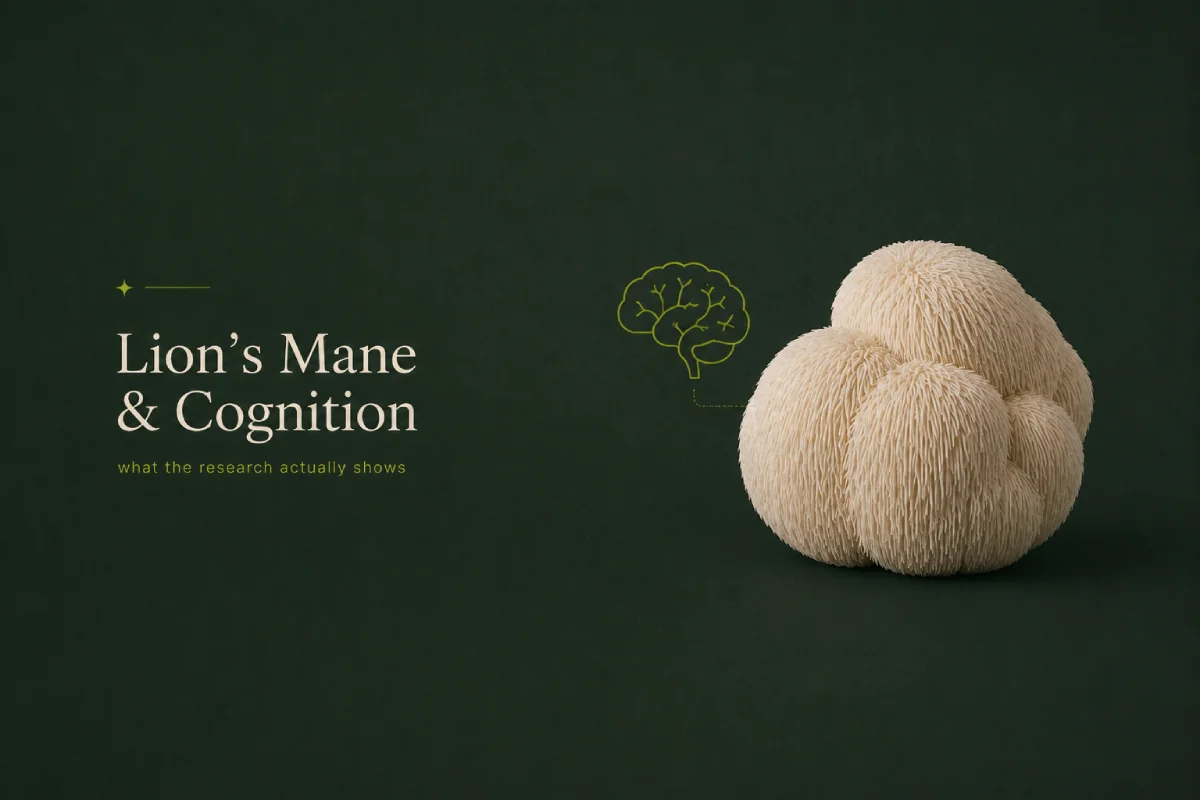
Hericium erinaceus — Lion’s Mane mushroom — contains two unique families of compounds found in no other fungus: hericenones (in the fruiting body) and erinacines (in the mycelium). Laboratory and clinical research has explored their potential to stimulate the synthesis of Nerve Growth Factor (NGF) and Brain-Derived Neurotrophic Factor (BDNF) — proteins that support the health, growth, and survival of neurons. This body of research makes Lion’s Mane the most widely studied functional mushroom specifically for cognitive support.
Here at Foxfire Mushrooms in Longmont, Colorado, we want to share what the science actually says — and what it doesn’t. This guide walks through the key compounds, the mechanisms researchers have explored, what human clinical studies have found, and what realistic expectations look like when incorporating Lion’s Mane into your routine.
These statements have not been evaluated by the Food and Drug Administration. This product is not intended to diagnose, treat, cure, or prevent any disease.
Table of Contents
Hericium erinaceus, commonly called Lion’s Mane, is a white, cascading mushroom that grows on hardwood trees across North America, Europe, and Asia. It’s the only mushroom known to produce both hericenones and erinacines — two compound families that have been the focus of growing scientific attention for their potential relationship to brain health.
The primary hypothesis driving Lion’s Mane research is straightforward: certain compounds in this mushroom may stimulate the body’s own production of proteins that neurons need to grow, connect, and survive. That’s a different mechanism from most cognitive-support compounds, which typically act on neurotransmitter levels directly. If these compounds can genuinely influence NGF and BDNF synthesis, the implications for brain health are worth investigating carefully — which is exactly what researchers have been doing since the 1990s.
What the research shows, as of the studies available, is promising but still developing. Laboratory findings are compelling. Small human trials have found notable differences from placebo. Larger, longer-term clinical studies are needed to fully understand how consistent Lion’s Mane use may support cognitive function in healthy adults across different age groups and contexts. We’ll cover each layer of the evidence in this article.
The compounds that make Lion’s Mane functionally distinctive are found in two different parts of the organism — and understanding this matters when you’re evaluating supplement quality.
Hericenones are a group of aromatic compounds found in the fruiting body — the part of the mushroom that emerges above the substrate and is most recognizable. Hericenones C, D, and E have been most studied for their potential NGF-stimulating activity. They are relatively large molecules that may have difficulty crossing the blood-brain barrier directly, but research suggests they may stimulate NGF production in peripheral tissues that then acts on the nervous system.
Erinacines are diterpenoid compounds found exclusively in the mycelium — the network of fungal threads that grows through the substrate below the surface. Erinacines A through I and others have been identified. They are smaller molecules that research suggests may cross the blood-brain barrier more readily than hericenones, making them particularly interesting for central nervous system applications. Erinacine A is among the most studied.
The practical implication for supplement quality: Because hericenones and erinacines are found in different parts of the organism, a supplement using only fruiting body extract will contain hericenones but minimal erinacines, and a mycelium-only product will contain erinacines but may lack the full fruiting body compound profile — and may also contain grain-substrate starch if it’s a mycelium-on-grain product.
A quality dual-source extract — using fruiting body for hericenones and clean mycelium (not mycelium-on-grain) for erinacines — provides the most complete Lion’s Mane experience. See our mushroom supplement comparison guide for more on how to evaluate quality.
To understand why Lion’s Mane research is interesting, it helps to understand what Nerve Growth Factor and Brain-Derived Neurotrophic Factor actually are and what they do.
Nerve Growth Factor (NGF) is a protein — specifically, a neurotrophin — that was discovered by Italian neurologist Rita Levi-Montalcini, whose work earned her the Nobel Prize in Physiology or Medicine in 1986. NGF plays essential roles in:
The cholinergic system — the network of neurons that uses acetylcholine as a neurotransmitter — is particularly dependent on NGF. This system plays a central role in attention, learning, and memory. NGF levels in the brain tend to shift over time and are influenced by a range of lifestyle and physiological factors.
Brain-Derived Neurotrophic Factor (BDNF) is a related but distinct protein — also a neurotrophin — that supports a broader range of neuronal functions:
Both NGF and BDNF are endogenous proteins: the body makes them itself. What Lion’s Mane researchers are examining is whether hericenones and erinacines can stimulate the body’s own synthesis of these proteins — supporting a process that the body already undertakes naturally.
The earliest Lion’s Mane research, conducted primarily in Japan and Taiwan in the 1990s and 2000s, focused on isolated cell cultures — what scientists call in vitro studies.
In these laboratory settings, researchers exposed neuronal cell lines (particularly PC12 cells, a commonly used model for studying neuronal differentiation) to isolated hericenones and erinacines. What they observed was notable: the compounds appeared to stimulate the synthesis and secretion of NGF in ways that caused the cells to extend processes called neurites — the cellular projections that eventually become axons and dendrites, the working connections of the nervous system.
These findings suggested a plausible mechanism: if Lion’s Mane compounds could stimulate NGF synthesis in neurons, and if NGF supports the health and connectivity of cholinergic neurons, then there might be a pathway through which Lion’s Mane could support cognitive function.
Subsequent animal studies built on this foundation. Rodent studies examined whether oral administration of Lion’s Mane extracts could influence NGF levels in brain tissue, and several found that it could — at least in these animal models. Studies also explored whether Lion’s Mane consumption could influence learning and memory performance on standardized rodent behavioral tests, with some finding positive associations.
An important caveat, clearly stated: in vitro and animal findings do not automatically translate to human outcomes. The history of medicine is full of compounds that showed remarkable activity in cells and rodents but did not replicate in human clinical trials. Cell studies and animal research establish biological plausibility and guide research directions — they are not proof that a compound works the same way in human beings.
The human clinical research on Lion’s Mane and cognitive function is small in volume but meaningful in quality — and it’s worth examining honestly.
Mori et al. (2009) — Phytotherapy Research This is the most frequently cited human study of Lion’s Mane and cognitive function. It was a randomized, double-blind, placebo-controlled trial — the gold standard design for clinical research. The study enrolled older Japanese adults and had participants consume either Lion’s Mane extract tablets or a placebo over a 16-week period. Researchers administered standardized cognitive function assessments at multiple time points throughout the study.
The Lion’s Mane group showed significantly higher scores on the cognitive function assessment compared to the placebo group. Notably, when the intervention ended and was followed by a four-week observation period, scores in the Lion’s Mane group declined — suggesting the effect was dependent on continued use. No major adverse effects were reported.
It’s important to note what this study was and wasn’t: it was a small trial (30 participants) in a specific age group, using a specific extract formulation. It was a meaningful finding that supports further research, not a definitive proof of efficacy across all populations.
Mori et al. (2021) — Update Research A subsequent study by the same research group explored Lion’s Mane extract in the context of a shorter administration period, examining different cognitive domains and outcomes. The findings continued to support a relationship between Lion’s Mane extract consumption and cognitive function measures, while reinforcing that larger studies with longer durations are needed.
Inanaga (2014) — Open-Label Study This open-label study (meaning participants knew they were taking Lion’s Mane, without a placebo control) explored the relationship between Lion’s Mane extract and measures of mood and cognitive function. Open-label studies carry more risk of placebo effect and researcher expectation bias than blinded trials, so findings should be interpreted with that limitation in mind.
Where the research stands today: The human clinical evidence for Lion’s Mane and cognitive support is promising and directionally consistent across the studies that exist. The studies have been small, have used specific populations and formulations, and have varied in duration. Larger, longer, more diverse clinical trials are ongoing and needed. What the existing evidence supports is the statement that Lion’s Mane may support cognitive function — a structure/function framing that is accurate to the current state of research.
These statements have not been evaluated by the Food and Drug Administration. This product is not intended to diagnose, treat, cure, or prevent any disease.
The research discussed in this article is presented for educational purposes. Lion’s Mane mushroom products are dietary supplements, not medications. They are not intended to diagnose, treat, cure, or prevent Alzheimer’s disease, dementia, cognitive decline, or any other medical condition. If you have concerns about cognitive health, please consult a qualified healthcare provider.
If you’re considering adding Lion’s Mane to your routine for cognitive support, here is an honest framing of what to expect:
Effects are not immediate. Unlike caffeine or other compounds with acute effects on alertness, Lion’s Mane’s proposed mechanism — supporting NGF and BDNF synthesis — is cumulative. The neurons that may benefit from increased neurotrophin support take time to respond. Most people who report noticeable changes describe them developing over several weeks of consistent daily use, not after one or two doses.
Effects are subtle and individual. People report a range of experiences with Lion’s Mane — some describe improved mental clarity and easier focus; others notice nothing obvious at consistent doses. Individual biology, baseline neurotrophin levels, age, sleep quality, and other lifestyle factors all play a role. Cognitive support supplements work best as part of a broader lifestyle that includes adequate sleep, exercise, and stress management.
Start with a moderate dose. Our functional mushroom dosing guide covers typical ranges used in research and general practice. Starting at the lower end of the range and building up helps you understand your individual response.
Not a replacement for medical care. Lion’s Mane is a wellness supplement with a promising research profile — not a treatment for any diagnosed medical condition. If you have concerns about memory, cognition, or brain health, please see a healthcare provider.
Generally well-tolerated. Lion’s Mane has a long history of safe use as a food and supplement. Most people tolerate it well. As with any supplement, if you experience unexpected reactions, discontinue use and consult a healthcare provider.
Morning coffee or matcha: The most popular way to incorporate Lion’s Mane tincture or powder. A dropper of Lion’s Mane tincture or a teaspoon of dried Lion’s Mane powder stirred into coffee or matcha is a low-friction daily habit. Many people find that combining it with the mild stimulation of caffeine feels natural for morning focus.
Smoothies: Dried Lion’s Mane powder blends easily into smoothies and doesn’t dramatically alter flavor — it contributes a mild, earthy note that most people don’t find objectionable.
Plain in water: Lion’s Mane tincture can be taken directly under the tongue or added to water. The flavor is mild enough that most people don’t find it unpleasant on its own.
Gummies: For those who prefer a pre-measured, no-fuss format, functional mushroom gummies are a convenient option.
For timing, morning use is most popular for Lion’s Mane given its association with focus and mental clarity — though there’s no strong clinical evidence that timing matters significantly. Consistency matters more than timing. See incorporating functional mushrooms into your daily routine for practical habit-building tips.
We’ve put thought into every Lion’s Mane product in our lineup — selecting for quality, transparency, and practical usability for Colorado customers and beyond.
Lion’s Mane Tincture — Dual Extract, 10ml Dropper Our Lion’s Mane tincture uses a dual extraction process: hot water for polysaccharides, and alcohol for hericenones and other lipophilic compounds. This gives you a more complete Lion’s Mane extract than either method alone. The 10ml dropper format makes it easy to add to any drink or take directly. A staple for daily cognitive-support routines.
These statements have not been evaluated by the Food and Drug Administration. This product is not intended to diagnose, treat, cure, or prevent any disease.
Dried Lion’s Mane (2oz) Whole dried Lion’s Mane fruiting body. Use it for DIY tincture projects, grind it into powder for coffee and smoothies, or hydrate and cook it for a genuinely remarkable culinary experience (Lion’s Mane sautéed in butter develops a flavor and texture remarkably similar to crab or scallop). 2oz of dried mushroom gives you a meaningful supply for either functional or culinary use.
These statements have not been evaluated by the Food and Drug Administration. This product is not intended to diagnose, treat, cure, or prevent any disease.
Brain Bears™ Gummies Brain Bears™ are a fun, accessible way to incorporate functional mushroom extracts into your daily routine — no droppers, no brewing, no earthy taste to manage. They’re our most approachable entry point for people who are curious about Lion’s Mane and functional mushrooms but want a familiar, convenient format.
Store Brain Bears™ out of reach of children.
These statements have not been evaluated by the Food and Drug Administration. This product is not intended to diagnose, treat, cure, or prevent any disease.
Grow Your Own Lion’s Mane Growing Lion’s Mane at home is one of the most satisfying mushroom cultivation projects available to beginners. The fruiting body is unmistakable, the yield is generous, and the fresh mushroom is genuinely one of the finest edible fungi you’ll encounter. Visit our Lion’s Mane growing guide to see how we do it — and check our cultivation shop for spawn.
Whether you’re starting with our Lion’s Mane Tincture, exploring dried mushroom powder, or trying Brain Bears™ as your first functional mushroom product, Foxfire Mushrooms is here to support your journey — with honest science, Colorado-proud quality, and products we stand behind.
Shop Lion’s Mane Mushroom Growing Kit →
Shop Lion’s Mane Colonized Grain Spawn →
Want to go deeper? Continue reading:
These statements have not been evaluated by the Food and Drug Administration. This product is not intended to diagnose, treat, cure, or prevent any disease.
The Mori et al. (2009) study used approximately 3 grams of dried Lion’s Mane extract per day, divided across three doses. General supplemental use often falls in the range of 500mg–3,000mg of fruiting body extract daily, with tinctures typically dosed at a dropper (roughly 1ml) one to two times daily. Our functional mushroom dosing guide covers this in detail. Start at the lower end and adjust based on your response.
Most people who notice subjective effects describe them developing gradually over two to six weeks of consistent daily use. The Mori et al. study found significant differences at the eight-week mark. Setting a four-to-eight week evaluation window is reasonable. Don’t expect dramatic day-one changes.
Yes — and this is one of the most popular ways to use it. Lion’s Mane tincture or powder added to coffee is a well-established daily ritual. There are no known interactions between Lion’s Mane compounds and caffeine. Some people find the combination particularly supportive of morning focus and alertness, though individual experience varies.
Lion’s Mane has been consumed as food and medicine in East Asia for centuries with no documented history of toxicity at typical use levels. The available clinical studies (up to 16 weeks duration) found no significant adverse effects. Long-term safety data beyond six months in formal studies is limited, which is common for dietary supplements. If you have any health conditions or take medications, consult your healthcare provider.
Yes — daily use is how most people incorporate it and how it’s been used in the clinical studies that showed benefits. Consistency appears to be more important than any particular timing or cycling pattern. There’s no established need to take breaks, though some practitioners suggest occasional cycling as a general practice with adaptogenic supplements.
Hericenones are found in the fruiting body; erinacines are found in the mycelium. Both compound families are interesting from a research standpoint. A fruiting body-only extract will have hericenones but minimal erinacines. A mycelium-on-grain product may have erinacines but may be diluted by grain starch. A quality dual-source extract aims to capture both. Read the label: look for stated beta-glucan percentages and check whether “mycelium” refers to clean mycelium or mycelium-on-grain.
A few smaller studies have explored Lion’s Mane in the context of mood, including an open-label study (Inanaga, 2014) examining mood and cognitive measures. Results have been exploratory rather than definitive. Lion’s Mane may support a sense of mental clarity, which some people associate with reduced anxiety — but it is not studied or established as an anxiety treatment, and anyone experiencing anxiety as a clinical concern should consult a healthcare provider.
Share this article
Grab a beginner-friendly kit and apply what you just read —
or take the quiz and we’ll match you to the right
starting point.
