Turkey tail mushroom (Trametes versicolor) contains two beta-glucan-derived compounds — PSK (polysaccharide-K) and PSP (polysaccharopeptide) — that have been the subject of more published clinical research than those of any other functional mushroom. PSK in particular has been extensively studied in Japanese immunology research for decades, with over 400 peer-reviewed papers exploring its role in immune cell function and the mechanisms by which it interacts with key immune receptors. At Foxfire Mushrooms in Longmont, Colorado, we think this research deserves an honest, grounded look — one that shares what the science actually shows while being clear about what it doesn’t prove for supplement use in the United States.
This is exactly the article for that. No hype. No overclaiming. Just a careful look at one of the most researched fungi on the planet.
When people talk about the science behind functional mushrooms, they often point to Lion’s Mane for its nerve growth factor (NGF) research, or Reishi for its extensive library of triterpene studies. But if you’re measuring sheer volume of published clinical research — particularly in immunology — Trametes versicolor, commonly called turkey tail, stands in a category of its own.
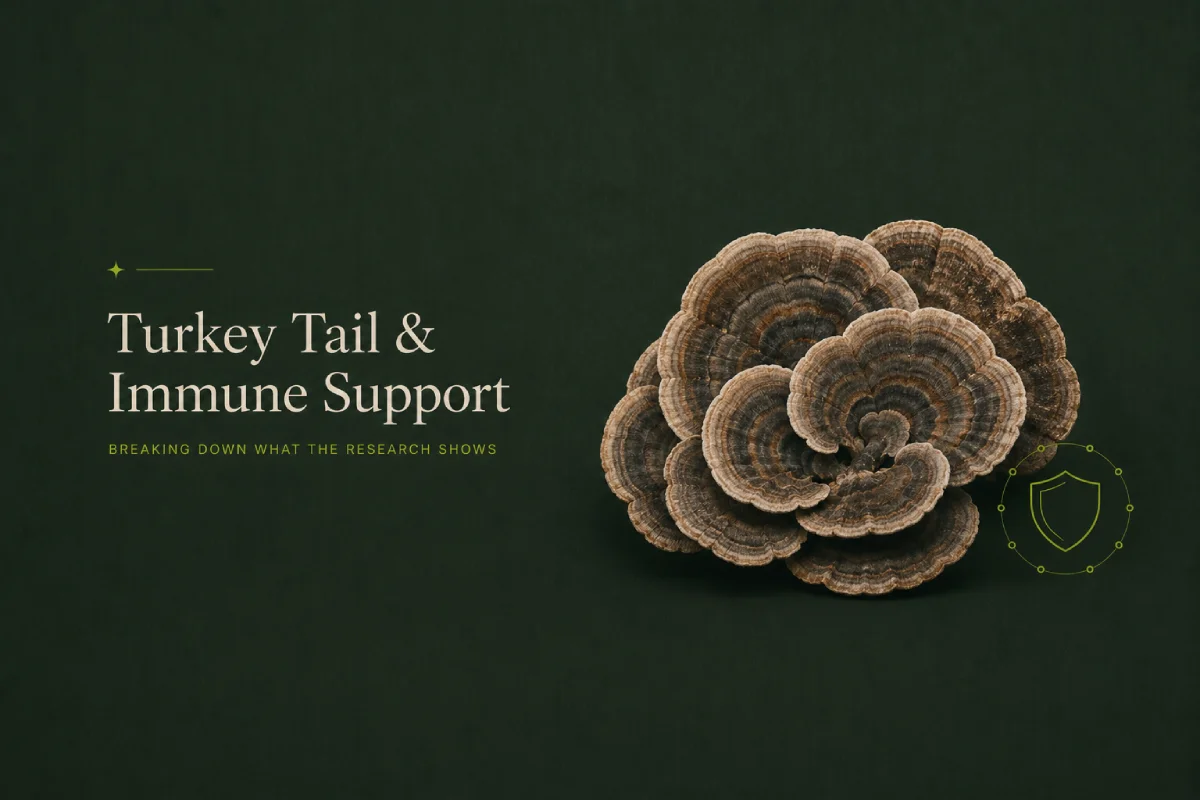
Named for the concentric rings of rust, brown, cream, and slate-blue that fan across its surface in a pattern resembling a wild turkey’s tail feathers, this bracket fungus grows across forests worldwide, including right here in Colorado’s Front Range foothills. It’s been used for centuries in traditional Chinese medicine under the name Yun Zhi (“cloud mushroom”), prized for what practitioners described as support for energy, vitality, and resilience.
What makes turkey tail scientifically distinctive is the pair of high-molecular-weight polysaccharide compounds it produces: PSK (polysaccharide-K, also called krestin) and PSP (polysaccharopeptide). Both are beta-glucan-derived. Both have been the focus of decades of immunological inquiry. And PSK alone has accumulated over 400 published peer-reviewed studies — a body of literature that dwarfs most other functional mushroom compounds.
This depth of research is exactly why writing about turkey tail requires care. The more research exists, the more tempting it is to overstate what that research means for supplement consumers in the United States. We’re going to resist that temptation and tell you what’s actually known.
PSK — short for polysaccharide-K (the “K” from krestin, its trade name in Japan) — is a protein-bound polysaccharide isolated from Trametes versicolor by Japanese researchers in 1969. Structurally, PSK consists of a beta-1,4-glucan backbone with beta-1,3 and beta-1,6 side chains, bound to a protein component. This protein-polysaccharide structure is thought to contribute to its biological activity and is what distinguishes PSK from simpler beta-glucan extracts.
PSK is produced by the fungal mycelium and fruiting body of T. versicolor and is relatively stable under heat, which makes it extractable through hot water processes.
PSP — polysaccharopeptide — was characterized by Chinese researchers, primarily Dr. Q.Y. Yang at the University of Hong Kong, in the 1980s. PSP shares structural similarities with PSK: it’s also a protein-bound beta-glucan, extracted from a strain of T. versicolor originating in China. The protein components differ slightly between PSK and PSP, and some researchers have explored whether these structural differences produce different biological effects — though both interact with similar immune system pathways.
Both PSK and PSP are members of the broader beta-glucan family — the same family of polysaccharides found in oats, yeast cell walls, and across the fungal kingdom. If you’re new to beta-glucans, our detailed guide to what beta-glucans are and how they interact with the immune system is a good place to start.
What’s notable about PSK and PSP specifically is that their protein-bound form may influence how they’re recognized and processed by immune cells — which is one reason researchers have continued to study them separately from simpler, unbound beta-glucan extracts.
To understand what PSK and PSP research is actually exploring, it helps to understand the basic biology of how beta-glucans interact with the immune system.
The most well-characterized receptor for fungal beta-glucans is Dectin-1, a pattern recognition receptor found on the surface of several key immune cell types, including:
When beta-glucans bind to Dectin-1, they trigger an intracellular signaling cascade — primarily through Syk kinase and the CARD9 pathway — that influences how these immune cells activate, communicate, and carry out their functions. This is a well-established interaction in immunological research, and it’s the mechanistic foundation behind most of the functional interest in beta-glucan-rich mushrooms.
For PSK and PSP specifically, researchers have studied how these compounds interact not just with Dectin-1 but also with Toll-like receptors (TLRs), which are another class of innate immune pattern recognition receptors. The protein component of PSK may enable receptor interactions that simpler unbound glucans do not have.
All of this research describes mechanisms — the biological interactions between compounds and cells. Under DSHEA (the Dietary Supplement Health and Education Act), supplement manufacturers in the United States may make structure/function claims about how nutrients or dietary ingredients affect the structure or function of the body. What we cannot claim — and what the research does not support for supplement contexts — is that turkey tail mushroom treats, cures, prevents, or mitigates any disease.
The research on PSK and PSP is immunological research. It explores how these compounds interact with immune cells. Whether and how those interactions translate to specific health outcomes in healthy supplement users is a different and more complex question — one the supplement research does not fully answer.
PSK has been the subject of more than 400 published peer-reviewed studies, the majority conducted in Japan over a period spanning more than five decades. Japanese researchers have explored PSK extensively in immunological contexts, examining how it interacts with macrophages, NK cells, and T-lymphocytes, and investigating the mechanisms behind these interactions.
PSK is registered as a pharmaceutical compound in Japan under the brand name Krestin® and is used there in specific medical contexts under physician supervision. This registration reflects the Japanese regulatory framework, not the United States regulatory framework. In the United States, PSK-containing turkey tail products are sold as dietary supplements and make no disease treatment claims.
What the body of Japanese research broadly shows — at the mechanistic and clinical research level — is that PSK interacts with multiple immune cell types in ways that researchers have found consistently reproducible. The volume and consistency of this research is why PSK is considered one of the most rigorously studied functional mushroom compounds in the world.
PSP research originated primarily in Chinese academic institutions and has explored similar immunological mechanisms — including interactions with macrophages and lymphocytes — with findings that broadly parallel those observed for PSK. Some comparative studies have examined PSK and PSP side by side, generally finding that both compounds influence immune cell activity through overlapping but potentially distinct mechanisms.
PSP has a somewhat smaller published literature than PSK, but it remains among the more studied functional mushroom compounds, particularly in Chinese immunological research contexts.
A substantial portion of the published turkey tail research is conducted in vitro (in cell cultures) or in animal models. These studies provide important mechanistic insight — they help researchers understand how PSK and PSP interact with immune cells at a molecular level. However, findings from cell and animal studies do not automatically translate to human outcomes, and it’s important to be honest about this limitation.
In vitro and animal model results inform human research hypotheses. They are a starting point, not a conclusion. When evaluating any functional mushroom research, we encourage you to note whether a study is in vitro, animal, or human — and to weight those findings accordingly.
These statements have not been evaluated by the Food and Drug Administration. This product is not intended to diagnose, treat, cure, or prevent any disease.
Turkey tail mushroom products — including dried turkey tail, turkey tail powder, and turkey tail extracts — are dietary supplements. They are not medicines. The research discussed in this article is presented to inform and educate, not to suggest that turkey tail mushroom treats or cures any condition. Always consult a qualified healthcare provider before beginning any supplement regimen, particularly if you have a medical condition or take prescription medications.
The fruiting body of Trametes versicolor — the bracket structure you’d recognize from a tree or log — is where PSK and PSP concentrations are highest. Many lower-cost supplements use mycelium grown on grain substrate (typically oats or rice), which often contains significant amounts of starch from the grain rather than fungal biomass. Look for products that specify whole fruiting body and that list a beta-glucan percentage.
Turkey tail is a tough, woody mushroom. Its cell walls are made of chitin, which is largely indigestible by humans. An effective turkey tail supplement requires hot water extraction (or dual water-alcohol extraction) to break through the chitin and make PSK and PSP bioavailable. Raw dried turkey tail powder alone, without extraction, delivers far fewer active compounds.
Quality turkey tail supplements will list a beta-glucan percentage on the label — ideally 25–40% or higher for an extract. If a label lists only “turkey tail powder” with no extraction method and no beta-glucan percentage, treat it with skepticism.
Dried turkey tail has a mild, slightly earthy, faintly sweet aroma. The fan-shaped brackets are thin, leathery, and light — concentric rings of color ranging from cream to rust to dark brown. Quality dried turkey tail should not smell musty, sour, or strongly of grain — that grain smell can indicate myceliated grain product rather than genuine fruiting body material.
Immune support is not immune “boosting.” The immune system is not something you want simply maximized — it’s something you want appropriately regulated. A healthy immune response is calibrated, not amplified.
Functional mushrooms like turkey tail are best understood as part of a broader daily wellness approach rather than a standalone intervention. Their effects, when present, tend to be subtle and cumulative rather than dramatic and immediate. Most people taking turkey tail don’t wake up the next morning feeling different. What some report, over weeks and months of consistent use, is a general sense of resilience — fewer down days, a more even energy level.
This is not a scientific claim. It’s the kind of anecdotal experience that should be understood as personal testimony, not evidence.
Turkey tail is not a substitute for medical care. If you have immune-related health concerns, please work with a licensed healthcare provider. Functional mushrooms can be a complement to a wellness-oriented lifestyle — they are not a replacement for medical treatment, vaccinations, or standard preventive health measures.
Dried Turkey Tail Tea: Simmer 3–5g of dried turkey tail in 3–4 cups of water for 45–60 minutes. Strain and drink. The resulting liquid is pale golden-brown with a mild, slightly woody flavor. This is the most traditional preparation and one of the most effective for extracting water-soluble beta-glucans.
Turkey Tail Broth: The same simmering process used for tea translates beautifully to savory broths. Our Turkey Tail mushroom broth recipe walks you through how to build a deeply flavored, beta-glucan-rich broth you can sip on its own or use as a base for soups and grains.
Tincture: A dual-extract turkey tail tincture captures both water-soluble polysaccharides and alcohol-soluble compounds. Our guide to making mushroom tinctures at home covers the full dual-extraction process.
Powder in Smoothies or Soups: Turkey tail extract powder can be stirred into smoothies, broths, or coffee. Look for hot-water-extracted powder, not raw fruiting body powder.
Turkey tail is one of the more rewarding functional mushrooms to grow at home, partly because it produces striking, photogenic fruiting bodies and partly because it grows on hardwood logs — a substrate that’s easy to source in Colorado.
Our Turkey Tail mushroom growing guide covers the full cultivation process, from inoculating hardwood logs with turkey tail spawn to the patience required for log-based growing (expect 6–18 months before first fruiting). Turkey tail is a slow-growing wood decomposer, but it rewards that patience with multiple flushes over several years from a single inoculated log.
Foxfire Mushrooms carries turkey tail spawn when available — check our shop for current stock. Growing your own means access to fresh-harvested fruiting bodies for drying, which you can then use for tea, broth, or home extraction. Fresh-dried turkey tail, properly prepared, is some of the highest-quality turkey tail you can get — because you know exactly what went into it.
Ready to explore turkey tail for yourself? At Foxfire Mushrooms in Longmont, Colorado, we carry turkey tail spawn for home cultivation and dried turkey tail for tea, broth, and home extraction — when in season and in stock.
Want to see turkey tail in action in the kitchen? Our Turkey Tail mushroom broth recipe is a delicious, warming way to work more of this extensively researched fungus into your week.
Curious how turkey tail stacks up against other functional mushroom forms? See our complete mushroom supplement comparison guide.
These statements have not been evaluated by the Food and Drug Administration. This product is not intended to diagnose, treat, cure, or prevent any disease.
“Strongest” isn’t quite the right frame for functional mushrooms and immune support — the immune system isn’t something you simply want maximized. Turkey tail does have the largest published research literature of any functional mushroom in the context of immunological research, which makes it one of the most studied. Reishi, Lion’s Mane, and Chaga are also extensively researched, each with different compound profiles and different areas of active study. Rather than ranking mushrooms by “strength,” it’s more useful to match the mushroom to your goals and research interest.
Research studies have used varying amounts depending on the preparation and context. For dried turkey tail used in tea, 3–5g per day is a commonly referenced range. For concentrated extracts, follow the manufacturer’s serving size, which accounts for the extraction ratio. Our functional mushroom dosing guide goes deeper on this topic. And of course, consult your healthcare provider for personalized guidance.
Turkey tail has a long history of traditional daily use in Chinese medicine (Yun Zhi preparations were consumed regularly over extended periods). From a safety standpoint, it is generally considered well-tolerated for daily use in healthy adults. Some people experience mild GI upset at higher doses. If you’re integrating turkey tail into a daily functional mushroom routine, starting with a lower dose and gradually increasing is a reasonable approach.
Turkey tail is generally considered safe, but because it interacts with immune system pathways, people taking immunosuppressant medications — such as those used after organ transplants — should consult their physician before using turkey tail supplements. This is not a theoretical concern; it’s a real pharmacological consideration. Additionally, if you are undergoing any medical treatment, always discuss supplement use with your healthcare team before adding turkey tail.
As a tea or broth, dried turkey tail has a mild, lightly earthy, slightly sweet flavor — far more approachable than Reishi’s notable bitterness. As a tincture, you’ll taste the alcohol and a faint woodsy note. Extract powder blended into smoothies or coffee is largely undetectable. Turkey tail is one of the easier functional mushrooms to work with from a flavor standpoint.
Both are protein-bound beta-glucan polysaccharides derived from Trametes versicolor. PSK (polysaccharide-K) was isolated by Japanese researchers in 1969 and has been studied in Japan for over 50 years. PSP (polysaccharopeptide) was characterized by Chinese researchers in the 1980s from a different strain of the same species. Structurally, they share a similar backbone but differ in their protein components and some side-chain characteristics. Research has explored both compounds in immunological contexts, with broadly similar findings — both appear to interact with macrophages, NK cells, and other immune cell types.
Turkey tail grows wild across Colorado’s forests and foothills, and is one of the more commonly encountered woodland bracket fungi here. Technically, yes — if you can correctly identify Trametes versicolor, it can be harvested and dried for tea or extraction. However, wild foraging carries responsibility: you must be confident in your identification (several similar-looking bracket fungi grow alongside turkey tail, some of which are not suitable for consumption), and you should harvest sustainably — take only what you need, leave plenty to sporulate. If you’re not experienced with mushroom identification, we recommend purchasing cultivated, quality-assured turkey tail rather than foraging wild.
Share this article
Grab a beginner-friendly kit and apply what you just read —
or take the quiz and we’ll match you to the right
starting point.
