

- Scott Brenton
- 10 min read
A walk along Left Hand Creek in Longmont, Colorado, one October evening turned up an unexpected sight: a faint green glow coming off a rotting
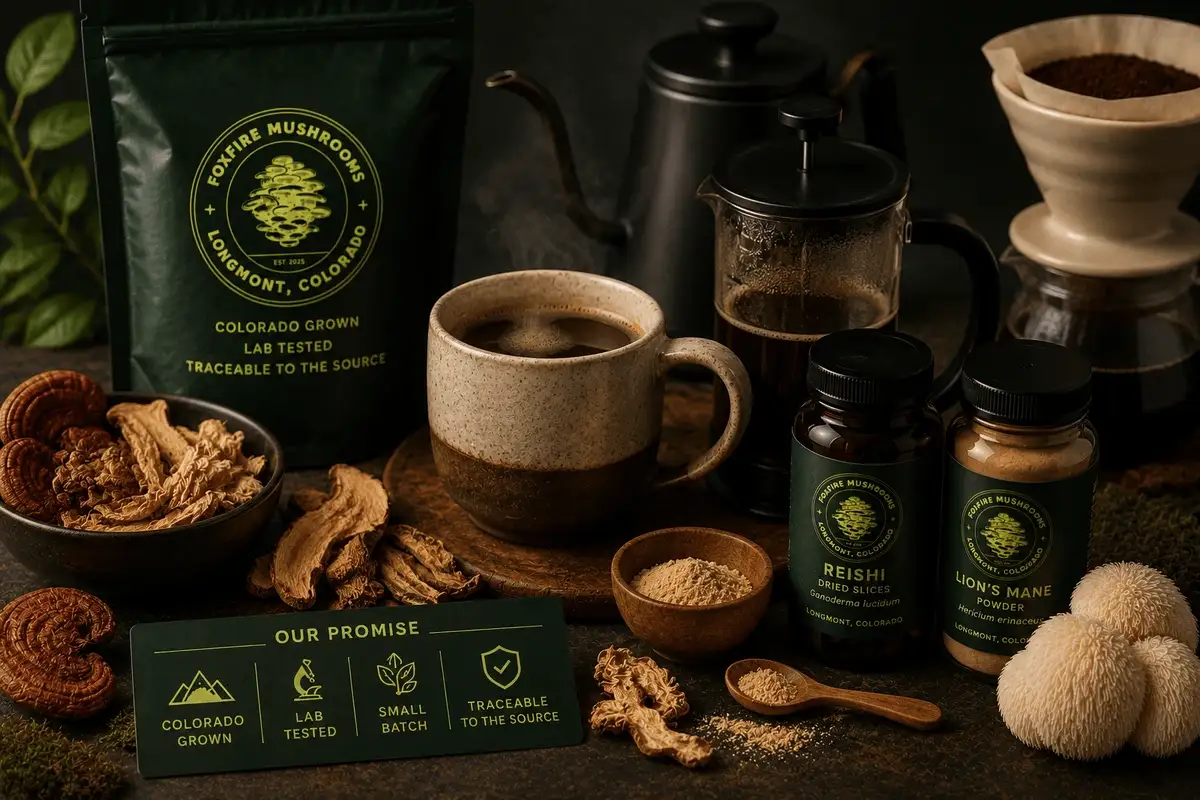
The first time I tried to make mushroom coffee at home, I dumped a spoonful of chopped dried reishi straight into my drip machine’s filter basket like it was ground coffee. What came out was thin, gritty, and about as flavorful as boiled cardboard. It took a few more tries, and a bag of dried lion’s mane slices from Foxfire Mushrooms sitting on my counter, before I understood that mushroom coffee is less about brewing and more about simmering.
So yes, you can absolutely make mushroom coffee with dried reishi and lion’s mane at home, but it works nothing like making a pot of regular coffee, and that’s the part most people get wrong on their first attempt.
Quick Facts — Reishi simmer time: 20-30 minutes – Lion’s Mane powder dose: 1-2 grams per cup – Reishi flavor profile: bitter and earthy, not sweet – Dried mushroom shelf life: 12-18 months in an airtight container – Cost per cup in dried mushroom: roughly 50 cents to 1 dollar – Free shipping on Foxfire orders over 75 dollars
Reishi is bitter. There’s no polite way around it. It has an almost cocoa like depth with a lingering, slightly medicinal aftertaste that some people love within a week and others never fully warm up to. Lion’s mane is milder and a little nutty, almost like it isn’t doing much on its own, which is why the two are often paired together, the lion’s mane rounds out the sharper edges of the reishi and gives the cup more body.
Brewed into an actual pot of coffee, the roasted flavor covers most of the bitterness. If a full cup of reishi water still tastes too strong on its own, cutting it half and half with plain water before brewing softens it noticeably.
Yes, and most home cultivators reach for this method because they already have dried reishi conks or lion’s mane pieces on hand, whether from a home harvest or a bag ordered from a supplier. Whole dried pieces need a much longer extraction time than powder does, because the beneficial compounds, particularly reishi’s triterpenes, sit inside a dense, woody structure.
A five minute steep the way you’d make tea will not pull much out. Reishi is technically a decoction mushroom, not an infusion mushroom, and that distinction changes how you have to treat it in the kitchen.
A small saucepan, a fine mesh strainer or cheesecloth, your regular coffee maker or French press, dried reishi pieces, and either lion’s mane powder or dried lion’s mane slices. If you don’t have cheesecloth, a paper coffee filter set inside a funnel works almost as well, it just drains slower.
Whole dried lion’s mane slices behave more like reishi and need to go into the saucepan with it in step two, rather than being stirred in at the end.
| Dried Whole Mushroom | Mushroom Powder | |
| Prep time | 20 to 30 minute simmer required | Stirs in instantly |
| Texture | Can be gritty if not strained well | Smooth, no straining |
| Extraction | Stronger, closer to a true decoction | Milder unless pre extracted |
| Storage | Bulkier, needs an airtight jar | Compact, easy to portion |
| Cost per use | Slightly cheaper | A few cents more, due to processing |
If you already have both mushrooms dried and sitting in a jar from a home harvest, the simmer method costs you almost nothing extra. If mornings are rushed, a fine powder is more realistic and worth the small price difference.
A full double extraction, meaning a hot water simmer followed by an alcohol extraction, pulls out the widest range of compounds, since some are water soluble and others only alcohol soluble. Most home users skip the alcohol step for a daily cup and rely on the hot water simmer alone, which is still effective, just less concentrated.
Store bought mushroom coffee powders are usually already double extracted before they’re dried back into powder, which is part of why they taste smoother and dissolve faster than a homemade batch.
Foxfire dries its reishi conks slowly at a low, controlled temperature in the Longmont lab rather than rushing them through high heat, since reishi’s triterpenes are sensitive to how it’s dried, not only how it’s later brewed. Every batch is checked for contamination before it’s packaged, the same standard the lab applies to its grain spawn and liquid culture lines.
It’s a small detail most sellers never mention, but it’s part of why a slow simmer at home still pulls a genuinely strong cup out of the dried mushroom, not a watered down version of it.
Reishi has a long history as an adaptogenic mushroom, traditionally used to help the body handle everyday stress rather than sharpen focus directly, while lion’s mane has been studied for its potential role in supporting nerve growth factor production, which is why so many home cultivators reach for it during long work mornings.
It won’t replace caffeine, since it works slowly and isn’t a stimulant. What I’ve noticed brewing it several mornings a week is a steadier stretch of focus without the crash around ten thirty, though that’s just my own experience, not a clinical claim.
There’s no single official dosage for either mushroom, but 1 to 2 grams of dried reishi per cup of water is a reasonable starting point, since it’s simmered into a larger batch anyway. For lion’s mane powder, 1 to 2 grams stirred into the finished coffee is standard, roughly half a teaspoon if you don’t own a kitchen scale. If you’re new to either, start on the lower end.
The reishi decoction holds up well in the refrigerator for four to five days sealed, so you can simmer a larger batch on a Sunday and brew coffee with it all week instead of repeating the full process every morning.
Warm it gently on the stove rather than in the microwave, since scorching it in short bursts brings out more bitterness than a slow reheat does. Lion’s mane powder should still go in fresh each cup, since batching it in advance doesn’t do anything for it.
Rushing the reishi simmer is the most common one. Pull it off at ten minutes because you’re impatient and you’re left with weak, watery results and a wasted mushroom. Skipping the strainer, or straining through something too coarse, is the other one, since that’s how you end up with grit at the bottom of the cup.
And the mistake I’ve made myself more than once is treating whole dried lion’s mane like the powder. It isn’t. Whole slices need that same long simmer as reishi.
If you already have a coffee routine, this combination takes a little more patience than opening a jar of instant powder, but it isn’t complicated once you’ve done it. Foxfire Mushrooms carries both mushrooms dried, sourced from their own Longmont lab, along with functional products like Brain Bears Lion’s Mane gummies for mornings when a full simmer isn’t realistic.
Pick up a bag, set aside twenty minutes on a slower morning, and see how the pairing actually tastes before deciding whether it earns a permanent spot in your routine.
Fresh lion’s mane can technically be simmered the same way, but it holds much more moisture, so you’d need a larger amount and a longer simmer time to get a similar strength. Dried is more practical and consistent.
The reishi decoction keeps well for about four to five days sealed in the refrigerator. Once brewed into an actual cup of coffee, it’s best enjoyed the same day.
Yes, if you’re brewing regular coffee grounds using the reishi water, you’re getting the same caffeine as your usual cup. Reishi and lion’s mane don’t add caffeine on their own.
You can, though it works better to brew your coffee normally and stir the mushroom powder into the finished cup, since dry powder mixed in before brewing doesn’t extract as evenly.
Many people drink reishi coffee daily without issue, but anyone on blood thinning medication or with an existing health condition should talk to a doctor first, since reishi can interact with certain medications.
Reishi is generally associated with calm and stress support, while lion’s mane is associated more with focus and cognitive clarity. That’s part of why the two are often combined rather than used alone.
Not really. A small saucepan, a fine mesh strainer, and whatever coffee maker or French press you already own is enough. No special extraction equipment is required for the basic hot water method.
Share this article
A walk along Left Hand Creek in Longmont, Colorado, one October evening turned up an unexpected sight: a faint green glow coming off a rotting

A pound of fresh Lion’s Mane can lose quality quickly when it sits unrefrigerated, going soft and faintly sour within a day, which is why

A countertop covered in mushrooms after a strong flush is a familiar problem for home growers, and the question that follows just as fast is
Grab a beginner-friendly kit and apply what you just read —
or start with our beginner’s guide to find the right first grow.