

- Scott Brenton
- 10 min read
A walk along Left Hand Creek in Longmont, Colorado, one October evening turned up an unexpected sight: a faint green glow coming off a rotting
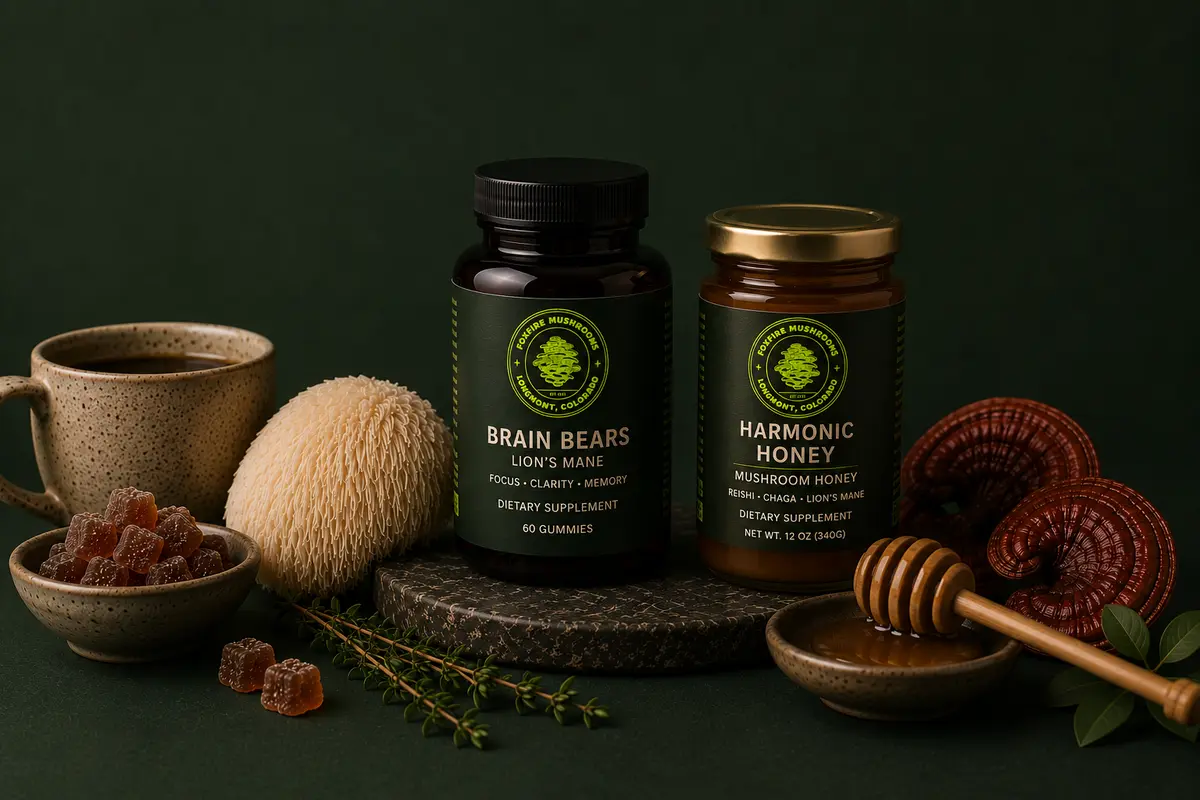
The first time I actually stuck with a lion’s mane habit longer than two weeks, it was because I moved my gummy from the kitchen counter to sit next to my toothbrush. Small thing, but it worked. I’d ordered my first batch of Brain Bears Lion’s Mane gummies from Foxfire Mushrooms after a friend swore by them, and my honest answer to the question everyone eventually asks, morning vs evening mushroom lion’s mane dosing, is that morning suits people chasing focus, evening suits people winding down, and the real trick isn’t the clock. It’s attaching the dose to something you already do without thinking.
Quick Facts — Lion’s Mane common dose: 500-1000 mg daily – Best for focus: morning, with food – Best for sleep support blends: evening, 30-60 minutes before bed – Time to notice effects: 1-2 weeks – Harmonic Honey suggested serving: 1 teaspoon – Average time for a daily habit to feel automatic: 66 days, range 18-254
Lion’s mane doesn’t work like caffeine. There’s no jolt. What people report, and what lines up with animal and small human studies on nerve growth factor stimulation, is a gradual sharpening over days and weeks, not minutes. As a nootropic, it behaves less like a stimulant and more like a slow building practice, which is part of why the compounds involved, hericenones and erinacines, are thought to support the production of nerve growth factor, a protein tied to how nerve cells maintain and repair themselves.
Lion’s mane itself has a long history as an edible fungus in East Asian cuisine and traditional medicine long before it became a research subject for cognitive support, which is part of why it’s generally considered food rather than a pharmaceutical. So when someone takes it in the morning, they aren’t chasing an immediate lift. They’re front loading their nervous system for a day of decisions, meetings, or whatever mental load is coming.
There’s also a circadian rhythm angle worth mentioning. Your body already runs on a daily cycle of alertness, digestion, and hormone release, and slotting a supplement into that same cycle, rather than fighting against it, tends to make the habit feel automatic rather than like one more chore competing for attention. This is a broader principle in how people build supplement routines generally, not something specific to lion’s mane, which is part of why timing advice for functional mushrooms tends to echo timing advice for things like probiotics or vitamin D.
Morning dosing pairs well with a fat-containing breakfast. Hericenones and erinacines appear to be fat soluble, meaning they may absorb somewhat better alongside dietary fat, which is one practical reason a gummy taken with breakfast has an edge over a plain powder stirred into black coffee on an empty stomach. You’re already eating something when you take it, so the absorption question mostly solves itself.
Evening dosing tends to fit two kinds of people. The first is someone using a blend that leans calming, something layered with reishi or paired with Harmonic Honey, formulated for grounding and gentle wind down rather than sharp focus. Reishi has a long history in traditional use as a calming adaptogen, distinct from the more stimulating reputation lion’s mane has built around cognitive support. The second is simply someone whose day is too chaotic for a morning routine to survive contact with reality. If mornings mean getting kids out the door, a supplement is going to lose that fight every time. Evening, after the house is quiet, is when the habit actually sticks.
Lion’s mane on its own tends to work fine in the evening for most people, since unlike a stimulant blend it isn’t the kind of compound that keeps you wired. I take mine at night sometimes and still sleep normally.
| Factor | Morning Dosing | Evening Dosing |
| Best paired with | Focus and productivity goals | Wind down and stress relief goals |
| Works well with | Coffee or breakfast, fat containing meal | Tea, Harmonic Honey, a quiet routine |
| Common product match | Brain Bears Lion’s Mane gummies alone | Blends with reishi or calming adaptogens |
| Risk of forgetting | Higher if mornings are rushed | Lower if bedtime is consistent |
| Reported by users | Sharper focus through midday slump | Easier transition into sleep |
Neither column is objectively correct, and the research on lion’s mane doesn’t strongly favor one hour over another. What breaks a dosing habit almost every time isn’t the wrong hour, it’s trying to dose at a moment your day doesn’t actually protect.
Not dramatically, and it’s worth being honest about that instead of overselling it. There isn’t strong research showing a meaningful difference between taking lion’s mane at 7am versus 9pm. What timing actually changes is adherence, meaning whether you keep taking it long enough to notice anything. Most people who report that lion’s mane didn’t do anything for them stopped after four or five days, far too short a window for a compound believed to work on nerve growth over weeks rather than hours.
So the honest framing is that morning versus evening is mostly a question about your life, not a question about mushroom chemistry.
I switched my own dosing time a few times before one stuck. Nobody’s ritual is perfectly smooth from day one, and if yours isn’t either, that’s normal.
Anchor the dose to an existing habit rather than building a brand new one from nothing. Brushing your teeth, making coffee, feeding the dog, whatever already happens automatically. Put the gummies or the honey jar physically next to that object so the habit rides along on a habit that already exists rather than competing with your memory for space. This is really the whole trick behind any dosing schedule that survives past the first week.
This works because of how habit formation is actually structured. Researchers at University College London tracked people building a new daily habit and found it took an average of 66 days for the behavior to feel automatic, with individual results ranging from 18 to 254 days depending on the person and the habit itself. The same research found that missing a single day did not meaningfully derail the process. That matters here specifically, because two months is a realistic window to expect before a mushroom ritual feels like a normal part of your day rather than something you’re still consciously remembering to do.
The placement piece is what people underestimate. A supplement stored in a cabinet requires a small decision every time. One sitting on top of something you already touch daily removes that decision entirely. When my gummies sat in a drawer, I took them maybe four days a week. On the counter, that jumped to nearly every day without trying harder.
Some more experienced users split their daily lion’s mane dose, taking half in the morning and half at night, particularly once they’re up around 1000 mg daily. The reasoning is straightforward. A single larger dose tends to taper off in effect by evening, so splitting it keeps a more even presence of the compound through the day rather than a single peak followed by a decline.
I don’t think this is necessary for most beginners starting out with a single serving. Splitting only really makes sense once you already have a feel for how your body responds, which usually takes a few weeks of consistent single dosing first. Start simple, and treat splitting as a refinement rather than a starting point.
Yes, and this is worth separating out because people often assume all functional mushroom products work the same way. Harmonic Honey is formulated as an evening ritual product, meant to be stirred into warm tea or taken straight off a spoon as part of winding down. It leans on a gentler blend rather than a straight lion’s mane isolate, so comparing it directly to the gummies isn’t quite apples to apples. If your goal is focus during work hours, the gummies in the morning are the more direct match. If it’s an evening ritual, the honey was built for exactly that moment.
If you’re building this ritual for the first time, the easiest entry point is picking one product and one anchor habit, not overhauling your whole day at once. Brain Bears fit a morning focus window, Harmonic Honey fits an evening wind down. Set whichever one you choose next to something you already do without fail every day. Foxfire ships both nationwide, orders over $75 ship free, and grower consultations are a reasonable place to ask about dosing fit if you’re still unsure.
Yes, plenty of people use the gummies in the morning and the honey in the evening as two separate parts of the same daily ritual, since they serve different purposes.
Most people report noticing something, usually mental clarity or steadier focus, somewhere between one and two weeks of consistent use. Some notice nothing for closer to three weeks, which is normal given how gradually the underlying compounds are believed to work.
For most people, no. Lion’s mane isn’t stimulating in the way caffeine is, so evening dosing generally doesn’t interfere with sleep, though individual sensitivity varies.
Less than most people assume. The UCL habit formation research found that missing a single day did not meaningfully derail the process of a behavior becoming automatic. Just pick the ritual back up the next day rather than doubling the dose to compensate.
There’s no single correct hour. Take them at whatever time of day you can genuinely repeat without fail, since sticking with it daily outweighs the exact clock time by a wide margin.
Start with whichever time is genuinely less likely to get skipped. For people with a busy or unpredictable morning, evening is often the safer starting point, even though morning gets recommended more often for focus goals specifically.
Most users take it continuously rather than cycling on and off, since the gradual mechanism it’s believed to work through doesn’t require a break. Anyone with an existing medical condition or on medication should still check with a doctor before starting a new supplement routine.
Share this article
A walk along Left Hand Creek in Longmont, Colorado, one October evening turned up an unexpected sight: a faint green glow coming off a rotting

A pound of fresh Lion’s Mane can lose quality quickly when it sits unrefrigerated, going soft and faintly sour within a day, which is why

A countertop covered in mushrooms after a strong flush is a familiar problem for home growers, and the question that follows just as fast is
Grab a beginner-friendly kit and apply what you just read —
or start with our beginner’s guide to find the right first grow.