

- Scott Brenton
- 10 min read
A walk along Left Hand Creek in Longmont, Colorado, one October evening turned up an unexpected sight: a faint green glow coming off a rotting
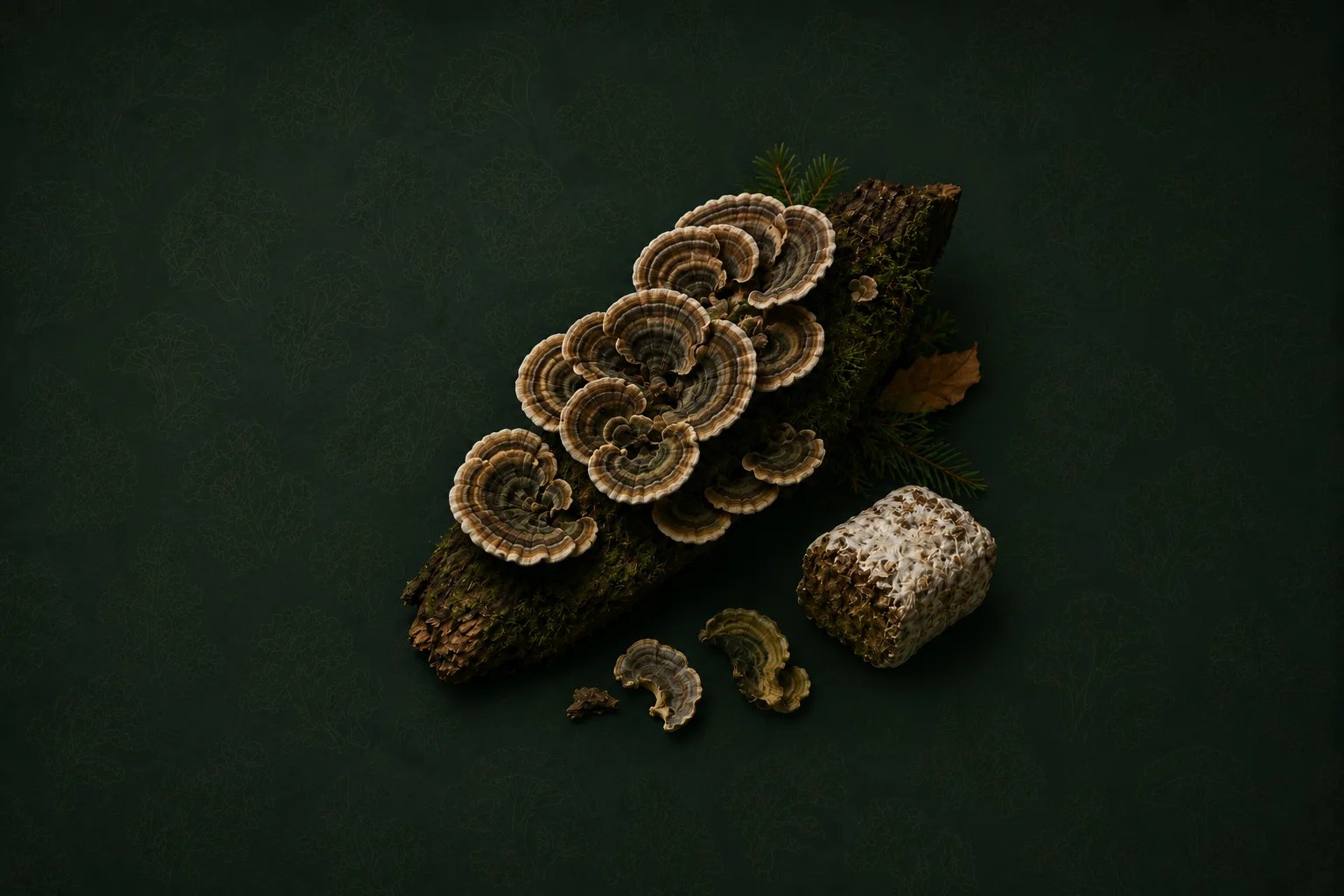
Trametes versicolor, known as Turkey Tail for its resemblance to a wild turkey’s spread tail feathers, is one of the most common and recognizable shelf mushrooms in North America. It grows on dead and dying hardwood trees, produces thin, colorful, fan-shaped brackets with concentric rings of color, and is cultivated on logs for traditional wellness preparations rather than as a culinary mushroom.
Turkey Tail is one of the most studied mushrooms in the world, with centuries of traditional use in East Asian herbal practice and a growing body of modern scientific research examining its bioactive compounds. At Foxfire Mushrooms in Longmont, Colorado, we grow Turkey Tail plug spawn for growers who want a reliable, easy-to-cultivate log species that connects the act of growing mushrooms to a deep tradition of wellness use.
This guide covers everything: how to identify Turkey Tail in the field, how to tell it from its look-alikes, where it grows in Colorado, how to cultivate it on logs, how to harvest and process it, and a grounded look at its traditional uses.
Here is the clean, beautifully formatted Markdown text designed specifically for the WordPress Gutenberg block editor.
Gutenberg parses standard Markdown perfectly—when you copy and paste the text below directly into a blank Gutenberg page, it will automatically convert the headers into Heading blocks, lists into List blocks, the table into a Table block, and the call-to-action section into clean Paragraph blocks.
Trametes versicolor — the species name literally means “of many colors” — is a bracket fungus in the family Polyporaceae. It grows in overlapping, semicircular clusters on dead and decaying hardwood logs, stumps, and fallen branches throughout North America, Europe, and Asia. The name Turkey Tail comes from the mushroom’s banded, fan-shaped form, which bears a genuine resemblance to the fanned tail feathers of a wild turkey.
Turkey Tail is saprotrophic — it feeds on dead organic matter, breaking down lignin and cellulose in wood — and plays an important ecological role as a decomposer. Its mycelium can run through a fallen log for years, and established logs will produce multiple flushes of brackets annually.
Unlike Oyster mushrooms, Lion’s Mane, or Shiitake, Turkey Tail is not eaten as food in the conventional sense. The brackets are tough, woody, bitter, and unpleasant as a culinary ingredient whether raw or cooked. Instead, Turkey Tail is used dried and powdered: simmered in teas and broths, tinctured in alcohol, or processed into powdered supplements. Its value lies not on the plate but in the cup.
Turkey Tail is one of the more identifiable mushrooms in North America once you know what to look for — but it has several look-alikes that can confuse new foragers. Learning the definitive identification features pays off here.
The most common misidentification of Turkey Tail is with False Turkey Tail (Stereum ostrea), a common bracket fungus that grows in similar habitats and has similar banding patterns on its upper surface. The test to distinguish them is simple: look at the underside.
| Feature | Turkey Tail (T. versicolor) | False Turkey Tail (S. ostrea) |
| Underside texture | Tiny, distinct pores (3–8 per mm) | Smooth — no pores, no gills |
| Underside color | White to cream | Orange, ochre, or buff |
| Flexibility | Pliable and flexible when fresh | Similar — flexible when fresh |
| Cap surface | Velvety, fuzzy texture | Smoother, sometimes with a slight sheen |
| Zone/band colors | Brown, tan, gray, orange, sometimes blue-green | Often more vivid orange-tan; less color variation |
| What to do with it | Harvest for tea and traditional use | Do not use; return to forest |
False Turkey Tail is not toxic — it will not harm you if you accidentally ingest some. But it does not contain the same bioactive compounds as T. versicolor and is not a substitute for the real thing. If the underside is smooth rather than pored, put it back.
A second look-alike worth knowing is the Violet Toothed Polypore (Trichaptum biforme). This species has a pored or toothed underside with a distinctive purple-violet tinge, particularly when fresh. It also grows on hardwood and can form overlapping bracket clusters. The purple tinge on the underside and the larger, more irregular pore structure distinguish it from Turkey Tail. It is not used in traditional wellness preparations and is not a substitute.
Turkey Tail is genuinely one of the most abundant wild mushrooms in Colorado. If you have hiked the foothills or followed a creek through a cottonwood grove and wondered about the small, layered brackets covering a dead log, there is a strong chance you were looking at Turkey Tail.
When to find Turkey Tail in Colorado: Brackets persist year-round, but fresh growth appears most often in spring through fall. Summer monsoon season (July–September) is particularly productive. Dried overwintered brackets can look faded and bleached; fresh growth has vivid coloration. For a full seasonal foraging calendar, see our seasonal mushroom guide for Colorado.
For more on what to look for on Colorado trails and in what habitats, see our wild edible mushrooms in Colorado guide.
If Turkey Tail is so common in Colorado’s wild spaces, why cultivate it?
For those interested in other log-cultivated medicinal species, our Reishi mushroom growing guide covers another traditional wellness species that does well on Colorado hardwood logs.
Turkey Tail is less fussy about wood species than most log-cultivated mushrooms. It grows naturally on a wide range of hardwoods and colonizes all of them in cultivation:
In Colorado, cottonwood and Gamble oak are the most accessible and locally abundant log sources. Freshly cut logs (cut 2 to 4 weeks before inoculation) colonize fastest; Turkey Tail is vigorous enough to succeed in logs up to 6 to 8 weeks from cutting.
Aim for logs 3 to 6 inches in diameter and 3 to 4 feet long. Smaller diameter logs colonize faster; larger logs produce longer.
The inoculation process follows the same steps as other plug spawn species — and Turkey Tail is arguably the most forgiving:
For a full visual walkthrough of the plug spawn process, see our log inoculation and plug spawn guide.
Turkey Tail colonizes relatively quickly compared to species like Chicken of the Woods or Reishi:
Place logs in a shaded, humid area during colonization. Turkey Tail logs need regular moisture in Colorado’s dry climate — soak briefly once a month if rainfall is insufficient, and ensure logs do not dry to cracking.
When to harvest: Harvest brackets when they are full-sized but still flexible, with vibrant color on the upper surface. Young growth at the bracket edges is the most potent material; very old, bleached, or brittle brackets are past their peak. Use scissors or a sharp knife to cut brackets close to the log surface.
Drying: Turkey Tail must be dried before use in teas or powders. Fresh brackets hold too much moisture and will mold within days.
Storage: Store dried Turkey Tail in an airtight glass jar away from direct sunlight. Properly dried and stored Turkey Tail keeps well for up to 2 years with minimal degradation.
Grinding for powder: A coffee grinder or high-powered blender reduces dried Turkey Tail to a fine powder in 30 to 60 seconds. The powder can be added to hot water directly (for a rougher preparation), blended into smoothies, or encapsulated. For best tea results, simmer whole or coarsely broken pieces rather than using powder.
Turkey Tail has one of the longest documented histories of use among edible and medicinal mushrooms. In Traditional Chinese Medicine, it is known as Yun Zhi (“cloud mushroom”) and has been used for centuries in formulas addressing fatigue, respiratory support, and general wellness. In Japanese practice, it is called Kawaratake (“mushroom by the riverbank”) and has been a traditional folk remedy for generations.
The mushrooms contain a number of bioactive polysaccharide compounds, most notably PSK (polysaccharide-K, also called krestin) and PSP (polysaccharopeptide). These compounds have been the subject of significant scientific research and are among the most studied bioactive compounds in any mushroom species. Turkey Tail has been examined in published research including studies in peer-reviewed journals such as the Journal of Ethnopharmacology and Integrative Cancer Therapies.
Turkey Tail is traditionally used and studied for its potential to support immune health and overall vitality.
These statements have not been evaluated by the FDA. This product is not intended to diagnose, treat, cure, or prevent any disease.
We will dive much deeper into the research landscape, specific compound activity, and evidence-based wellness applications in an upcoming dedicated article. For now, we have kept this section focused on cultural and traditional context. When that article is live, you will find it at Turkey Tail Mushroom and Immune Support.
The practical takeaway for growers: Turkey Tail is not a culinary mushroom — you are not growing it to eat fresh. You are growing it to dry, process, and use in traditional preparations. That changes how you think about yield and harvest, and makes the multi-flush nature of established Turkey Tail logs particularly valuable.
Turkey Tail tea is the most common traditional preparation and the simplest way to start working with your harvest.
What it tastes like: Turkey Tail tea is earthy, slightly woody, and mildly bitter — similar to a light medicinal herbal tea. It is not unpleasant, but it is also not a dessert tea. A small amount of honey rounds it out nicely. Some people add it to broth rather than drinking it as tea, which works well and adds depth to soups.
Storage: Brewed Turkey Tail tea can be stored in the refrigerator for up to 3 days. Reheat before drinking.
Wild Turkey Tail is everywhere in Colorado — so why cultivate it?
This is a fair question. Turkey Tail is genuinely common throughout Colorado’s foothills and riparian corridors. If you have access to good foraging spots near cottonwood or oak, you can certainly harvest wild specimens.
The case for cultivation comes down to three things: freshness, cleanliness, and convenience. A log you inoculate in your yard produces fresh Turkey Tail on your schedule, without a hike. Cultivated specimens grown on clean, known-species logs start from a clean baseline. And a productive Turkey Tail log in a shaded corner of your yard produces far more material per season than occasional foraging.
Colorado log sourcing: Cottonwood is the easiest to find in the Front Range and Boulder Valley — it grows along virtually every waterway and urban parks often have fallen or removed cottonwood available. Ask your city’s parks department or local arborists. Gamble oak is abundant in the foothills but less commonly cut or available as urban street tree trimmings.
Comparing Turkey Tail and Reishi for Colorado growers: Both are log-cultivated medicinal species with traditional wellness uses. Turkey Tail fruits faster (6 to 12 months vs. 12 to 18+ months for Reishi), tolerates a wider range of host woods, and produces multiple flushes per year. Reishi produces larger, more dramatic fruiting bodies but is slower and pickier. Both are excellent additions to a Colorado log yard. See our Reishi mushroom growing guide for details on the side-by-side comparison.
Timing in Colorado: Inoculate Turkey Tail logs in spring (April–June). Expect first fruiting in fall of the same year or the following spring — often within 6 to 8 months of inoculation on cottonwood. Keep logs moist through Colorado’s dry summers; the monsoon season (July–September) will often trigger natural flushes without any intervention.
At Foxfire Mushrooms in Longmont, Colorado, we carry Turkey Tail plug spawn in 100-count bags — enough to inoculate one to two hardwood logs. Turkey Tail is a genuinely rewarding log species: vigorous, productive, multiple flushes per year, and connected to one of the richest traditions of wellness use in the mushroom world.
Shop Turkey Tail Plug Spawn — 100ct Bags →
Read Our Full Log Inoculation Guide →
Read Our Plug Spawn Buying Guide — All Species →
No — Turkey Tail is not an edible mushroom in the conventional sense. The brackets are tough, woody, and bitter whether raw or cooked as food. Do not attempt to eat them as you would a culinary mushroom. Turkey Tail is processed into teas, broths, and extracts — traditional preparations that extract its bioactive compounds into a drinkable form.
Flip the bracket over. Turkey Tail has a pored underside — tiny white pores covering the entire lower surface, visible to the naked eye. False Turkey Tail (Stereum ostrea) has a smooth lower surface, often with an orange or ochre color. This single test is definitive. If it is smooth on the bottom, it is not Turkey Tail.
Yes, with care. Confirm the identification using the pore test and the species features described in this guide. Avoid very old, bleached, or crumbling brackets. Do not harvest from conifer hosts. Rinse lightly to remove debris and dry as described above. Wild Turkey Tail is safe to use in tea preparations once correctly identified and properly dried.
Properly dried and stored in an airtight glass container away from direct light, dried Turkey Tail holds quality for up to 2 years. Signs of degradation include an off smell, visible mold, or significant color fading from bright brown and tan to dull gray. When in doubt, make a fresh batch from your next harvest.
Not easily in the conventional indoor grow kit format. Turkey Tail is a log species adapted to slow, outdoor wood colonization. It does not perform well in small fruiting bags or grow kits the way Oyster or Lion’s Mane does. Outdoor log cultivation is the approach that works and produces the best results.
Earthy, mildly woody, and slightly bitter — similar to a light herbal tea or a very mild bark decoction. It lacks the savory depth of mushroom broth and the pleasant earthiness of a good Reishi tea, but it is not unpleasant. Honey and ginger improve it significantly. Think of it as a functional tea rather than a flavor experience.
Yes — it is one of the most beginner-friendly log cultivation species available. Its mycelium is vigorous and competitive; colonization is faster than most medicinal log species; it tolerates a wide range of host woods and conditions; and it requires no cold-shock triggering or elaborate fruiting chamber management. If you are new to log inoculation and want to start with a species that is forgiving and productive, Turkey Tail is an excellent choice — alongside Shiitake and Blue Oyster plug spawn.
Share this article
A walk along Left Hand Creek in Longmont, Colorado, one October evening turned up an unexpected sight: a faint green glow coming off a rotting

A pound of fresh Lion’s Mane can lose quality quickly when it sits unrefrigerated, going soft and faintly sour within a day, which is why

A countertop covered in mushrooms after a strong flush is a familiar problem for home growers, and the question that follows just as fast is
Grab a beginner-friendly kit and apply what you just read —
or start with our beginner’s guide to find the right first grow.