

- Scott Brenton
- 10 min read
A walk along Left Hand Creek in Longmont, Colorado, one October evening turned up an unexpected sight: a faint green glow coming off a rotting
I still remember standing in my kitchen with three different mushroom tinctures lined up on the counter, none of them labeled clearly enough for me to know which one I’d actually grabbed that morning, and feeling a little embarrassed that I’d spent money on something I couldn’t even identify anymore.
That confusion is exactly why choosing the right mushroom for your health goal matters more than most people realize before they start. Short version, Lion’s Mane is what people reach for when they want sharper focus, Reishi is for calm and sleep, and Chaga or Turkey Tail are associated with daily immune support.
The team at Foxfire Mushrooms gets asked this question almost every week, usually from someone standing in front of a shelf of options feeling exactly as overwhelmed as I was that morning.
Quick Facts — Best for focus: Lion’s Mane – Best for calm and sleep: Reishi – Best for daily immune support: Chaga and Turkey Tail – Typical gummy serving: 500-600 mg – Time to notice a difference: 2-4 weeks of daily use – Extraction type that matters most: dual extract, not powder alone
The mistake most beginners make is picking whatever mushroom has the most exciting marketing on the label instead of starting with their actual goal. A better approach, and the real starting point of any useful medicinal mushroom guide, is to name the one thing you’re trying to change, whether that’s brain fog, restless nights, or getting sick every time the seasons shift.
Functional mushrooms aren’t interchangeable because their active compounds act on different systems in the body, and after fielding this question hundreds of times, the pattern I see most often is someone who bought a five mushroom blend before ever trying one species on its own, so they have no idea which part is actually working.
None of them do everything, and any product claiming one mushroom solves every problem you have is worth a second look before you buy it.
Each of these adaptogens tends to get picked for one specific reason, so match your own goal first rather than trying all four at once.
Lion’s Mane is the mushroom I get asked about the most, and if focus is what brought you here, it’s usually the one both research and everyday feedback point back to. The benefit people notice most is mental clarity and steadier focus rather than a burst of energy, more like static clearing than a jolt. It’s not a stimulant, so it won’t feel like caffeine, and that trips people up the first week.
What it’s actually doing, based on the research so far, is supporting production of nerve growth factor, a protein involved in how brain cells communicate and repair themselves, a slower, more foundational process than simply spiking a neurotransmitter the way caffeine does. That’s also why the timeline matters more here than with a stimulant.
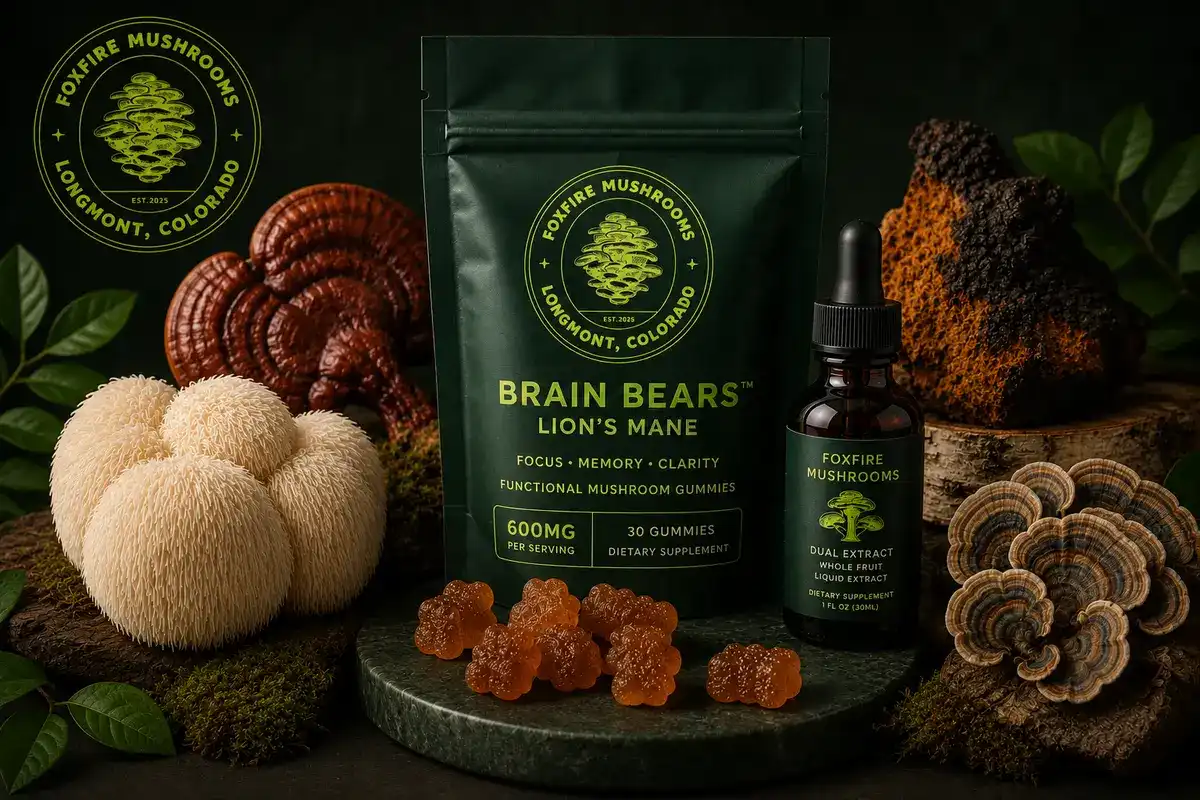
Foxfire’s Brain Bears gummies use 600 mg of whole fruit, dual extracted Lion’s Mane per serving, on the higher end for a gummy format, and a bottle runs $34.99 for thirty gummies. Most people take one in the morning with breakfast, and most people I’ve talked to who take it consistently report noticing a difference in the second or third week, not the first day.
Reishi has a reputation as the calming mushroom, and in my experience that reputation is earned, though it works slowly rather than knocking you out the way a sleep aid might. What people notice most is lower stress and an easier time settling down at night, not sedation, since a true sedative acts on the central nervous system directly while Reishi’s triterpenes and beta glucans work more on the body’s stress response over time.
That’s why it’s taken in the evening as a tea or tincture rather than at the moment you want to fall asleep. If racing thoughts at bedtime are your main complaint, Reishi is usually the better starting point than Lion’s Mane, which is more of a daytime mushroom.
One practical note, Foxfire currently sells Reishi as a $12.99 liquid culture syringe for growers rather than a finished gummy or tincture, so a ready to drink version means growing and brewing it yourself, or sourcing an extract elsewhere for now.
Chaga and Turkey Tail both get grouped under immune support, but they’re not identical. Chaga grows as a hardened mass on birch trees and carries one of the highest antioxidant contents of any medicinal mushroom, which is why it’s popular steeped as tea.
Turkey Tail is studied for its polysaccharide content, particularly compounds called PSK and PSP, examined for their relationship to immune cell activity, and it has a deeper research base than Chaga.
If you catch every cold that goes around the office, either is a reasonable place to start. Worth knowing before you go looking, Foxfire doesn’t currently stock either one, so you’ll need a supplier that specializes in cultivated extracts.
| Mushroom | Primary Goal | Best Time to Take | Common Form | Available at Foxfire |
| Lion’s Mane | Focus and mental clarity | Morning | Gummy, capsule, powder | Grow kit, liquid culture, gummy |
| Reishi | Calm, stress, and sleep | Evening | Tea, tincture, extract | Liquid culture only |
| Turkey Tail | Daily immune support | Morning or with food | Capsule, powder | Not currently stocked |
| Chaga | Antioxidant support | Anytime | Tea, tincture | Not currently stocked |
This is the part most competitor posts skip, and it’s what actually separates a product that works from one that’s mostly filler. Raw mushroom powder alone doesn’t give your body access to all the beneficial compounds, because some of the most studied ones, like the triterpenes in Reishi, are only soluble in alcohol, while the beta glucans need hot water extraction to break down the tough cell walls around them.
Neither process alone gets everything out, which is the actual reason dual extraction exists, not just a marketing term. In Foxfire’s Longmont lab, every batch of fruiting body material goes through both the hot water and alcohol stages before it’s concentrated and blended into the gummies, tested for contamination at multiple points along the way, not just at the end.
That process takes longer and costs more than grinding dried mushrooms into a capsule, which is exactly why so many cheap products skip it entirely.
Buying the right species is only half of it, the other half is knowing how to use it and whether growing your own even makes sense.
Yes, and a lot of experienced users end up doing exactly that once they’ve found their baseline with one species first. A common combination is Lion’s Mane in the morning and Reishi in the evening, covering both ends of the day without overlapping, since the two don’t compete for the same receptors or systems.
I’d still recommend starting with just one mushroom for the first two to three weeks so you can tell what’s doing what.
Most people using Lion’s Mane or Reishi consistently start noticing subtle shifts around two to four weeks in, and the effect builds gradually rather than announcing itself, which tracks with how slowly compounds like nerve growth factor and triterpenes accumulate in the body.
If you take a gummy once and expect an immediate change, you’ll likely be disappointed. A trick that actually helps, jot down one line in your phone each week about focus or sleep before you start, since it’s easy to forget your own baseline once the change happens slowly.
The people who get the most out of these products treat it like a daily habit, similar to a multivitamin.
If you’re the type who wants to understand exactly where your wellness products come from, growing your own is genuinely satisfying, and species like Lion’s Mane are beginner friendly enough that a first timer can get a real harvest within seven to fourteen days using a Foxfire grow kit.
But growing fresh mushrooms and getting a therapeutic dose of extracted compounds are two different goals, since the concentration in a whole mushroom is far lower than in a dual extract, which is something a lot of first time growers don’t realize until they’re standing over a beautiful harvest wondering why it doesn’t feel like the gummy.
Fresh Lion’s Mane is fantastic sautéed in butter, but you’d need a large amount regularly to match what’s in a single 600 mg gummy. Most people end up doing both, growing for the kitchen and taking a dual extract product for daily intake.
If focus is your main goal, start with a Lion’s Mane product and give it a full three weeks before judging it. If it’s evening calm you’re after, Reishi is the better first step. Foxfire’s Brain Bears gummies are a straightforward way to try it without measuring tinctures or brewing anything, and a Lion’s Mane grow kit is a fun place to start if you’d rather grow it yourself, backed by a live arrival guarantee.
Pick the one that actually fits what you’re trying to fix, give it a few honest weeks, and trust that the small, boring consistency of a daily habit is usually what gets you there, not the mushroom itself.
Lion’s Mane is the most commonly recommended species for brain fog and mental clarity, largely because of its association with nerve growth factor support.
Yes, many people take Lion’s Mane in the morning and Reishi in the evening, since one supports daytime focus and the other supports evening calm.
Chaga tea is generally considered safe for daily use by healthy adults, though anyone on blood thinning medication or with kidney concerns should check with a doctor first.
Most beginner gummy and capsule products land around 500 to 600 mg per serving. With Foxfire’s Brain Bears, that means one gummy a day is the standard starting point rather than two.
A quality gummy made with dual extracted, whole fruit material can deliver a comparable dose to a tincture, though flavoring and sugar content vary between brands, so it’s worth checking the label.
Fruiting body products come from the actual mushroom cap and stem, where most studied active compounds concentrate, while mycelium products often include grain filler that dilutes potency.
Yes, that’s the norm rather than the exception. Most functional mushrooms build gradually, and noticeable effects usually take two to four weeks of consistent daily use.
Share this article
A walk along Left Hand Creek in Longmont, Colorado, one October evening turned up an unexpected sight: a faint green glow coming off a rotting

A pound of fresh Lion’s Mane can lose quality quickly when it sits unrefrigerated, going soft and faintly sour within a day, which is why

A countertop covered in mushrooms after a strong flush is a familiar problem for home growers, and the question that follows just as fast is
Grab a beginner-friendly kit and apply what you just read —
or start with our beginner’s guide to find the right first grow.