

- Scott Brenton
- 10 min read
A walk along Left Hand Creek in Longmont, Colorado, one October evening turned up an unexpected sight: a faint green glow coming off a rotting
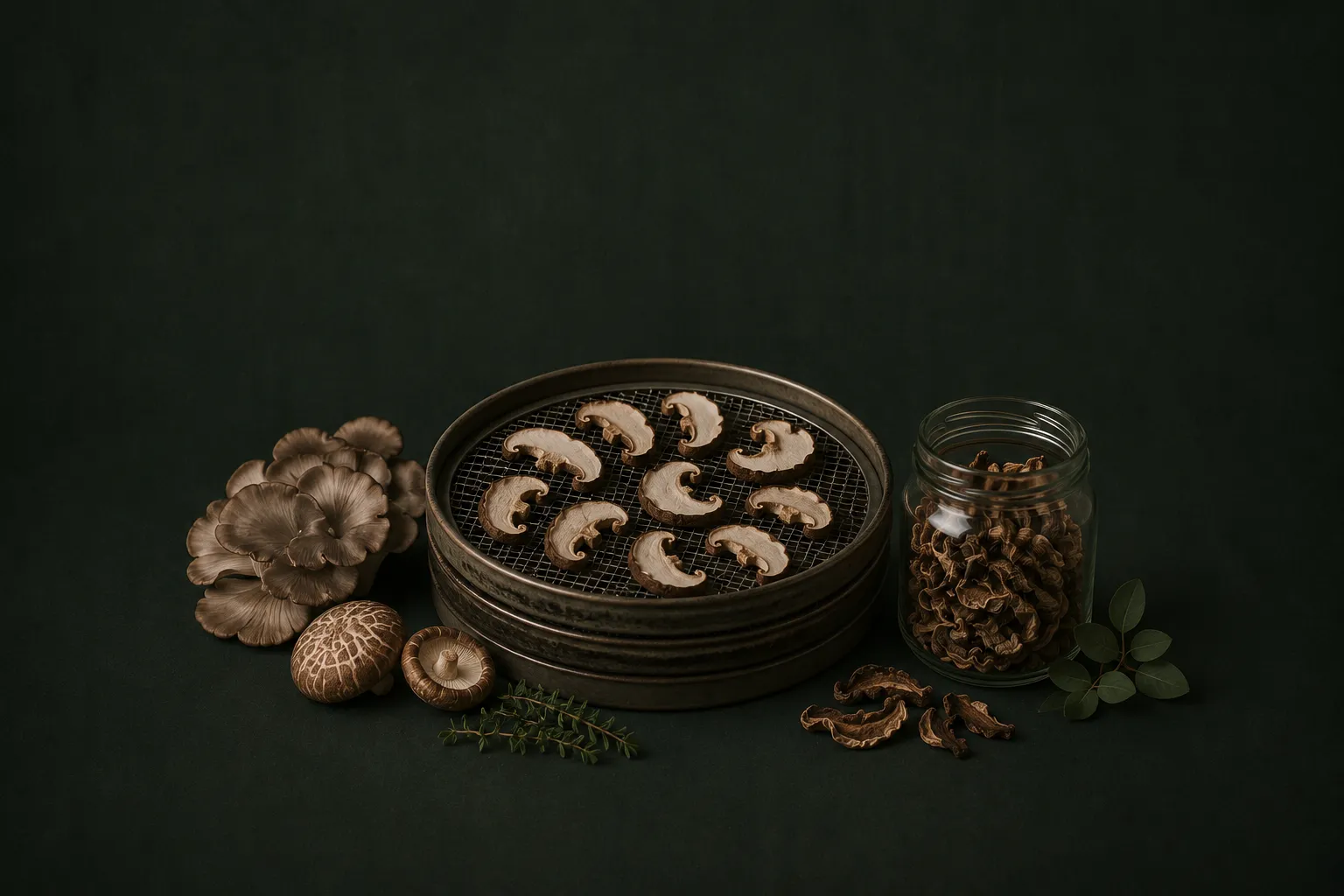
Dehydrating mushrooms at home extends their shelf life from a few days in the fridge to 1–2 years in a pantry jar — and concentrates their flavor in the process. The standard temperature for home dehydrators is 95°F / 35°C, which preserves both culinary quality and active compounds like beta-glucans. Drying time ranges from as little as 2 hours for thin Turkey Tail brackets to 8 hours for thick Lion’s Mane slices. Once you’ve done it once, you’ll never let another fresh flush go to waste.
At Foxfire Mushrooms in Longmont, Colorado, we grow and dry mushrooms year-round. This guide covers everything you need to know — equipment, prep, species-specific timing, storage, and making mushroom powder at home — so you can preserve every harvest with confidence.
Fresh mushrooms are extraordinary — and perishable. A beautiful flush of Lion’s Mane or a basket of Shiitake caps can go from fridge to compost in under a week if you’re not ready for them. Dehydrating changes that equation entirely.
You have three practical options for drying mushrooms at home. Each has its distinct place.
A dedicated food dehydrator is the most reliable tool for the job. It maintains a consistent, low temperature with steady airflow — exactly what mushrooms need. Entry-level models (around $50–$80) work well; a unit with a horizontal airflow fan and stackable trays gives the most even results.
Most home ovens work at a minimum of 170°F / 77°C — hotter than ideal, but usable. The key technique: leave the oven door slightly ajar (1–2 inches) to allow moisture to escape. Without this, your oven turns into a steam chamber and your mushrooms will never fully dry.
The oldest method — and often overlooked. Thread mushrooms on butcher’s twine or lay them on a clean mesh rack in a warm, dry room with good airflow. No electricity or equipment needed.
Good prep is the difference between a jar of crispy, flavorful dried mushrooms and a moldy disappointment. Here’s what to know before you start.
Do not wash mushrooms before dehydrating — water is the absolute enemy here. Instead, use a slightly damp cloth or a soft brush to wipe away any debris. If you grew them yourself (as many of our customers in Longmont and across Colorado do), they’re generally very clean to begin with.
Use this as your quick reference. All times assume a home food dehydrator with horizontal airflow. Add 20–30% more time for vertical-airflow stacking dehydrators, and monitor your first batch closely until you learn your machine.
| Species | Prep | Temp | Time | Done When | Best Used Dried |
| Shiitake | Remove stems; slice caps ¼” | 95–115°F | 4–6 hrs | Crispy, snaps | Ramen broth, soups, umami powder |
| Lion’s Mane | Slice ¼” thick (mandatory) | 95°F | 6–8 hrs | Snaps cleanly | Tea, powder, smoothies |
| Blue Oyster | Tear into pieces; thin | 95°F | 3–5 hrs | Crispy | Soups, rehydrated stir-fry |
| Pink Oyster | Tear; thin | 95°F | 3–4 hrs | Crispy | Soups, chili |
| Reishi | Slice thin; woody — grind after | 95°F | 4–6 hrs | Rock hard | Tea only (not eaten as-is) |
| Turkey Tail | Whole brackets; thin | 95°F | 2–4 hrs | Crispy, slightly flexible | Tea, broth |
| Wine Cap | Slice ¼” | 95–115°F | 4–6 hrs | Snaps | Soups, pasta sauce |
This step matters more than most guides admit. Under-dried mushrooms look finished but aren’t — and they will grow mold in the jar within days of storage.
Why this matters: Any remaining moisture creates a microenvironment for mold in a sealed jar. An extra hour in the dehydrator costs nothing. A batch of moldy dried mushrooms costs everything.
Pro-Tip: After drying, let mushrooms cool on the tray for 15–20 minutes before jarring — condensation from hot mushrooms going directly into a sealed container can re-introduce surface moisture.
Proper storage is what earns you that 1–2 year shelf life. Cut corners here and even well-dried mushrooms will go stale or absorb ambient moisture.
Mushroom powder is one of the most versatile pantry upgrades you can make. A teaspoon stirred into soup stock, sprinkled on eggs, or blended into a morning smoothie adds deep umami and nutritional density with no prep time.
What you need: A spice grinder (a dedicated coffee grinder works perfectly), a fine-mesh sieve, and fully dried mushrooms.
Dried mushrooms need only a simple soak to come back to cooking life — and the soaking liquid is often the most flavorful part.
Place dried mushrooms in a bowl and cover with warm (not boiling) water. Let soak for 20–30 minutes. The mushrooms will soften and plump; they’ll feel slightly firmer than fresh but cook down beautifully.
Do not discard the soaking liquid! Especially with Shiitake, the soaking water turns a rich amber-brown and is loaded with glutamates and aromatic compounds. Strain it through a fine mesh or coffee filter (to catch any grit) and add it directly to your broth, sauce, or cooking liquid. This is what professional cooks call “mushroom stock” — and you get it for free.
After Soaking: Gently squeeze the mushrooms to remove excess liquid, then slice or chop as needed. They’re ready to use exactly as you would fresh mushrooms in most applications.
Not everyone has a dehydrator, or the time to run one. That’s exactly why we offer professionally dried mushrooms, ready to use the moment they arrive.
Both are grown right here in Longmont, Colorado — same mushrooms, same care, just already done for you. And every purchase is backed by our 30-day satisfaction guarantee.
Whether you’re drying your own harvest or starting with professionally dried mushrooms from our farm, the goal is the same: great ingredients, ready when you need them.
Shop Dried Reishi and Dried Lion’s Mane →
Looking for ways to use your dried mushrooms? Start with our Turkey Tail mushroom broth recipe — a warming, savory extraction that comes together with almost no active effort. Or explore the full gourmet mushroom recipes collection for more ideas.
Foxfire Mushrooms | 426 Crystal Place, Longmont, Colorado 80504
“These statements have not been evaluated by the Food and Drug Administration. This product is not intended to diagnose, treat, cure, or prevent any disease.”
Yes. An oven set to its lowest temperature (typically 170°F / 77°C) with the door propped open 1–2 inches works well for most species. Check every 30–45 minutes. Air drying on a mesh rack also works for thin mushrooms like Turkey Tail and Oyster — especially in Colorado’s dry climate, where ambient humidity is low enough to make air drying practical and reliable.
Yes. An oven set to its lowest temperature (typically 170°F / 77°C) with the door propped open 1–2 inches works well for most species. Check every 30–45 minutes. Air drying on a mesh rack also works for thin mushrooms like Turkey Tail and Oyster — especially in Colorado’s dry climate, where ambient humidity is low enough to make air drying practical and reliable.
Whole dried mushrooms stored in an airtight glass jar, away from heat and light, keep for 1–2 years without noticeable quality loss. Mushroom powder has a shorter shelf life — about 6 months — because the increased surface area from grinding accelerates oxidation. Adding an oxygen absorber to each jar extends storage life for both forms.
Absolutely. Grocery store Shiitake, Cremini, Portobello, and Oyster mushrooms all dehydrate well. The process is identical — slice to ¼ inch where needed, dry at 95°F / 35°C until fully crisp. Drying store-bought mushrooms is one of the easiest ways to reduce food waste and build up a pantry supply.
Shiitake is the most universally useful dried culinary mushroom — the flavor concentrates dramatically and the soaking liquid alone is a prized ingredient. For functional uses in teas and broths, Reishi and Turkey Tail are the workhorses. For culinary-plus-functional versatility, Lion’s Mane powder is hard to beat.
Clean them first, but do not wash them in water before dehydrating. Use a slightly damp cloth or soft brush to remove any visible debris. Dirt or substrate particles don’t cause problems during the drying itself, but they’ll end up in your final product — and in your soaking liquid — if you skip this step.
Share this article
A walk along Left Hand Creek in Longmont, Colorado, one October evening turned up an unexpected sight: a faint green glow coming off a rotting

A pound of fresh Lion’s Mane can lose quality quickly when it sits unrefrigerated, going soft and faintly sour within a day, which is why

A countertop covered in mushrooms after a strong flush is a familiar problem for home growers, and the question that follows just as fast is
Grab a beginner-friendly kit and apply what you just read —
or start with our beginner’s guide to find the right first grow.