

- Scott Brenton
- 10 min read
A walk along Left Hand Creek in Longmont, Colorado, one October evening turned up an unexpected sight: a faint green glow coming off a rotting
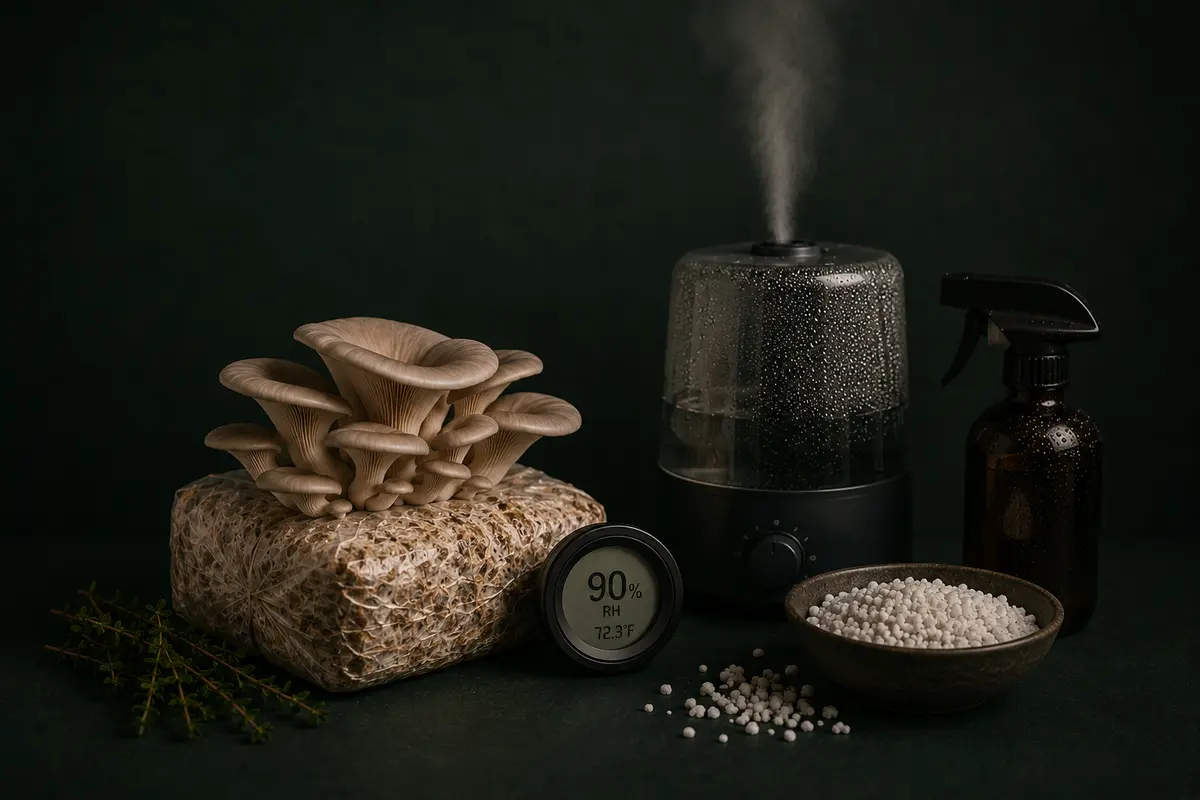
Last July, I opened my grow tent at seven in the morning and the humidity gauge had already dropped to forty percent, even though I had misted everything heavily before bed. I remember standing there in my socks, half annoyed and half impressed at how fast the tent had dried out overnight. That is the honest reality of controlling humidity for mushroom fruiting in summer heat: the air outside gets drier as it warms, and whatever chamber you built dries out right along with it.
I have been growing Blue Oyster and Lion’s Mane at home for a few seasons now, using kits from Foxfire Mushrooms, and every July I relearn some version of the same lesson. If your pins are drying out or a flush has stalled, most fixes below cost under fifteen dollars and show results within a week.
Quick Facts — Ideal fruiting humidity: 85-95% – Ideal fruiting temperature: 65-75°F – Typical first flush timing: 7-14 days, often faster in summer heat – Recommended misting frequency in July: 2-4 times daily – Warning sign of low humidity: dry, cracked, or stalled pins – Warning sign of stagnant moisture: sour smell or film on substrate
Warm air holds more moisture than cool air, but it also evaporates moisture faster from any wet surface, including your fruiting substrate. So even though the air outside might feel thick and humid in July, the inside of a grow tent sitting near a window or in a garage can dry out within a couple of hours after a good spray.
I noticed this the first summer I grew Shiitake blocks near a south facing window. The room felt muggy to me, yet the block itself was bone dry by early afternoon. This is why people who never had trouble in spring suddenly struggle the moment temperatures climb. It is rarely the mushroom species. It is almost always the environment shifting underneath them.
Most gourmet species, including the ones Foxfire ships as kits and grain spawn, fruit best between eighty five and ninety five percent relative humidity. Below that range, pins often form but dry out before they open into a proper cap, leaving small brown nubs that never develop further.
Above that range for extended periods, especially with poor air exchange, you start inviting bacterial blotch or a sour smell from the substrate. The tricky part in summer is that holding ninety percent takes real effort once daytime temperatures pass eighty five degrees, since the surrounding air keeps pulling moisture away faster than a single morning spray can replace it.
A small ultrasonic humidifier placed inside or feeding into a grow tent through a port maintains humidity far more consistently than spraying by hand, especially during the hottest part of the day when you are not home to mist every few hours. A basic model runs twenty to thirty dollars and usually pays for itself within a season if you are managing more than a couple of kits, since a single missed spray session in July can undo a full day of steady moisture.
The tradeoff is that it needs clean water, regular cleaning to avoid mineral buildup, and a way to vent excess moisture so the substrate does not sit in standing water. Spraying by hand is cheaper and fine for one or two kits on a counter, but it demands attention exactly when heat makes attention hardest to keep up with.
Move it out of direct sun and away from any heat source first. I have talked to more than one beginner who set their tent near a sunny window for the light, not realizing mushrooms do not need bright light, and that the window was baking the tent into a dehydrator for hours each day.
After that, spray more often, aim for a fine mist rather than a soak, and check the substrate both morning and evening, since a chamber that looks fine at noon can be bone dry by four in the afternoon. Lining the bottom of the tent with wet perlite helps too, since it releases moisture slowly as the air dries, acting as a buffer against sudden drops.
| Method | Cost | Effort | Best For | Watch Out For |
| Hand misting | Very low | High, several times daily | One or two kits, beginners | Easy to forget during peak heat |
| Ultrasonic humidifier | Moderate | Low once set up | Multiple kits or a dedicated tent | Mineral buildup, needs venting |
| Wet perlite bed | Low | Low to moderate | Buffering humidity swings | Can mold if soaked without airflow |
I run all three at once during July, a humidifier on a timer for baseline moisture, a perlite bed underneath for buffering, and a hand spray in the evening when I am checking on things anyway. Together they cost under fifty dollars and have held my tent within five percentage points of ninety through the worst heat waves.
High humidity alone does not cause contamination, and that surprises a lot of people. Stagnant, poorly circulated humid air does. If your tent is sealed tight to hold moisture in but has no fresh air exchange, carbon dioxide builds up and condensation collects on surfaces, and that stagnant moisture becomes exactly what mold spores prefer.
The fix is not lowering humidity, it is adding a small clip fan, usually under fifteen dollars, or fanning the tent by hand a couple of times a day so the moist air keeps moving instead of sitting still against the substrate.
Room humidity readings are almost useless for judging what is happening inside a sealed fruiting chamber, yet most beginners buy a hygrometer for the room instead of one small enough to sit inside the tent.
At Foxfire’s lab in Longmont, humidity inside cultivation chambers is checked at the chamber level, not the room level, because the two numbers can differ by twenty percentage points or more in summer, especially when a swamp cooler or air conditioner is drying out the room air around the tent. If you take one thing from this post, let it be that: buy a cheap hygrometer, tuck it inside your actual grow space, and stop guessing based on how the room feels.
In dry climates, you will spray more often and may need a humidifier running most of the day to hold a stable range, especially if your house relies on evaporative cooling, since that kind of cooling pulls moisture out of the air even as it lowers the temperature.
In humid climates, you may barely need to mist at all in summer, but you will need to watch airflow more closely, since ambient humidity plus a sealed tent tips into stagnant territory fast. I grow in Colorado, which is part of why Foxfire leans so heavily on active humidity management rather than passive setups in its own guidance.
Two summers ago I lost most of a Pink Oyster flush because I trusted a room hygrometer sitting six feet from the actual tent. It read seventy percent, so I skipped a midday spray.
The tent itself had dropped closer to fifty percent by early afternoon, and the pins that had just started forming dried out and stalled for good. It was not a dramatic failure, just a quiet one, and it taught me to stop trusting numbers I had not actually measured at the source.
Whether you are running a beginner Blue Oyster kit on a counter or a home setup with grain spawn and a dedicated tent, the principles stay the same in July. Watch the chamber, not the room. Spray more than you think you need to. Keep air moving instead of sealing everything shut.
Foxfire’s grow kits ship with a live arrival guarantee specifically because heat during transit and heat during fruiting are two different challenges, and orders over $75 ship free, which makes it easy to grab a spare kit for practice runs while you dial in your summer setup. Restaurants and markets running into the same humidity issues at larger scale can also book a grower consultation through Foxfire’s wholesale program.
If summer heat has been making your grow kit harder to manage, start by adding a hygrometer inside your fruiting chamber. Once you know what the humidity is actually doing, it’s much easier to adjust your setup and get healthy flushes again. If you’re ready for another grow, Foxfire’s current lineup of kits is a good place to start.
Most gourmet mushrooms fruit best between eighty five and ninety five percent relative humidity, measured inside the growing chamber rather than the surrounding room.
Warmer air pulls moisture out of substrate faster through evaporation, so a chamber that held humidity fine in cooler months can lose moisture within hours once summer heat sets in.
Yes, if misting leaves standing water on the substrate with no airflow to dry it between sessions, that stagnant moisture invites mold and bacterial issues rather than helping the mushrooms.
No, but keep the chamber out of direct heat sources like sunny windows, and add a small humidifier if the room stays warm.
Two to four times a day is reasonable for most home setups in July, adjusted based on how quickly the substrate surface dries between sessions.
It can, but usually because of poor air exchange rather than humidity itself. A small fan or brief hand fanning reduces this risk significantly.
Yes, it exists specifically to cover issues that show up when a kit arrives stressed from summer transit, including heat related damage.
Share this article
A walk along Left Hand Creek in Longmont, Colorado, one October evening turned up an unexpected sight: a faint green glow coming off a rotting

A pound of fresh Lion’s Mane can lose quality quickly when it sits unrefrigerated, going soft and faintly sour within a day, which is why

A countertop covered in mushrooms after a strong flush is a familiar problem for home growers, and the question that follows just as fast is
Grab a beginner-friendly kit and apply what you just read —
or start with our beginner’s guide to find the right first grow.