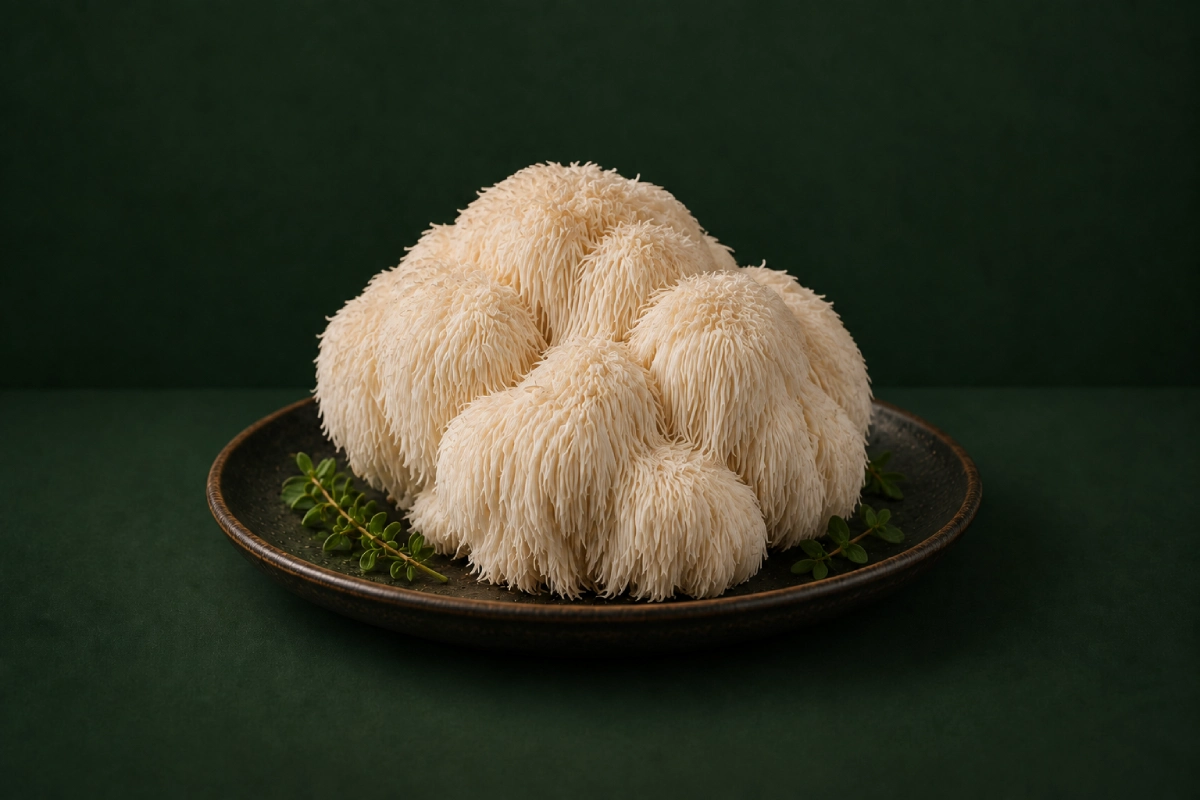
Hericium erinaceus — a cream-white cushion covered in soft downward spines instead of a cap and gills. In the wild it grows out of wounds in hardwood; indoors it fruits as a dense rounded block. Nothing else in the produce world looks like it, which is half of why chefs put it on menus.
It is also the species with a second life: lion’s mane is the best known of the functional mushrooms, which means people arrive at it from two directions — cooks who want the texture, and readers who want to know what it does. Both are legitimate; the cooking is what we grow it for.
Sweet and mild with a genuine crab or lobster character, and a fibrous structure that shreds into strands exactly like picked crab meat. It is the most convincing seafood substitute in the fungal kingdom and it does not need much help.
Press the water out. Lion’s mane is a sponge. Cut it into thick slabs, put them in a dry hot pan, and press them with a spatula or a second pan for the first two minutes — you will hear the water leave. Once the surface is dry and golden, add butter and finish. Skip the pressing and you get a wet, squeaky, spongy result, which is the single complaint everyone has the first time.
If it squeaks, it is undercooked and still full of water. Cook it past that point every time.
Almost no trim — pull off any residual substrate at the base and use the entire block. Trim loss 2–3%, but expect real cooking shrink, because you are deliberately driving out water: a pound of fresh gives roughly ten ounces cooked. For chefs, the working numbers, portion sizes and plating notes are on the lion’s mane chef page.
Five to seven days at 34–38°F in paper, if it arrived dry-picked. It shows age faster than the oysters because the white surface yellows visibly. If you need to hold it longer, cook and freeze — pressed and seared slabs freeze well; raw does not.
Year-round from Longmont, in steady weekly volume, and one of the three species we can always supply. It appears fresh on the harvest board and, when the harvest overruns, as dried and in the functional line.
Sweet and mild with a distinct crab or lobster character. Cooked properly it shreds into strands like picked crab meat, which is why it turns up as a seafood substitute.
Too much water still in it. Cut thick slabs, press them in a hot dry pan for the first couple of minutes to drive the moisture out, then add fat. If it squeaks, keep going.
No. Water is absorbed straight into the spines and makes the sponge problem worse. Brush or wipe, nothing more.
It is better cooked — raw it is watery, squeaky and much harder to digest. Cooking also develops the sweetness that makes it taste like shellfish.
Share this article
Grab a beginner-friendly kit and apply what you just read —
or take the quiz and we’ll match you to the right
starting point.
