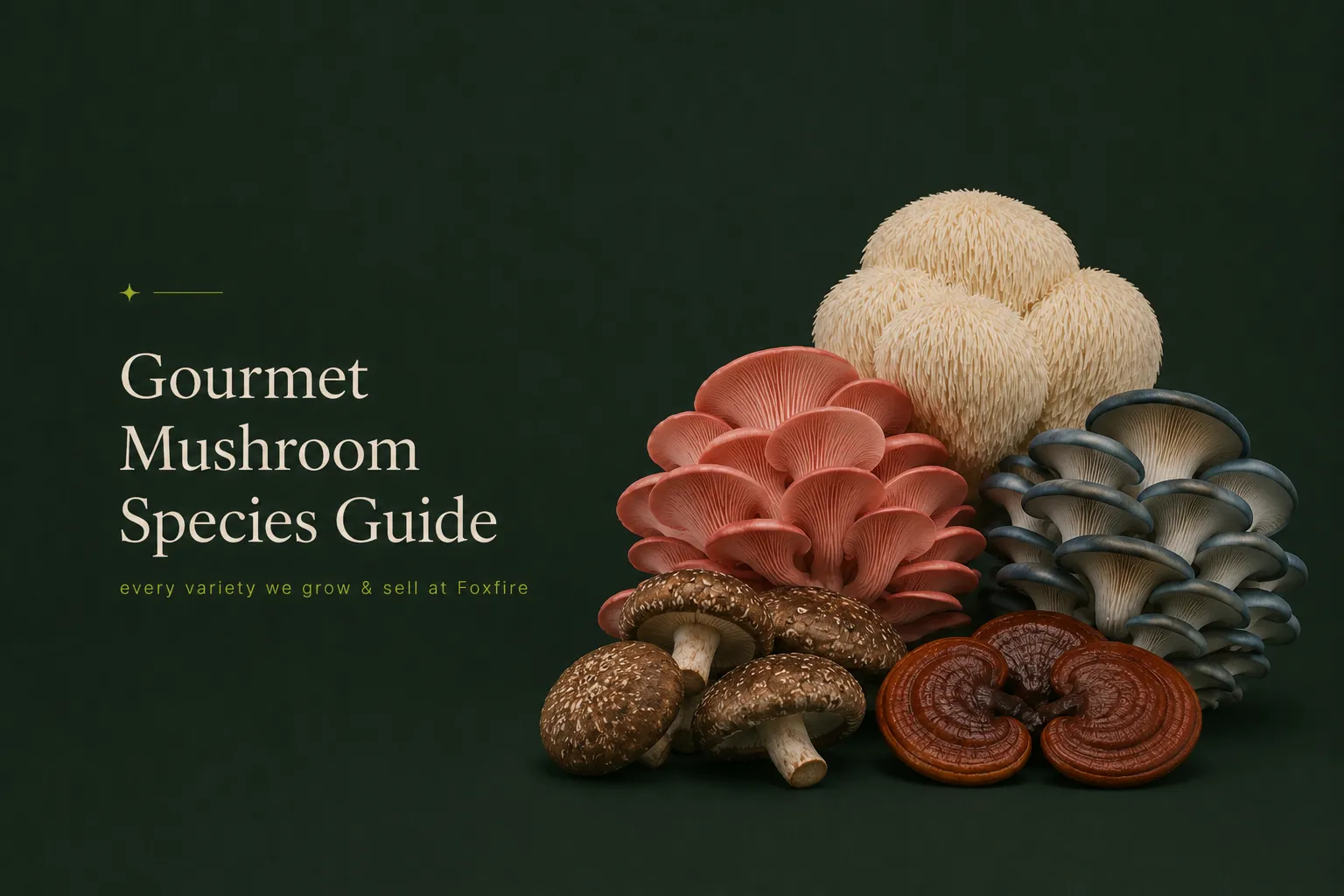
At Foxfire Mushrooms in Longmont, Colorado, we carry grain spawn, liquid culture syringes, plug spawn, and ready-to-fruit grow kits for a carefully curated lineup of gourmet mushroom species — from beginner-friendly Blue Oysters that colonize in under two weeks, to slow-growing Reishi that rewards patience with a medicinal woody fruiting body. This guide covers every species we stock: flavor profile, ideal growing conditions, difficulty level, substrate preference, and which Foxfire products will get you there fastest.
Whether you’re unboxing your very first grow kit or ready to inoculate a row of oak logs in your backyard, this is your complete reference. Bookmark it. You’ll come back to it.
This guide uses a simple system to help you find the right fit fast.
| Species | Scientific Name | Difficulty | Best For | Best Substrate | Colonization Time | Fruiting Temp | Foxfire Products |
| Blue Oyster | Pleurotus ostreatus | Beginner | Indoor fruiting blocks | CVG, straw, hardwood | 7–14 days (grain) | 55–65°F | Colonized Spawn, LC, Grow Kit |
| Pink Oyster | Pleurotus djamor | Beginner | Fast indoor harvests | CVG, straw | 7–14 days (grain) | 70–85°F | Colonized Spawn, LC, Grow Kit |
| Lion’s Mane | Hericium erinaceus | Intermediate | Indoor supplemented blocks | Oak Soy Hull hardwood | 10–14 days (grain) | 65–75°F | Colonized Spawn, LC, Grow Kit |
| Shiitake | Lentinula edodes | Intermediate | Indoor blocks + outdoor logs | Supplemented hardwood, oak logs | 14–21 days (grain) | 55–65°F | Colonized Spawn, LC, Plug Spawn |
| Reishi | Ganoderma lucidum | Intermediate–Advanced | Dried extracts, tinctures | Supplemented hardwood | 14–21 days (grain) | 75–85°F | Colonized Spawn, LC |
| Wine Cap | Stropharia rugosoannulata | Beginner | Outdoor garden beds | Wood chip mulch | N/A (outdoor) | 55–75°F | Plug Spawn |
| Chicken of the Woods | Laetiporus sulphureus | Intermediate | Outdoor log grows | Hardwood logs | 12–24+ months (logs) | 60–80°F | Plug Spawn |
| Turkey Tail | Trametes versicolor | Beginner–Intermediate | Dried wellness broth | Hardwood logs | Moderate (outdoor) | 50–80°F | Plug Spawn |
| Snow Oyster | Pleurotus pulmonarius | Beginner | Cool-weather indoor grows | CVG, straw | 7–14 days (grain) | 55–65°F | Coming Soon |
| Hen of the Woods (Maitake) | Grifola frondosa | Advanced | Outdoor oak root grows | Oak roots/logs | 12–24+ months | 50–65°F | Coming Soon |
Scientific Name: *Pleurotus ostreatus*
Difficulty: Beginner | Phase: 1 (Indoors)
If you had to pick one mushroom to learn on, Blue Oyster would win nine times out of ten. It’s the most forgiving, fastest-fruiting, and most responsive species we carry — and the flavor is genuinely excellent.
Growing Conditions
Blue Oysters colonize grain in 7–14 days at 65–75°F and prefer to fruit on the cooler side: 55–65°F is the sweet spot. This makes them a great fall-through-spring indoor grow in Colorado, where nighttime temps naturally drop. Maintain 85–95% relative humidity during fruiting with 4–6 fresh air exchanges per day to prevent CO2 buildup, which causes long, leggy stems instead of full caps.
Fruiting bodies emerge in dense clusters from cut areas or holes in the grow bag. Expect pins within 5–7 days of initiating fruiting conditions, with a full harvest ready 3–5 days after that.
Substrate
Blue Oysters thrive on CVG (coco coir, vermiculite, gypsum), straw, or supplemented hardwood. For colonized grain spawn, mix your spent grain block into a bulk substrate of CVG or straw at a 1:3 spawn-to-substrate ratio for best yields. Our [Mushroom Substrate Guide](/blog/mushroom-substrate-guide/) walks through mixing ratios in detail.
Flavor Profile
Mild, savory, and slightly meaty with a delicate ocean-like aroma. Blue Oysters sauté beautifully — cook hot and fast in butter or olive oil for a golden, silky result. They’re versatile enough for everything from pasta to tacos to ramen.
Foxfire Products
– Colonized Grain Spawn (3lb and 6lb)
– Liquid Culture Syringes (10ml)
– Blue Oyster Grow Kit
Full Guide: Blue Oyster Mushroom Growing Guide
Scientific Name: *Pleurotus djamor*
Difficulty: Beginner | Phase: 1 (Indoors)
Pink Oyster is the showstopper. Vivid hot-pink clusters that look almost tropical — because they are. This species originates from subtropical Asia and Africa, which means it loves warmth that would stress out its Blue Oyster cousins.
Growing Conditions
Where Blue Oysters want cool temps, Pink Oysters want heat: 70–85°F fruiting temperature, with the sweet spot around 75–80°F. This makes them a natural for warm summer indoor grows in Colorado when you don’t want to run AC in your grow space. Colonization on grain takes 7–14 days at 75–85°F.
Humidity during fruiting: 85–95% RH. Fresh air exchanges are important — without adequate FAE, you’ll get elongated stems and reduced pinning. Once conditions are right, Pink Oysters pin fast: expect primordia within 5–7 days of triggering, and harvest-ready clusters just 3–5 days after that. They’re the fastest-fruiting oyster species we carry.
A Word About Color
That brilliant pink fades — both after harvest (within 24–48 hours at room temperature) and when cooked (heat turns them pale pink to white). Harvest while the edges are still uptight and the color is at peak saturation. In the pan, the color transformation is dramatic, but the flavor — deep, savory, almost bacon-like umami — more than compensates.
Substrate
CVG and straw both work beautifully. Pink Oysters are aggressive colonizers that don’t need heavy supplementation to fruit well. Keep substrate moisture content around 60–65% field capacity.
Foxfire Products
– Colonized Grain Spawn (3lb and 6lb)
– Liquid Culture Syringes (10ml)
– Pink Oyster Grow Kit
Full Guide: Pink Oyster Mushroom Growing Guide
Scientific Name: *Hericium erinaceus*
Difficulty: Intermediate | Phase: 1 (Indoors)
Lion’s Mane is one of the most visually distinctive mushrooms in the world — a cascading white waterfall of spines, somewhere between a sea creature and a snow globe. It’s also one of the most rewarding grows once you understand what it wants.
Growing Conditions
Fruiting temperature: 65–75°F. Lion’s Mane is more temperature-sensitive than oysters — wide swings will stress the mycelium and cause browning or stalling. Relative humidity needs to stay high: 90–95% RH during fruiting is not optional. Drop below that consistently and you’ll see the spine tips turn yellow-brown, which signals stress.
The single most important variable beyond humidity: CO2 levels. Lion’s Mane is extremely CO2-sensitive. High CO2 (poor fresh air exchange) causes antler-like elongated growth instead of the classic round pom-pom shape. Aim for 500–800 ppm CO2 in your fruiting environment, which means 4–6 strong fresh air exchanges per day. If your fruiting chamber doesn’t have good FAE, this is the species that will tell you immediately.
Colonization on grain: 10–14 days at 68–75°F. Colonize in the dark and avoid disturbing the mycelium until colonization is complete.
Substrate
Lion’s Mane performs best on supplemented hardwood — oak sawdust with a wheat bran or soy hull addition. At Foxfire, our Oak Soy Hull substrate bags are formulated specifically for species like Lion’s Mane that need that extra nitrogen boost for dense, heavy fruiting bodies. Plain CVG will work for small flushes, but supplemented hardwood is where you see real yields.
Flavor Profile
Extraordinary. Raw Lion’s Mane has almost no smell, but cooked — especially pan-seared with butter until golden-brown — it develops a sweet, delicate flavor that most people describe as crab or lobster. The texture is firm and meaty, making it one of the most impressive culinary mushrooms you can grow at home.
Foxfire Products
– Colonized Grain Spawn (3lb and 6lb)
– Liquid Culture Syringes (10ml)
– Lion’s Mane Grow Kit
Full Guide: Lion’s Mane Mushroom Growing Guide
Scientific Name: *Lentinula edodes*
Difficulty: Intermediate | Phase: 1 (Indoors) + Phase 2 (Outdoor Logs)
Shiitake has been cultivated in East Asia for over 1,000 years, and it’s earned every year of that reputation. Deep umami, rich earthiness, and a complex flavor that intensifies dramatically when dried — it’s the most glutamate-dense cultivated mushroom you can grow. It also gives you two completely different cultivation paths: fast indoor blocks or multi-year outdoor logs.
Growing Conditions (Indoor)
Colonization temperature: 68–78°F on grain; 14–21 days. Fully colonizing a supplemented hardwood block takes longer — expect 8–12 weeks before it’s ready to fruit. Shiitake needs cold shock to initiate pinning, mimicking the temperature drop of autumn. Soak your colonized block in 50–55°F water for 12–24 hours, or move it to a cooler space (50–60°F) overnight. Without this trigger, you may wait a long time and see nothing.
Fruiting temperature: 55–65°F — cooler than most people expect. Humidity: 80–90% RH. CO2 sensitivity is moderate; standard FAE (4–6 exchanges/day) is sufficient.
Growing Conditions (Outdoor Logs)
This is the traditional method — inoculate freshly cut hardwood logs (oak, maple, or alder; 3–6″ diameter, 3–4 feet long) with plug spawn. Drill holes in a staggered diamond pattern, rows 6″ apart with holes 2″ apart. Tap in plug spawn dowels and seal immediately with melted cheese wax to prevent contamination. Inoculate in late winter to early spring (March–April in Colorado’s Front Range) before bud break.
First fruiting: 12–18 months. Yes, patience is required. But once a log is producing, it will fruit 2–3 times per year for 4–7+ years. Trigger established logs by soaking in cold water 12–24 hours and striking the log on the ground 2–3 times to simulate rain and impact.
Flavor Profile
Shiitake brings deep savory umami with earthy, almost smoky undertones. Fresh shiitake is excellent sautéed or in broth. Dried shiitake is extraordinary — the drying process concentrates glutamates and creates the most intensely flavored mushroom product you can make at home. Reconstitute in warm water and use both the mushroom and the soaking liquid in your cooking.
Foxfire Products
– Colonized Grain Spawn (3lb and 6lb)
– Liquid Culture Syringes (10ml)
– Plug Spawn (100-count)
Full Guide: Shiitake Mushroom Cultivation Guide
Scientific Name: *Ganoderma lucidum*
Difficulty: Intermediate–Advanced | Phase: 1 (Indoors)
Reishi is the outlier in our lineup. It doesn’t fruit fast, it doesn’t taste great fresh, and it has a growth behavior unlike any other species we carry. But it has been revered in East Asian wellness traditions for millennia — “the mushroom of immortality” — and for growers who want to produce their own dried material for teas and tinctures, it’s one of the most rewarding long-game grows you can do.
Growing Conditions
Colonization: 14–21 days on grain at 75–85°F. Fruiting temperature: 75–85°F — warmer than most of our lineup. Reishi is a tropical species and wants heat to fruit well.
Here’s what makes Reishi genuinely interesting and different from everything else: it has two distinct growth stages with completely different environmental needs.
– Antler Stage: When CO2 is high and fresh air exchange (FAE) is low, Reishi grows long, finger-like projections called antlers. Many growers intentionally cultivate Reishi in this form; it’s striking and the antler stage is harvested for use.
– Cap Stage: When FAE is increased (CO2 drops below ~1,000 ppm), antlers transition to the classic flat, kidney-shaped shelf with a glossy lacquered red-brown surface. This is the traditional fruiting body used in dried preparations.
You can control which form you get by managing air exchange. High CO2 = antlers. Normal FAE = caps. Both are valid harvest forms.
Total grow time from colonized block to mature fruiting body: 3–4 months. This is not a quick-turnaround species.
Substrate
Supplemented hardwood, similar to Lion’s Mane. Oak sawdust with soy hull or wheat bran additions. Reishi is a wood rot fungus (specifically white rot) that takes its time breaking down dense hardwood lignin.
Harvest and Use
Reishi is intensely bitter and woody — not typically eaten fresh as a vegetable. The proper preparation is drying the fruiting body completely, then grinding or simmering for extended periods. Dual extraction (hot water + alcohol) is common for tinctures. The fruiting body is hard and shelf-like when mature; harvest by cutting at the base.
Foxfire Products
– Colonized Grain Spawn (3lb and 6lb)
– Liquid Culture Syringes (10ml)
Full Guide: Reishi Mushroom Growing Guide
Scientific Name: *Stropharia rugosoannulata*
Difficulty: Beginner | Phase: 2 (Outdoors Only)
Wine Cap is the garden mushroom — and if you have access to wood chips or straw mulch and a garden bed, it’s one of the most satisfying outdoor grows you can do. No pressure cooker, no grow tent, no humidity chamber. Just plug spawn, wood chips, and patience.
Growing Conditions
Wine Cap grows naturally in wood chip mulch beds, garden paths, and forest duff. In Colorado, the seasons that matter are spring and fall — Wine Cap prefers temperatures of 55–75°F and will pause or die back in summer heat and winter freeze. Once established in a wood chip bed, it’s perennial: the mycelium overwinters and re-emerges each spring, fruiting reliably year after year.
Inoculate in spring (April–May in Longmont) or early fall (September–October) directly into a wood chip or straw bed. Spread a thin layer of spawn, cover with 2–4″ of fresh wood chips, and water regularly if rain is scarce. First fruiting can come within weeks to a few months depending on conditions and bed size.
What to Expect
Young Wine Caps are magnificent — deep burgundy caps with a skirt-like veil and thick white stems. Harvest when the cap edge is still slightly curved downward, before it fully flattens and opens. Flavor is earthy and mild, sometimes described as potato-like or woodland. They sauté and roast beautifully.
No sterile technique required for outdoor plug spawn inoculation — this is genuinely the most accessible entry point into mushroom cultivation we offer.
Foxfire Products
– Plug Spawn (100-count)
Scientific Name: *Laetiporus sulphureus* (on hardwood) / *L. cincinnatus* (at tree base)
Difficulty: Intermediate | Phase: 2 (Outdoor Logs)
Few wild mushrooms are as visually stunning as Chicken of the Woods — bright orange and yellow shelf brackets that look almost neon against dark bark. Growing it from plug spawn requires the patience of an outdoor log grower, but the payoff is extraordinary.
A Safety Note First
Some individuals experience sensitivity reactions to Chicken of the Woods — particularly when harvested from certain tree species (locust, eucalyptus, conifers) or when not cooked thoroughly. Always cook completely before eating. It is not recommended as a precaution for those with shellfish allergies, as a small subset of people report cross-reactive symptoms. When in doubt, try a small amount first.
Growing Conditions
Log inoculation follows similar protocol to Shiitake: drill, plug, wax. Use hardwood logs — oak is ideal; avoid conifer. Logs should be freshly cut (within 4–8 weeks of felling) and without signs of existing fungal colonization.
Colonization time: 12–24+ months before first fruiting. This is not fast. But when Chicken of the Woods fruits, it does so dramatically — prolific orange shelves that can add up to 20–100+ lbs of production over the life of the log. Fruiting temperature: 60–80°F, primarily in warmer months.
Foxfire Products
– Plug Spawn (100-count)
Scientific Name: *Trametes versicolor*
Difficulty: Beginner–Intermediate | Phase: 2 (Outdoor Logs, or Indoor)
Turkey Tail is everywhere in Colorado’s mountain forests — those layered fan-shaped brackets with concentric rings of brown, tan, rust, and cream on nearly every fallen hardwood log. Growing your own gives you a steady supply of one of the most researched wellness mushrooms in the world.
Growing Conditions
Turkey Tail is adaptable and relatively forgiving. Outdoors on hardwood logs, it colonizes reliably and produces multiple flushes through the warm months at temperatures ranging from 50–80°F. Indoor cultivation is also possible on supplemented hardwood blocks, though most growers find outdoor logs to be the better fit for this species.
The fruiting body itself is thin, leathery, and beautiful — concentric rings of color that vary depending on light, humidity, and genetics. Turkey Tail is not typically eaten as a vegetable (texture is tough and chewy even when cooked). It’s harvested, dried, and prepared as tea or added to long-simmered broths. It is also used as the base for dual-extraction tinctures.
Beta-Glucan Content
Turkey Tail contains beta-glucans, including polysaccharide-K (PSK), a compound that has been studied in relation to immune function. It’s one of the most extensively researched functional mushrooms, with clinical interest that spans decades of Japanese and international research.
Foxfire Products
– Plug Spawn (100-count)
With eight species in the lineup (and two more coming soon), the choice can feel overwhelming. Here’s a practical decision tree.
Start with a Blue Oyster or Pink Oyster grow kit from Foxfire. Both species are forgiving, fast, and produce results that will give you the confidence boost to keep going. Blue Oyster for cooler rooms; Pink Oyster for warm summer grows. Read our Best Mushrooms for Beginners guide for a side-by-side comparison.
Lion’s Mane rewards the grower who has learned to control humidity and FAE. Shiitake on supplemented hardwood blocks gives you the full intermediate experience: longer colonization, cold shock triggering, and flushes every 4–6 weeks. Both are available as colonized grain spawn or liquid culture. Our Complete Beginner’s Guide covers the grain-to-block process in detail.
Shiitake is the classic starting point — reliable, well-documented, and deeply rewarding as a multi-year fruiting log. Wine Cap in garden beds is even easier. Chicken of the Woods and Turkey Tail add diversity and long-term productivity to an outdoor mushroom garden. Check our Plug Spawn Buying Guide to understand quantities and log sizing.
Reishi for dried teas and tinctures. Turkey Tail for beta-glucan-rich broth additions. Both require patience — Reishi especially — but neither requires advanced technique once you understand their specific environmental preferences.
| Species | Colonized Grain Spawn | Sterilized Grain Bags | Liquid Culture | Plug Spawn | Grow Kit |
| Blue Oyster | 3lb / 6lb | 3lb / 6lb | 10ml | — | Yes |
| Pink Oyster | 3lb / 6lb | 3lb / 6lb | 10ml | — | Yes |
| Lion’s Mane | 3lb / 6lb | 3lb / 6lb | 10ml | — | Yes |
| Shiitake | 3lb / 6lb | 3lb / 6lb | 10ml | 100-count | — |
| Reishi | 3lb / 6lb | 3lb / 6lb | 10ml | — | — |
| Wine Cap | — | — | — | 100-count | — |
| Chicken of the Woods | — | — | — | 100-count | — |
| Turkey Tail | — | — | — | 100-count | — |
Not sure which product format is right for you? Our Colonized vs. Sterilized Grain Spawn guide explains the difference in plain terms. For liquid culture specifically, the LC Syringes Guide covers everything from storage to inoculation technique.
All products ship from our facility in Longmont, Colorado. We back every order with our 30-day money-back guarantee — if something isn’t right, we make it right.
Ready to Grow? Start Here.
At Foxfire Mushrooms in Longmont, Colorado, every product in our lineup ships with the species-specific guidance you need to succeed. Whether you’re starting with a single grow kit or building out a full cultivation setup with sterilized bags, liquid culture, and bulk substrates — we’ve got you covered.
30-day money-back guarantee on every order. If something doesn’t work, we don’t leave you guessing.
Shop Liquid Culture Syringes →
Blue Oyster (Pleurotus ostreatus) and Pink Oyster (Pleurotus djamor) are the two easiest species we carry. Both colonize quickly (7–14 days on grain), fruit reliably without precise conditions, and produce impressive harvests within weeks of starting. If you want zero guesswork, start with one of our ready-to-fruit grow kits — just open, mist, and harvest.
Yes, and many of our customers do. The key is grouping species with similar environmental requirements. Blue Oyster and Lion’s Mane both like 65–75°F fruiting temps and can share a grow tent. Pink Oyster wants warmer temps (70–85°F) and does better solo in summer or in a separately managed space. Shiitake’s cold shock requirement means it’s easiest to manage in its own space during the fruiting trigger phase.
Grain spawn (oat, rye, wheat, or millet colonized with mycelium) is used to inoculate bulk substrates for indoor fruiting blocks. Plug spawn (hardwood dowels colonized with mycelium) is pressed into drilled holes in logs for outdoor cultivation. They’re tools for different growing systems, not interchangeable. Our Grain Spawn vs. Sawdust Spawn guide explains the broader spawn format landscape.
Both are valid. Grow kits are the easiest entry point — fully colonized, ready to fruit, no additional materials needed. Colonized grain spawn gives you more control and scales better: one 6lb bag of grain spawn can inoculate a much larger bulk substrate block than a single grow kit provides. If you want to learn the full process, start with spawn and our Mushroom Substrate Guide.
Pink Oyster wins easily. From a colonized grain spawn bag to first harvest: as little as 3–4 weeks total. Colonization: 7–14 days. Pinning after fruiting conditions are initiated: 5–7 days. Pin-to-harvest: 3–5 days. On the opposite end, Reishi takes 3–4 months, and outdoor log species like Chicken of the Woods can take 12–24 months before first fruiting.
Colorado’s Front Range offers excellent conditions for outdoor log grows in spring and fall, when temps hover in the ideal range for Shiitake (55–65°F), Wine Cap (55–75°F), and Turkey Tail (50–80°F). The dry climate means humidity management is important for indoor grows — especially for Lion’s Mane, which needs 90–95% RH. We’re based in Longmont and grow everything here, so all our spawn is adapted to and tested for Colorado conditions.
A few general rules: oyster species (Blue, Pink) do well on CVG or straw. Lion’s Mane and Shiitake need supplemented hardwood for best yields. Reishi requires supplemented hardwood. Wine Cap, Chicken of the Woods, and Turkey Tail grow on wood chips or logs outdoors. See our full Mushroom Substrate Guide for mixing ratios, field capacity guidelines, and substrate comparisons.
It depends on species, substrate quality, and growing conditions. A rough guide: Pink Oyster — 1+ lb per flush from a 5lb block, 2–3 flushes; Blue Oyster — similar; Lion’s Mane — 0.5–1 lb per flush from a 5lb block, 2–3 flushes; Shiitake — 200–300g per flush on supplemented hardwood, 3–4 flushes. These are averages — ideal conditions push them higher, neglect drops them lower.
Share this article
Grab a beginner-friendly kit and apply what you just read —
or take the quiz and we’ll match you to the right
starting point.
