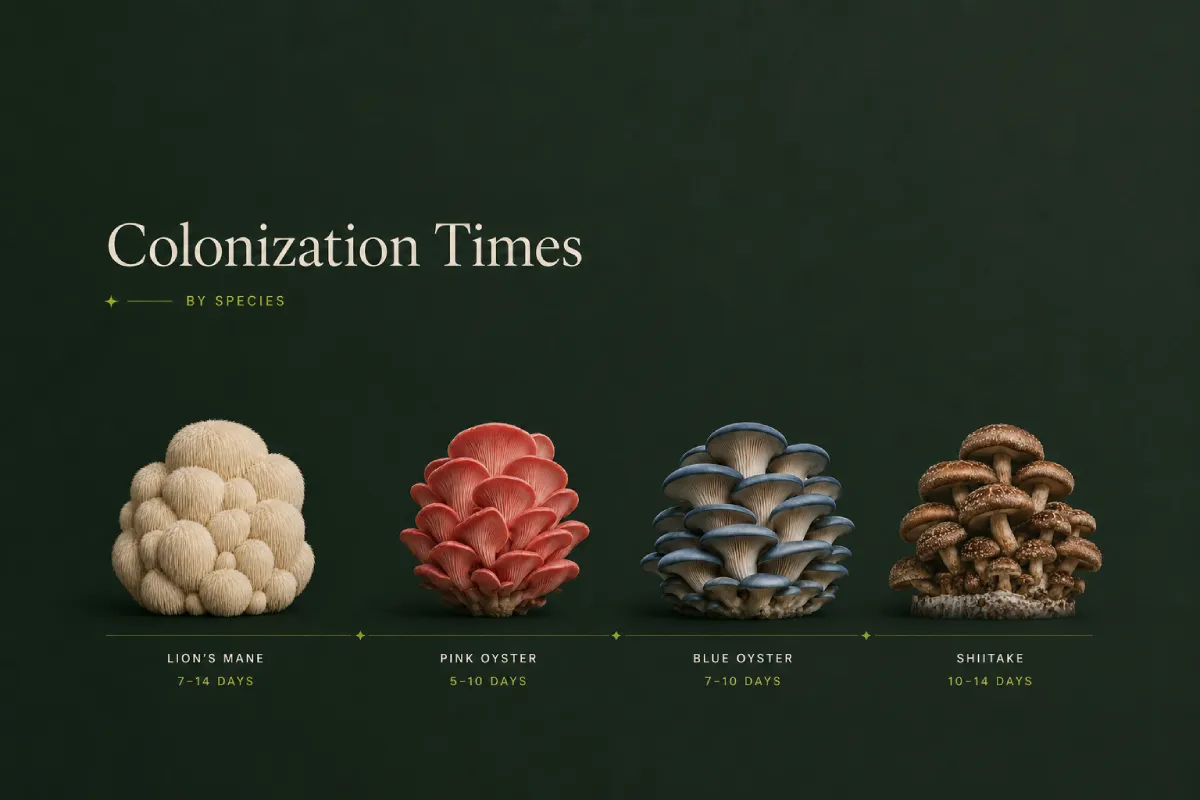
Colonization time — the period between inoculation and full white mycelium coverage — ranges from as little as 7 days for Pink Oyster on grain to 18+ months for Shiitake on logs. The biggest variable is temperature: within each species’ optimal range, warmer means faster. After temperature, spawn rate and substrate type have the most significant impact on how quickly you’ll see your grain or block fully colonized. This complete reference chart, assembled by the team at Foxfire Mushrooms in Longmont, Colorado, covers every commonly cultivated gourmet species with exact times across grain, sawdust block, and log substrates.
If you need a quick answer: most gourmet mushroom species fully colonize a grain substrate in 10–21 days and a hardwood sawdust block in 14–35 days, given appropriate temperature. Pink Oyster is the fastest commonly grown species on grain (7–12 days). Shiitake on a supplemented hardwood block is the slowest in-bag species (60–90 days). Log species like Shiitake and Reishi can take 12–24 months to fully colonize before fruiting, which is why most growers start with grain or sawdust block cultivation.
These timelines assume you’re starting with quality spawn — whether from Foxfire’s colonized grain spawn or your own home-inoculated grain using liquid culture syringes.
| Species | Substrate | Colonization Temp | Time (Grain) | Time (Sawdust/Block) | Time (Log) | Notes |
| Blue Oyster (P. ostreatus) | Grain / Hardwood | 70–77°F | 10–14 days | 14–21 days | 6–12 months | Vigorous mycelium; one of the fastest colonizers overall |
| Pink Oyster (P. djamor) | Grain / Straw | 75–85°F | 7–12 days | 10–18 days | N/A | Fastest commonly grown species; needs consistent warmth |
| Lion’s Mane (H. erinaceus) | Grain / Hardwood | 70–75°F | 14–21 days | 21–35 days | 6–12 months | Slower colonizer; produces distinctive white, ropy mycelium |
| Shiitake (L. edodes) | Grain / Supplemented HW | 68–78°F | 14–21 days | 60–90 days | 12–18 months | Very long block colonization; cold shock triggers fruiting |
| Reishi (G. lucidum) | Grain / Hardwood | 75–85°F | 14–21 days | 25–35 days | 18–24 months | Prefers warmth throughout; slow but reliable producer |
| Wine Cap (S. rugosoannulata) | Wood chips | 55–70°F | N/A | 4–8 weeks (chips/beds) | N/A | Primarily outdoor; very forgiving; garden bed inoculation |
| Turkey Tail (T. versicolor) | Grain / Hardwood | 65–80°F | 14–21 days | 21–35 days | 6–12 months | Aggressive colonizer; very contamination-resistant |
| Chicken of the Woods (L. sulphureus) | Grain / Oak | 70–80°F | 14–25 days | N/A | 12–24 months | Primarily a log/stump species; challenging in bagged format |
| King Oyster (P. eryngii) | Grain / Supplemented HW | 65–75°F | 14–21 days | 21–35 days | N/A | Requires cold fruiting (45–60°F); rewards patience with yield |
All times assume optimal temperature, healthy spawn, and a spawn rate of 10–15% by volume of dry substrate weight.
Colonization is biological growth, and like all biological growth, it responds predictably to a handful of variables. Understanding them lets you troubleshoot slow colonization and make smart decisions about your setup.
The single most powerful variable. Within a species’ optimal range, every 5°F above the minimum roughly doubles the metabolic rate of the mycelium. A Blue Oyster grain jar colonizing at 72°F will colonize noticeably faster than the same jar at 65°F. Outside the optimal range — either too hot or too cold — mycelium slows dramatically or stops entirely. At temperatures above the species’ maximum, mycelium can be killed outright or stressed in ways that reduce yield later.
Higher inoculation rates mean more mycelium starting points throughout the substrate, which means the mycelium covers distance faster. A 15–20% spawn rate (by volume) colonizes measurably faster than a 5% rate. For home growers, 10–15% is the practical sweet spot — aggressive enough to colonize quickly, conservative enough to not waste expensive spawn.
Richer, more supplemented substrates can fuel faster mycelial growth — but they also support faster contamination growth if your sterilization or inoculation isn’t clean. A lightly supplemented substrate (1–5% wheat bran by weight) colonizes faster than straight hardwood sawdust; a heavily supplemented mix colonizes even faster but carries higher contamination risk. This is why shiitake blocks, which are often heavily supplemented, require meticulous technique and why their 60–90 day colonization is a window where contamination can move in.
Contamination doesn’t just threaten your crop — it actively competes with and slows mycelium before it becomes visibly obvious. If your colonization seems stalled and you can’t identify any obvious green or black patches, look carefully at the edges of mycelial growth for discoloration, or smell the substrate for anything sour or off. Invisible early contamination is a real phenomenon. See our contamination prevention guide for diagnostic steps.
For grain jars and bags, shaking at day 3–5 (once you can see visible mycelial growth but before it’s reached 50% coverage) redistributes mycelium throughout the substrate, creating many new colonization starting points. This single technique speeds up colonization by 20–30% without any additional inputs. Do not shake after 50% colonization — at that point you’re more likely to introduce oxygen that helps contaminants than to help the mycelium.
Smaller containers colonize faster than larger ones. A half-pint jar colonizes in 7–12 days; a quart jar in 12–18 days; a 5-lb block in 14–35 days. This is because mycelium has less distance to travel and heat accumulates more evenly in smaller volumes. When you’re troubleshooting slow colonization, container size is worth considering.
Healthy colonization has a recognizable look and timeline. Here’s what to expect week by week for a typical grain jar inoculated with liquid culture:
Warning signs:
Yes. The terms are used interchangeably in mushroom cultivation, including in this guide. “Colonization period” and “incubation period” both refer to the same phase: the time between inoculation and full white mycelium coverage of the substrate, during which the grain or block is kept in warm, dark conditions without active fruiting conditions.
Some growers use “incubation” to refer specifically to the early phase (first few days after inoculation) and “colonization” to refer to the full period. Others use them completely interchangeably. Neither usage is wrong. If you see “incubation time” in another guide’s data, you can map it directly to “colonization time” in this chart.
What colonization is not the same as: the subsequent fruiting chamber phase, where blocks are exposed to humidity, fresh air exchange, and light to trigger pinning.
Ranked by grain colonization time (fastest to slowest):
At Foxfire Mushrooms’ home base in Longmont, Colorado, our team and local growers have a few conditions to keep in mind that differ from coastal or lower-elevation cultivation guides.
Colonization takes time and skill to do well. If you want to focus on the fruiting side of cultivation — learning to read your mushrooms, dial in your environment, and maximize yields — starting with fully colonized spawn from Foxfire Mushrooms lets you skip the colonization phase entirely.
Foxfire Mushrooms — 426 Crystal Place, Longmont, Colorado 80504. All spawn and supplies backed by our 30-day guarantee.
For grain substrates, colonization takes 7–21 days depending on species and temperature. Pink Oyster is the fastest at 7–12 days; Lion’s Mane and Shiitake are among the slower at 14–21 days. Sawdust and hardwood blocks take 14–90 days depending on species and whether the substrate is supplemented. Logs are the slowest, taking 6–24 months depending on species.
The three most effective techniques: (1) maintain temperature at the top of the species’ optimal range; (2) increase your spawn rate to 15–20%; (3) shake grain jars at 30–50% colonization to redistribute mycelium. Using high-quality liquid culture or vigorous colonized grain spawn as your starting point matters more than most technique adjustments — start with good spawn and the rest is optimization.
It varies by species. Most gourmet oyster species prefer 70–77°F. Pink Oyster and Reishi prefer 75–85°F. Lion’s Mane, Shiitake, and King Oyster prefer 68–78°F. Wine Cap, grown outdoors, tolerates 55–70°F. Refer to the full chart above for species-specific ranges. When in doubt, 72–75°F is a safe colonization temperature for most commonly grown species.
Colonization is complete when white mycelium covers the entire visible surface of the substrate — there should be no uncolonized patches of grain, sawdust, or straw visible. In a grain jar, the grain should be bound together in a cohesive cake by mycelium. In a sawdust block, the entire block should be firm and white throughout. Some species also produce surface pinning (primordia) as a sign they’re ready for fruiting conditions. When in doubt, wait another 3–5 days after what appears to be full colonization before initiating fruiting.
Yes, with one important qualifier: shake once, at 30–50% colonization (not before mycelium is visible and not after 50% coverage). Shaking redistributes mycelium throughout the substrate, multiplying growth points and speeding up overall colonization by 20–30%. Shaking too late can damage developed mycelium and introduce oxygen that favors contamination.
The most common causes in order of frequency: (1) temperature is too low — check that your colonization area is hitting at least 68–72°F; (2) spawn quality issues — old or degraded liquid culture or spawn takes longer to establish; (3) contamination competing invisibly — look and smell carefully; (4) substrate was too wet after sterilization — excess moisture slows oxygen flow through the substrate. If none of these apply, a longer wait is sometimes just the answer — Lion’s Mane and Shiitake are legitimately slow and patience is part of growing them. Review our guide on how to inoculate grain spawn to make sure your technique is dialed in from the start.
Share this article
Grab a beginner-friendly kit and apply what you just read —
or take the quiz and we’ll match you to the right
starting point.
