

- Scott Brenton
- 4 min read
How to read this page We have tried to describe the state of the research rather than the state of the marketing, which means this
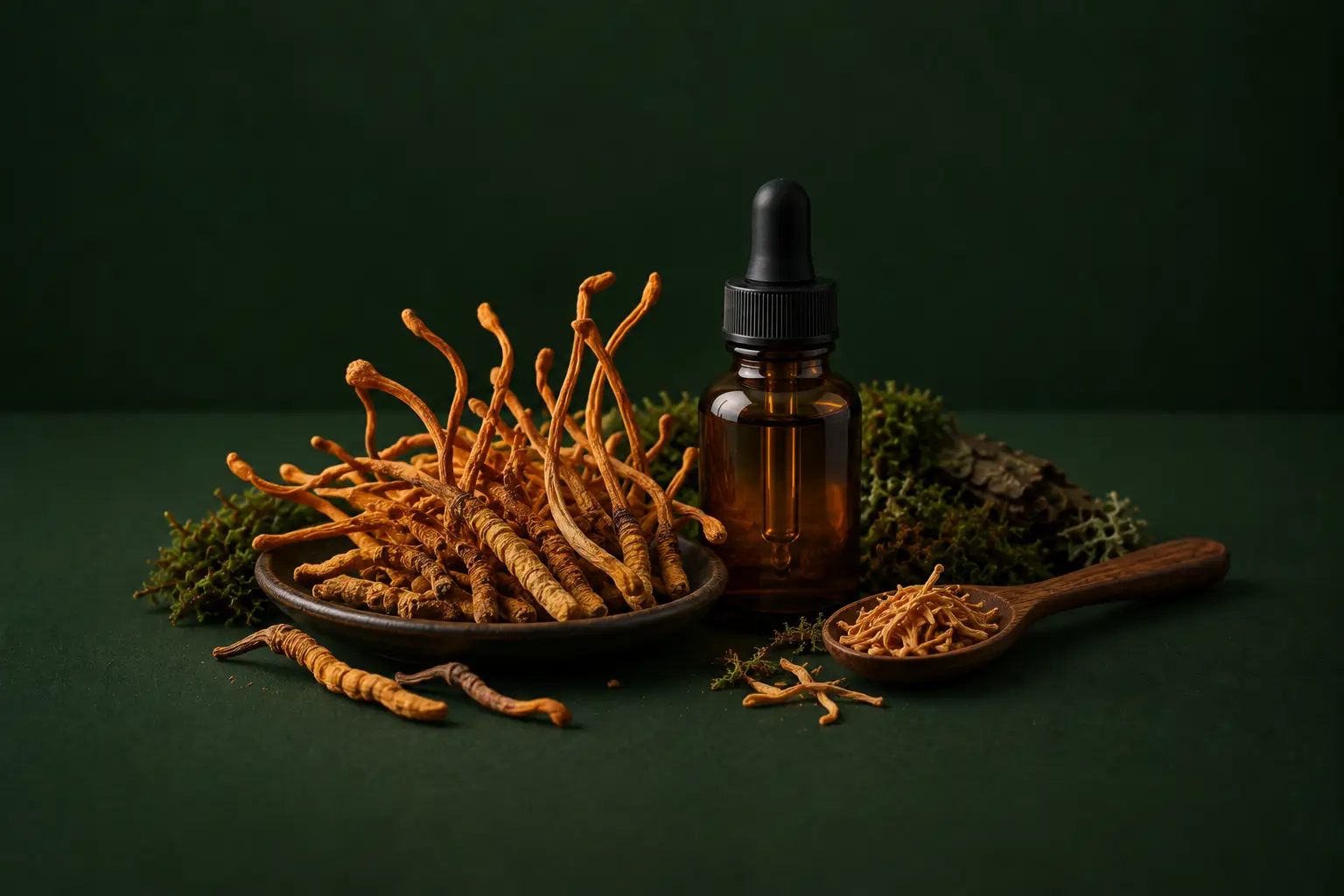
We have tried to describe the state of the research rather than the state of the marketing, which means this page is less exciting than most pages about this mushroom. Nothing here is medical advice, and nothing here should be read as a claim that this mushroom treats, prevents or cures any condition. If you are considering a supplement — particularly alongside prescription medication — that is a conversation with a clinician, not a website.
This is where most confusion starts, and it is worth getting straight before any discussion of evidence.
So when a study, a tradition and a product all say “cordyceps”, they may be referring to three different organisms. Any evidence claim that does not name the species and preparation is not a usable claim.
Cordycepin (3′-deoxyadenosine) is the compound most associated with cordyceps, along with adenosine and various polysaccharides. Interestingly, cultivated C. militaris often contains more cordycepin than wild sinensis — which is a genuine argument in favour of the cultivated product over the romantic one.
This is the main area of human study, and the honest summary is that it is small, mixed and short-term.
Fair reading: there may be a small effect on some aerobic markers in some populations, and the evidence is not strong enough to rely on. If you want a reliable ergogenic aid, the evidence base for caffeine and creatine is orders of magnitude larger.
The most common study design problem with cordyceps: it is tested inside a proprietary blend. When a blend shows an effect, you have learned about the blend.
Wild O. sinensis has been used in Tibetan and Chinese medicine as a tonic for a long time, and it is genuinely among the most valuable biological commodities on earth by weight. That value has driven serious ecological pressure and social conflict on the Tibetan plateau, and wild populations have declined.
Which is a real reason to prefer cultivated C. militaris: it is more consistent, cheaper, testable, often higher in cordycepin, and it does not involve harvesting a wild species under pressure.
Cultivated cordyceps is generally well tolerated, with mild gastrointestinal effects reported occasionally. Points to raise with a clinician: anticoagulants, immunosuppressants, diabetes medication, and any autoimmune condition. Pregnancy and breastfeeding — insufficient data. As always, if you take regular medication, ask before adding a supplement.
Cordyceps is the functional mushroom where the marketing outruns the evidence most obviously, mainly because “performance” is easy to sell and hard to measure. If you want to try it, buy cultivated C. militaris fruiting body with a stated cordycepin content, and treat any effect as small and unproven. Read functional mushroom forms before you buy anything.
Sinensis is the wild Himalayan caterpillar fungus — rare, extremely expensive and under ecological pressure. Militaris is a cultivable relative that makes up essentially all commercial product, and it often contains more cordycepin.
Some small trials report modest improvements in aerobic markers, others find nothing, and many test it inside multi-ingredient blends. The evidence is not strong enough to rely on.
A nucleoside analogue (3’-deoxyadenosine) that is the compound most associated with cordyceps. Cultivated C. militaris often contains more of it than wild sinensis.
Cultivated cordyceps is generally well tolerated with occasional mild gastrointestinal effects. Discuss it with a clinician if you take anticoagulants, immunosuppressants or diabetes medication, or have an autoimmune condition.
Share this article
How to read this page We have tried to describe the state of the research rather than the state of the marketing, which means this

How to read this page We have tried to describe the state of the research rather than the state of the marketing, which means this

How to read this page We have tried to describe the state of the research rather than the state of the marketing, which means this
Grab a beginner-friendly kit and apply what you just read —
or start with our beginner’s guide to find the right first grow.