

- Scott Brenton
- 4 min read
How to read this page We have tried to describe the state of the research rather than the state of the marketing, which means this
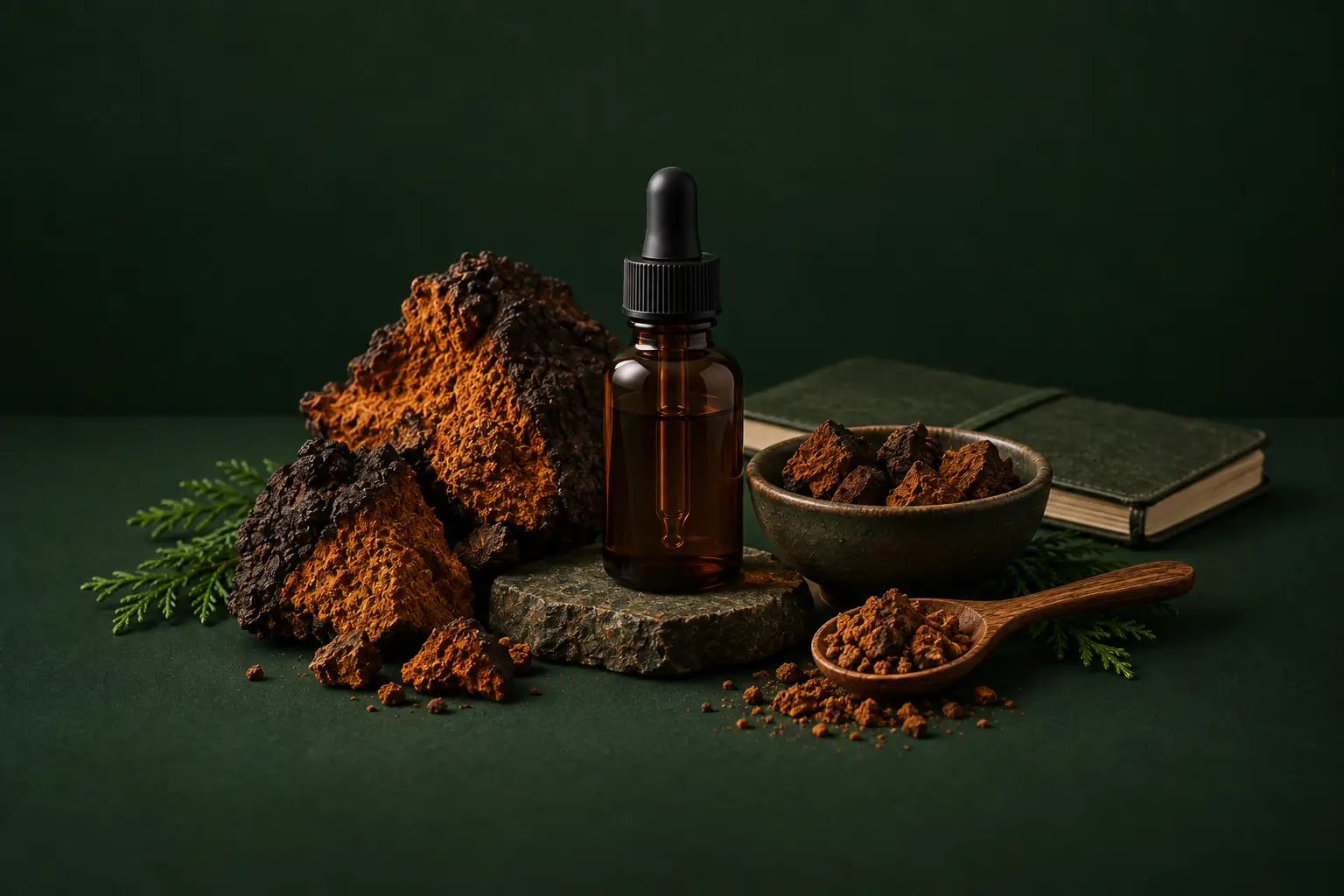
We have tried to describe the state of the research rather than the state of the marketing, which means this page is less exciting than most pages about this mushroom. Nothing here is medical advice, and nothing here should be read as a claim that this mushroom treats, prevents or cures any condition. If you are considering a supplement — particularly alongside prescription medication — that is a conversation with a clinician, not a website.
Inonotus obliquus is not a mushroom in the everyday sense. It forms a sterile conk — a hard, black, cracked mass of fungal tissue mixed with birch wood — on living birch trees, usually over many years. It looks like burnt charcoal on the trunk.
That composition matters. Chaga contains birch-derived compounds as well as fungal ones, and it cannot be cultivated in a fruiting room the way an oyster mushroom can, because it takes years growing on a living tree. Some producers grow the mycelium in liquid culture, which is a different product again.
Chaga has an active preclinical literature — cell culture and animal studies covering antioxidant activity, inflammatory markers, immune signalling and a variety of other endpoints. It is genuinely rich in melanin and polyphenols and scores very highly on laboratory antioxidant assays.
Human clinical evidence is close to absent. There are few controlled human trials of any size, and no body of evidence that supports a health claim. Systematic reviews consistently note the mismatch between preclinical enthusiasm and clinical data.
The high antioxidant assay scores also deserve a caveat: laboratory antioxidant capacity has repeatedly failed to predict health outcomes, and food ORAC-type values have largely fallen out of scientific favour for that reason.
Chaga is the clearest case in this cluster of marketing volume greatly exceeding evidence volume.
Chaga is among the highest-oxalate substances people consume deliberately. Oxalates bind calcium and can form kidney stones, and there are published case reports of oxalate nephropathy — kidney injury — associated with prolonged heavy chaga consumption.
This is not a theoretical concern and it is not scaremongering. Practical implications:
The near-total absence of this information from chaga marketing is, frankly, the reason this page exists.
Chaga may affect blood glucose and platelet function, so raise it with a clinician if you take anticoagulants, antiplatelet drugs or diabetes medication. Insufficient data for pregnancy and breastfeeding. Autoimmune conditions and immunosuppressant therapy are worth a conversation.
Because chaga is wild-harvested from living birch over many years, demand has produced real pressure — over-harvesting, damage to host trees, and removal of conks before they can regenerate. Harvesting practice matters: a responsible harvest takes part of a conk and leaves the rest, and does not strip a stand.
We do not grow chaga and we do not sell it. Everything in our line is cultivated indoors from documented strains — see our practice — which is one of the reasons chaga has never been part of it.
Chaga is an interesting organism with a thin human evidence base, a genuine and under-communicated kidney risk, and a sustainability problem. If you drink it, drink it as an occasional tea rather than a daily high dose, and not at all if your kidneys are compromised. If you want something in this space with better-characterised chemistry and a farm behind it, reishi is the more defensible choice.
Daily long-term high-dose use is the pattern associated with published cases of oxalate-related kidney injury. Chaga is very high in oxalates, and anyone with kidney disease or a history of kidney stones should avoid it.
There is an active preclinical literature on antioxidant and inflammatory markers, but human clinical evidence is close to absent. No health claim is supported.
Not in the way other mushrooms are. It forms a sterile conk on living birch over many years. Some producers grow the mycelium in liquid culture, which is a different product.
Everything in our line is cultivated indoors from documented strains, and chaga is a wild-harvested product with sustainability pressure and a real oxalate risk. It has never fitted what we do.
Share this article
How to read this page We have tried to describe the state of the research rather than the state of the marketing, which means this

How to read this page We have tried to describe the state of the research rather than the state of the marketing, which means this

How to read this page We have tried to describe the state of the research rather than the state of the marketing, which means this
Grab a beginner-friendly kit and apply what you just read —
or start with our beginner’s guide to find the right first grow.