

- Scott Brenton
- 4 min read
How to read this page We have tried to describe the state of the research rather than the state of the marketing, which means this
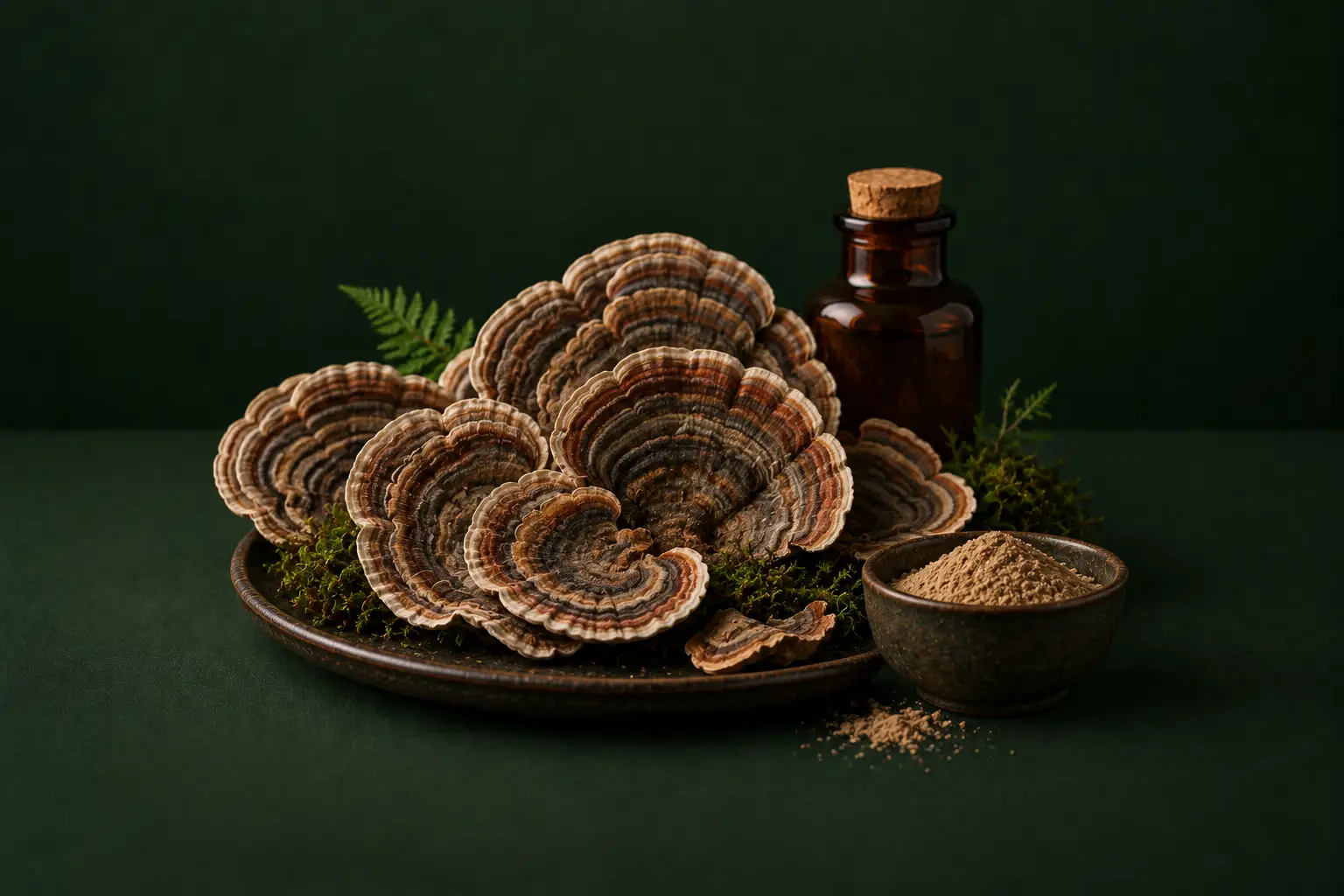
We have tried to describe the state of the research rather than the state of the marketing, which means this page is less exciting than most pages about this mushroom. Nothing here is medical advice, and nothing here should be read as a claim that this mushroom treats, prevents or cures any condition. If you are considering a supplement — particularly alongside prescription medication — that is a conversation with a clinician, not a website.
Trametes versicolor is a common bracket fungus that grows in overlapping fans on dead hardwood — it is probably the most abundant fungus in temperate forests worldwide. It is also the source of the two most-studied fungal preparations in modern medicine: PSK (polysaccharide-K, marketed in Japan as krestin) and PSP (polysaccharide peptide).
Unlike almost every other functional mushroom, this is not a story about cell cultures. PSK has been used in Japan for decades as an approved adjunct alongside conventional cancer treatment, and there is a substantial clinical literature — including randomised trials and meta-analyses — examining its use in that setting.
This is the part that matters, and it is the part that gets dropped:
So the honest statement is: a standardised turkey tail extract has been studied as a monitored adjunct to conventional cancer treatment, with results that led to its approval in Japan. That is a real and significant fact. It is not a basis for anyone to buy a supplement and self-treat a serious illness.
If you or someone close to you has cancer: this is a conversation for your oncology team, and only for them. Supplements can interact with chemotherapy and radiotherapy in ways that matter. Please do not act on a website — ours or anyone else’s.
Turkey tail is woody and not edible in any culinary sense — it is prepared as a long hot-water decoction or bought as an extract. The same label questions apply as for everything in this cluster: species in Latin, fruiting body or mycelium, extraction method, ratio, and beta-glucan percentage rather than total polysaccharide. See functional mushroom forms.
Turkey tail is extremely common on dead hardwood, including along the Front Range, and it is easy to identify — but it has lookalikes in the Stereum group, distinguished by the presence of pores on the underside in true Trametes. If you are collecting anything wild, read dangerous lookalikes first, and note that we sell nothing foraged.
Turkey tail deserves respect: it is the one functional mushroom where serious clinical research exists. It also deserves accuracy, and accuracy means saying clearly that the research is about a standardised pharmaceutical extract used under medical supervision alongside conventional treatment. Selling a wellness product on the back of an oncology literature is the least defensible thing in this industry, and we would rather point at the distinction than blur it.
No, and nobody should read the research that way. A standardised extract called PSK has been studied and used in Japan as an adjunct alongside conventional cancer treatment. That is a very different claim, and any decision belongs with an oncology team.
Polysaccharide-K, a standardised pharmaceutical-grade extract of Trametes versicolor used in Japan for decades as an approved adjunct in cancer care. It is not the same as a turkey tail supplement from a shelf.
No. The clinical research used a specific standardised extract at defined doses under medical supervision. Commercial supplements vary widely in preparation and content.
Not in a culinary sense — it is woody and tough. It is prepared as a long hot-water decoction or taken as an extract.
Share this article
How to read this page We have tried to describe the state of the research rather than the state of the marketing, which means this

How to read this page We have tried to describe the state of the research rather than the state of the marketing, which means this

How to read this page We have tried to describe the state of the research rather than the state of the marketing, which means this
Grab a beginner-friendly kit and apply what you just read —
or start with our beginner’s guide to find the right first grow.