

- Scott Brenton
- 10 min read
A walk along Left Hand Creek in Longmont, Colorado, one October evening turned up an unexpected sight: a faint green glow coming off a rotting
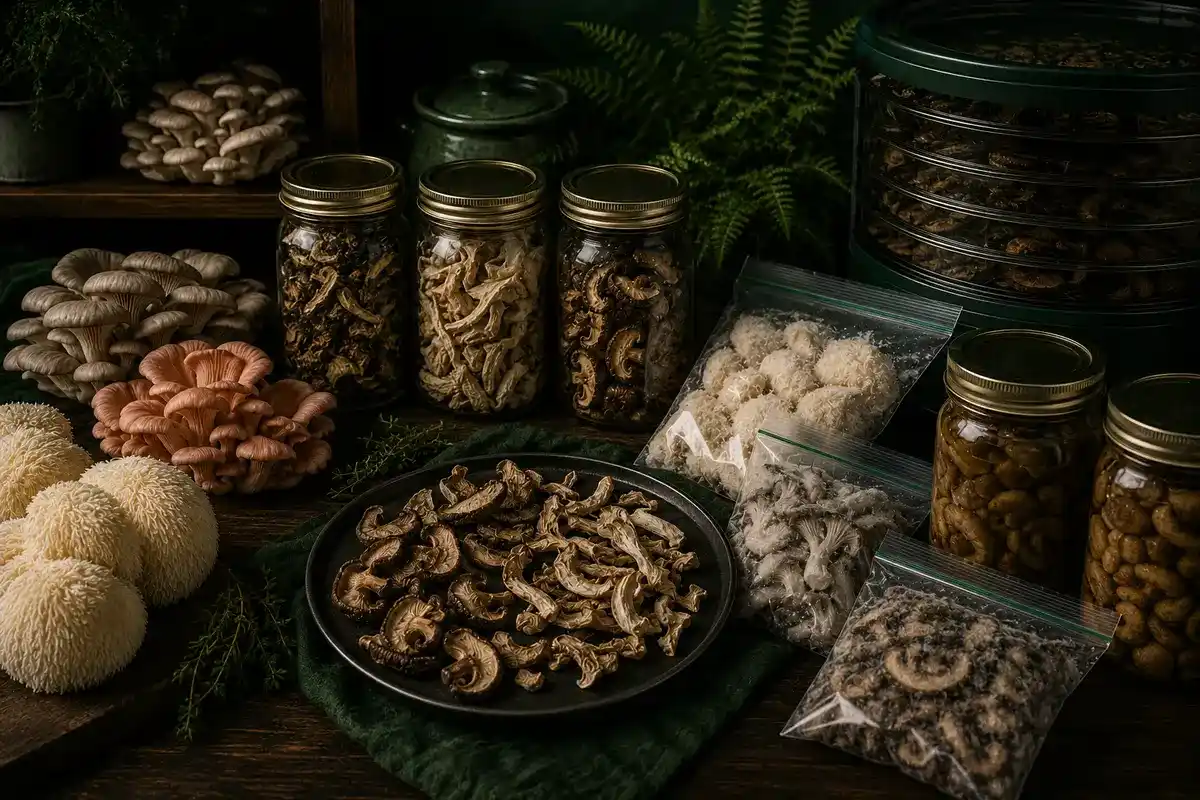
A pound of fresh Lion’s Mane can lose quality quickly when it sits unrefrigerated, going soft and faintly sour within a day, which is why learning how to preserve fresh mushrooms matters once a harvest is bigger than one meal. The short answer: dry them for the longest pantry life, freeze them for use within the year, and can plain mushrooms only with a pressure canner, since they are a low acid food and a water bath cannot reach a safe temperature for them. At Foxfire Mushrooms, this is one of the most common questions customers ask once their grow kits start producing, and it deserves an answer grounded in real food safety guidance rather than kitchen folklore.
Quick Facts — Best method for long term storage: drying – Dried mushroom pantry life: 1-2 years, best quality estimate – Frozen mushroom quality window: 10-12 months – Fresh mushroom fridge life: several days when refrigerated – Canning method for plain mushrooms: pressure canner only – Common drying temperature range: 110-135°F
Mushrooms run close to 90 percent water by weight, and unlike a potato or an onion, they have no real skin holding that moisture in. Once harvested, water escapes through the surface almost immediately, giving bacteria and mold an easy foothold. Refrigeration slows this but never stops it. A paper bag in the crisper drawer, not sealed plastic, generally helps mushrooms last longer than plastic would, since paper lets moisture escape instead of trapping it against the surface, though exactly how many days a batch keeps depends on variety, freshness at harvest, and how cold the fridge runs.
Past that window, one of the three methods below becomes necessary. None of the three methods reverse spoilage that has already started. Mushrooms with slimy patches, dark wet spots, or a sour smell should be discarded rather than dried, frozen, or canned, since preservation slows further decay but does not undo it.
The right method depends on how the mushrooms will be used later, how much time is available, and what equipment is already in the kitchen. Storing fresh mushrooms in the fridge only buys a few days, so once a bigger harvest needs to last, the choice comes down to three paths. Drying is the most forgiving and gives the longest pantry life. Freezing keeps more of the original bite but eats freezer space. Canning demands the most equipment and care, and it is the one method where a shortcut becomes an actual health risk.
| Method | Typical Shelf Life | Equipment Needed | Best For | Texture After Storage |
| Drying | 1 to 2 years, best quality | Dehydrator or low oven | Soups, broths, powders, long term pantry storage | Chewy, needs rehydrating |
| Freezing | 10 to 12 months | Freezer, sheet pan, bags | Sautéed dishes, stir fries, sauces | Softer, slightly watery |
| Canning | 12 to 18 months, best quality | Pressure canner, jars | Shelf stable pantry storage | Very soft, fully cooked |
Drying does not require specialized equipment, and it is the method most Foxfire customers land on once they see how long a dried batch lasts. Dehydrating mushrooms at home really comes down to two variables: slice thickness and temperature. Slice mushrooms evenly, about a quarter inch thick, so they finish at the same time instead of some pieces drying while others stay tacky.
Most dehydrator guides and extension sources put the working range for culinary mushrooms between 110°F and 135°F. Exact drying time varies by dehydrator model, mushroom variety, slice thickness, airflow, and how much moisture the batch started with, so it is worth following the dehydrator manufacturer’s guidance and checking mushrooms periodically rather than relying on one universal time. Firmer mushrooms like Shiitake take eight to ten hours, while something delicate like Pink Oyster can finish in six. Without a dehydrator, an oven propped open with a wooden spoon, on its lowest setting, works reasonably well, though most home ovens cannot reach that lower range, trading some flavor for convenience.
Mushrooms are ready when a piece snaps cleanly instead of bending. If it bends at all, it needs more time, since remaining moisture becomes a mold risk once sealed. Let pieces cool completely before storing, since warm mushrooms release condensation inside a closed container, undoing hours of drying in an afternoon. Store cooled, fully dry mushrooms in a glass jar with a tight lid, labeled with the drying date, away from light.
For storage beyond a year, a food grade oxygen absorber packet inside the jar can help slow flavor loss by limiting oxidation, or the sealed jar can be kept in the freezer instead of the pantry for an extra buffer against staleness. Properly dried mushrooms can maintain good quality for a year or longer when stored airtight in a cool, dark place, although actual storage life depends on how thoroughly they were dried and how well they are protected from moisture, so the one to two year range commonly cited in preservation guides is a best quality estimate rather than a hard cutoff.
As a rough rule of thumb commonly cited in cooking and preservation guides, it takes somewhere around ten pounds of fresh mushrooms to produce one pound dried, since roughly 90 percent of the starting weight is water. The exact ratio varies by variety and moisture content, with watery mushrooms like Oyster and Lion’s Mane generally losing a bit more weight than denser varieties like Shiitake, though exact figures are not tightly standardized across sources.
When a recipe calls for fresh mushrooms but only dried are on hand, a commonly used rough substitution is about one ounce of dried for every eight ounces of fresh, since the flavor concentrates as the water leaves. Fully dried mushrooms can also be ground into a powder in a spice grinder for stocks and seasoning blends, and stored the same way, airtight and away from light.
Technically yes, but raw frozen mushrooms turn rubbery and release a surprising amount of water once thawed, a texture change generally attributed to ice crystals forming inside the cells and rupturing their walls as water freezes. That is fine for a broth, but disappointing in a sauté where texture matters. For a deeper walkthrough of freezer prep and storage timing, see How to Freeze Fresh Mushrooms for Long Term Storage.
The National Center for Home Food Preservation recommends a steam blanch before freezing, timed by size: about five minutes for whole mushrooms, three and a half minutes for buttons or quarters, and three minutes for slices. This deactivates the enzymes responsible for flavor and color loss in the freezer. Many home cooks instead use a dry pan sauté until the mushrooms release moisture and shrink slightly, then cool before freezing.
The blanch is the tested method behind the official guidance, while the sauté is a flavor preference some cooks default to since nothing gets rinsed away in water. Whichever method is used, spread the pieces on a sheet pan and freeze solid before bagging, labeled with the date, so a handful can be pulled out later instead of a frozen brick. Mushrooms thawed in the refrigerator can be safely refrozen if needed, though quality drops each time; mushrooms left out at room temperature to thaw should be cooked rather than refrozen raw.
Canning at home is the one method where a shortcut can genuinely cause harm, so canning mushrooms safely really comes down to two non-negotiables. Plain mushrooms are a low acid food, in the same category as green beans or carrots, and should be pressure canned using a tested process; a water bath does not reach a high enough temperature to destroy the bacteria responsible for botulism in low acid foods. The one documented exception is a specifically tested acidified recipe, where whole mushrooms are marinated in a vinegar solution first, which the National Center for Home Food Preservation does allow to be processed in a boiling water bath canner.
Outside of following that exact tested recipe, plain mushrooms need a pressure canner. The National Center for Home Food Preservation is also explicit that only cultivated, domestic mushrooms with short stems and unopened caps should be canned. Foraged or wild mushrooms are not recommended, since their density and moisture vary too much to guarantee heat reaches every part of the jar evenly.
Trim and soak the mushrooms in cold water for ten minutes, then boil for five minutes before packing hot into jars with an inch of headspace. NCHFP guidance calls for processing half pints or pints forty five minutes in a pressure canner, at a pressure that varies by elevation. After the jars cool, check that the lids have sealed properly by pressing the center of each one. A sealed lid confirms the jar is airtight, but it does not by itself prove the contents were safely processed; the tested time, pressure, jar size, and elevation adjustment are what actually determine whether the mushrooms are safe, so a seal check is a useful step, not a substitute for following the process correctly.
Any jar that did not seal should go straight into the refrigerator and be used within a few days, not stored on a shelf. New to canning should work from the USDA Complete Guide to Home Canning or the NCHFP website directly rather than improvising. Before opening a stored jar later, check it for a bulging or leaking lid, cloudy liquid, or spurting when opened. Any of those signs, or an off smell once opened, means the jar should be discarded without tasting it, since botulism toxin cannot be detected by taste or smell alone.
Drying concentrates flavor, part of why dried Shiitake tastes deeper and almost meaty compared to fresh. Freezing holds flavor reasonably well but softens texture. Canning changes texture the most, since the mushrooms finish fully cooked, though flavor holds up better than expected. Any cooking based preservation method can reduce some heat sensitive nutrients, such as certain B vitamins, though exactly how much varies by method and mushroom variety; fiber and most minerals are generally more heat stable.
Excess surface moisture going into the dehydrator can add drying time and lead to uneven results. Harvest mushrooms when practical rather than right after misting or heavy humidity, gently wipe away any visible surface moisture before slicing, and arrange the pieces in a single layer with space between them so air can circulate around each one. None of this replaces checking for doneness by the snap test, but it helps a batch finish more evenly.
Soak dried mushrooms in warm water for twenty to thirty minutes, then save the soaking liquid, since it carries a surprising amount of flavor and works well as a soup or risotto base. Squeeze out excess water before adding them to a dish, or they will water down a sauce. Dried mushrooms rarely match the texture of fresh ones in a quick sauté, but they shine in slow cooked dishes, where concentrated flavor has time to spread through the pot.
Preservation only pays off when there is a good harvest behind it, and once the basics of how to preserve fresh mushrooms are second nature, a bigger flush stops feeling wasteful. A Foxfire grow kit produces a first flush within seven to fourteen days, enough for a fresh meal with plenty left over to dry or freeze using the methods above. Growers looking to scale up beyond a single kit can start from grain spawn or a liquid culture syringe, and every order over $75 ships free. For a harvest large enough to justify a full canning session, a grower consultation can help plan flush timing so mushrooms are ready in batches rather than all at once. Shop the current grow kits to start the next flush.
Many fresh mushrooms are best used within several days when refrigerated, though storage life varies by variety, freshness at purchase or harvest, and how the fridge is running. A paper bag helps more than sealed plastic, since it lets excess moisture escape instead of trapping it against the surface.
No, not for plain mushrooms. Mushrooms are a low acid food and require a pressure canner to reach the temperature needed to destroy the bacteria that causes botulism. The one exception is a specifically tested acidified recipe, where mushrooms are marinated in vinegar first; outside of following that exact recipe, a water bath canner cannot reach a safe temperature for plain mushrooms.
A light wipe with a damp cloth, or a quick rinse and pat dry, is usually enough. Soaking first just adds moisture that has to be removed again during drying or blanching.
Blanching or sautéing before freezing generally gives better results than freezing mushrooms raw, especially for anything headed into a cooked dish. Blanching is the NCHFP tested method for preserving color and quality, while sautéing is a commonly used alternative preparation.
Check for softness, visible moisture, or a musty smell, which usually means moisture got into the container at some point. Properly dried mushrooms stay brittle and smell earthy, not stale or damp.
Yes. Homegrown mushrooms from a kit, whether Blue Oyster, Lion’s Mane, or Shiitake, preserve the same way as anything from a grocery store. Freshness at harvest gives homegrown mushrooms a slight edge, since shipping related moisture loss has not happened yet.
Shiitake and other firmer varieties dry exceptionally well and develop deep, savory flavor. Softer varieties like Oyster can dry fine too, but many growers prefer freezing them after a quick sauté to hold onto their delicate texture.
Share this article
A walk along Left Hand Creek in Longmont, Colorado, one October evening turned up an unexpected sight: a faint green glow coming off a rotting

A countertop covered in mushrooms after a strong flush is a familiar problem for home growers, and the question that follows just as fast is

Restaurant owners, small farms, and shop buyers researching wholesale mushrooms Colorado sourcing usually land on the same question after scrolling past the marketing page: what
Grab a beginner-friendly kit and apply what you just read —
or start with our beginner’s guide to find the right first grow.