

- Scott Brenton
- 4 min read
Why the format matters more than the species People choose a functional mushroom by name — lion’s mane, reishi, cordyceps — and then buy whichever
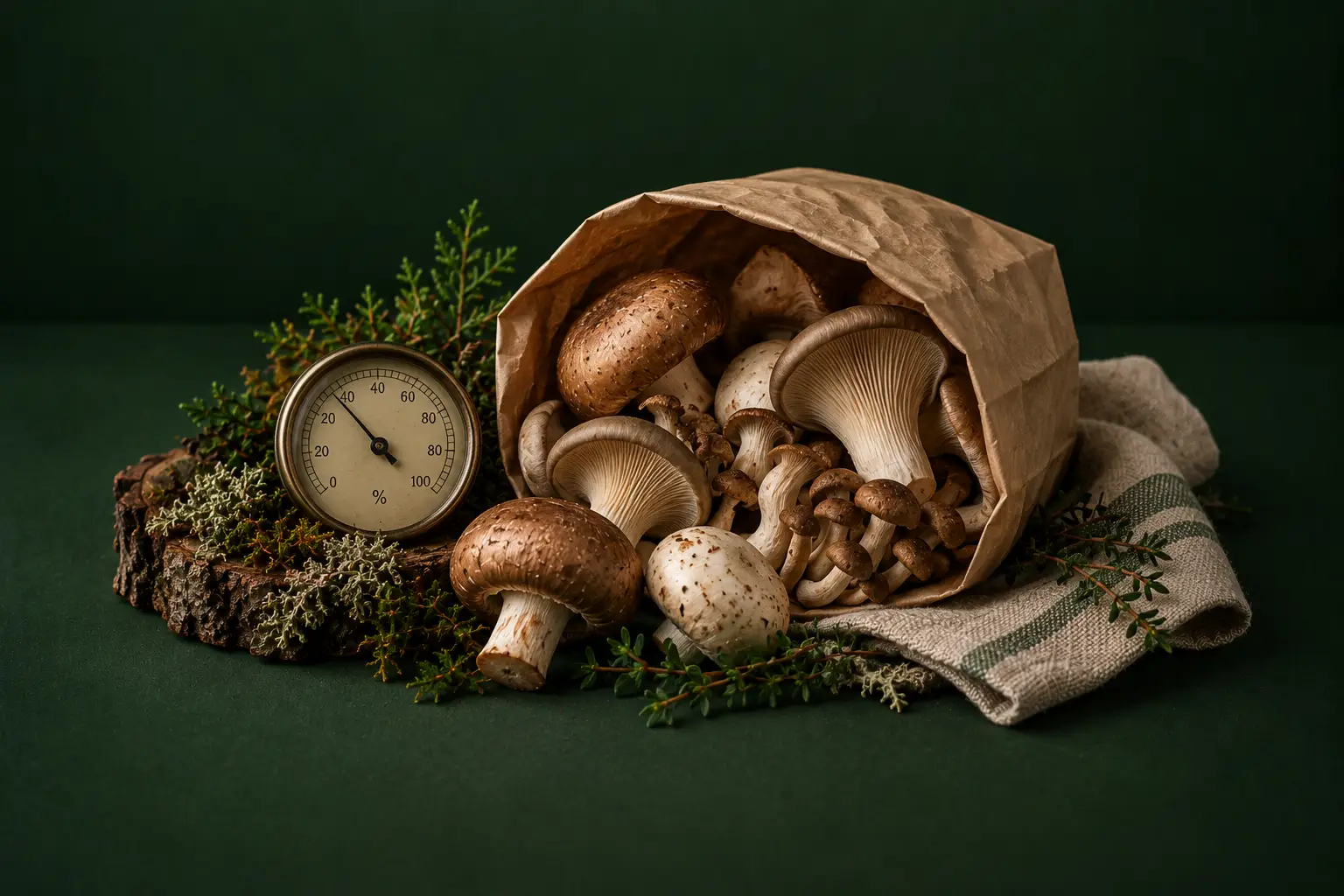
Colorado’s air is dry, and in winter with the heating on, indoor relative humidity on the Front Range routinely sits between 20 and 30%. A frost-free refrigerator is drier still, because the defrost cycle continually pulls moisture out of the compartment.
The result: mushrooms here usually dry out before they slime. The paper-bag advice that saves mushrooms in Houston can accelerate water loss in Longmont, because paper wicks moisture away from a mushroom that had little to spare.
The principle does not change — cold, breathing, single layer, never sealed plastic. What changes is the towel.
Watch for wrinkling rather than slime. If your mushrooms are going wrinkly and light rather than wet and sour, you have a dry-storage problem, and a damp towel fixes it.
Air-drying genuinely works here. Sliced mushrooms on a cooling rack in a warm room will dry to a snap in two or three days with no dehydrator, no oven and no energy cost — something that is simply not possible in most of the country. It makes drying the default way to handle surplus on the Front Range rather than a project. Method on drying mushrooms at home.
Dry air also means slime is rare. If you get it, look at the packaging first — it will nearly always be plastic.
At 5,000 feet water boils at about 203°F, which changes blanching and boiling times for most vegetables. For mushrooms it barely matters, because almost every good mushroom technique is dry-heat: searing, roasting, grilling. Altitude does make evaporation faster in the pan, which is helpful — mushrooms brown a little more readily here than at sea level, since the water leaves faster.
The one real altitude effect is on your fridge and your counter, not your stove. Everything else on the main storage guide holds.
Yes. Indoor humidity on the Front Range is often 20–30%, and frost-free refrigerators are drier still, so mushrooms here typically wrinkle and lose water before they ever go slimy.
In a dry climate like Colorado, barely damp. In a humid climate, dry. The towel is there to buffer humidity in whichever direction your air is wrong.
Usually not — but at Front Range humidity it often is, because the ambient air is so dry. This is the one storage rule that reverses at altitude.
Barely, because mushroom cooking is dry-heat. Evaporation is faster at 5,000 feet, which actually helps them brown. Boiling-point changes matter for vegetables, not for a seared mushroom.
Share this article
Why the format matters more than the species People choose a functional mushroom by name — lion’s mane, reishi, cordyceps — and then buy whichever

What they are Beta-glucans are polysaccharides — long chains of glucose molecules — that form part of the structural cell wall of fungi. They also

What mushroom fibre actually is Plant fibre is largely cellulose. Fungal cell walls are built from chitin — the same polymer as an insect exoskeleton
Grab a beginner-friendly kit and apply what you just read —
or start with our beginner’s guide to find the right first grow.