

- Scott Brenton
- 3 min read
What it is Ganoderma lucidum, called reishi in Japan and lingzhi in China. It fruits either as a fan-shaped bracket with a glossy, lacquered red-brown
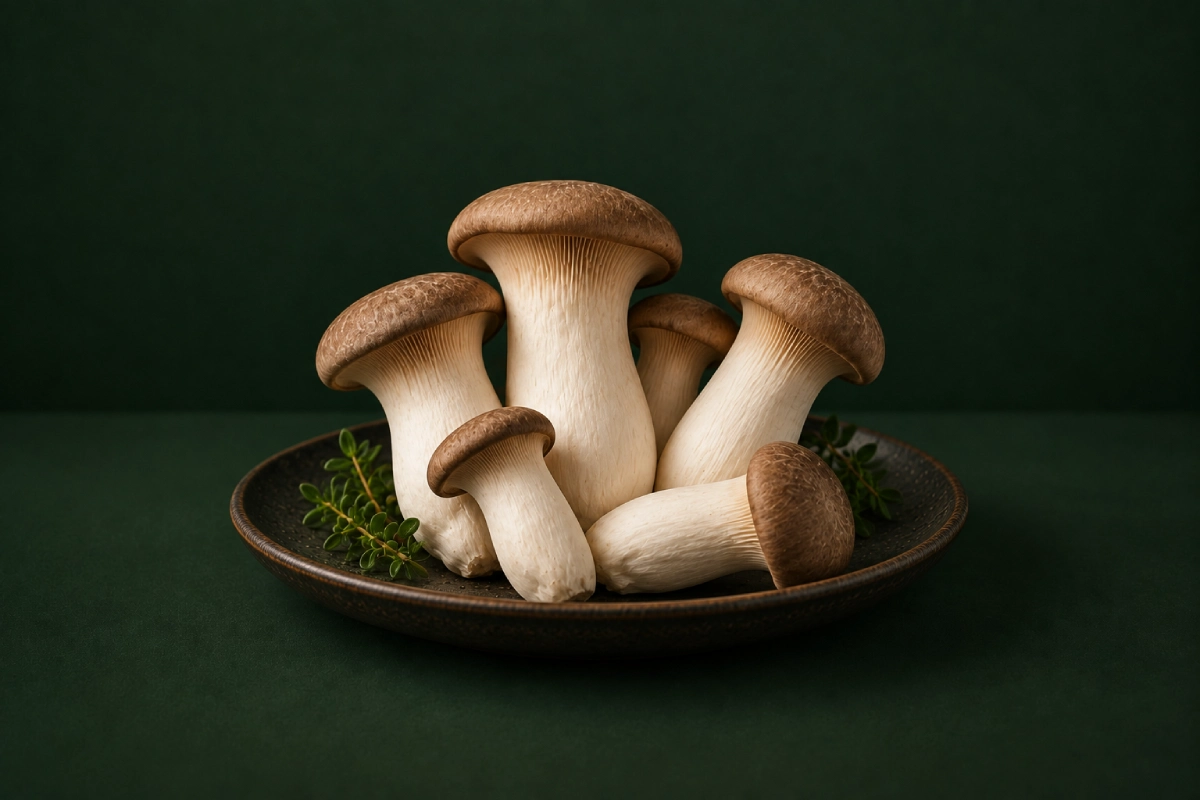
Pleurotus eryngii — king oyster, king trumpet, eryngii. It looks nothing like the rest of its family: a single thick white stem with a small tan cap, grown one to a bottle or in small clusters. Almost all the eating is in the stem, which is dense, uniform and pure white, and it behaves in a pan far more like a scallop or a pork chop than a mushroom.
It is also the outlier on shelf life. Seven to ten days in a proper fridge, and it firms up rather than softening — the only species we grow that is arguably better on day four than day one.
Sweet and savoury with a distinct abalone or scallop character, more umami than any oyster and completely without the earthiness of shiitake. The dense flesh means it takes colour beautifully and holds a shape through anything.
The scallop cut is the reason this species has a following. Cut the stem into inch-thick coins, score a shallow crosshatch on both faces, salt them, sear hard in a dry pan, then add butter and baste. Six or seven minutes and you have something you can serve on a tasting menu.
Salt it before it goes in the pan, not after. Unlike thin-fleshed species, king trumpet has enough density that early salt draws surface moisture out and helps the crust rather than turning it grey.
Trim a thin slice off the base and that is it — trim loss around 2%, the lowest of any species we grow, and the reason it is often the cheapest mushroom per usable pound despite a higher shelf price. A pound yields roughly twelve to fourteen scallop coins, or four generous centre-of-plate portions. Chefs can model this against every other species in the plate-cost calculator.
Seven to ten days at 34–38°F, unwrapped or in paper, in the crisper. It tolerates being stored whole better than any other species; portion it to order rather than pre-cutting, since a cut face is a spoilage surface.
Year-round, every week, and one of our two deepest lines. It is the species most restaurant accounts standardise on because the shelf life fits real ordering cycles — see the chef notes and the price sheet for volume breaks.
None — they are two names for Pleurotus eryngii. King trumpet, king oyster and eryngii all describe the same thick-stemmed species.
Cut the stem into inch-thick coins, crosshatch both faces shallowly, salt, and sear in a hot dry pan until deeply coloured. Add butter, thyme and garlic and baste for the last two minutes.
Seven to ten days at 34–38°F, longer than any other gourmet species. They firm up as they age rather than going soft.
Yes, cap and stem. Only a thin slice off the base gets trimmed — usable yield is about 98%.
Share this article
What it is Ganoderma lucidum, called reishi in Japan and lingzhi in China. It fruits either as a fan-shaped bracket with a glossy, lacquered red-brown

What it is Hypsizygus tessulatus — beech mushroom, shimeji, buna-shimeji in its brown form and bunapi in the white. Grown in tight bouquets of fifty

What it is Black pearl is a Pleurotus hybrid — usually credited as a cross of ostreatus and eryngii — grown for the best traits
Grab a beginner-friendly kit and apply what you just read —
or start with our beginner’s guide to find the right first grow.