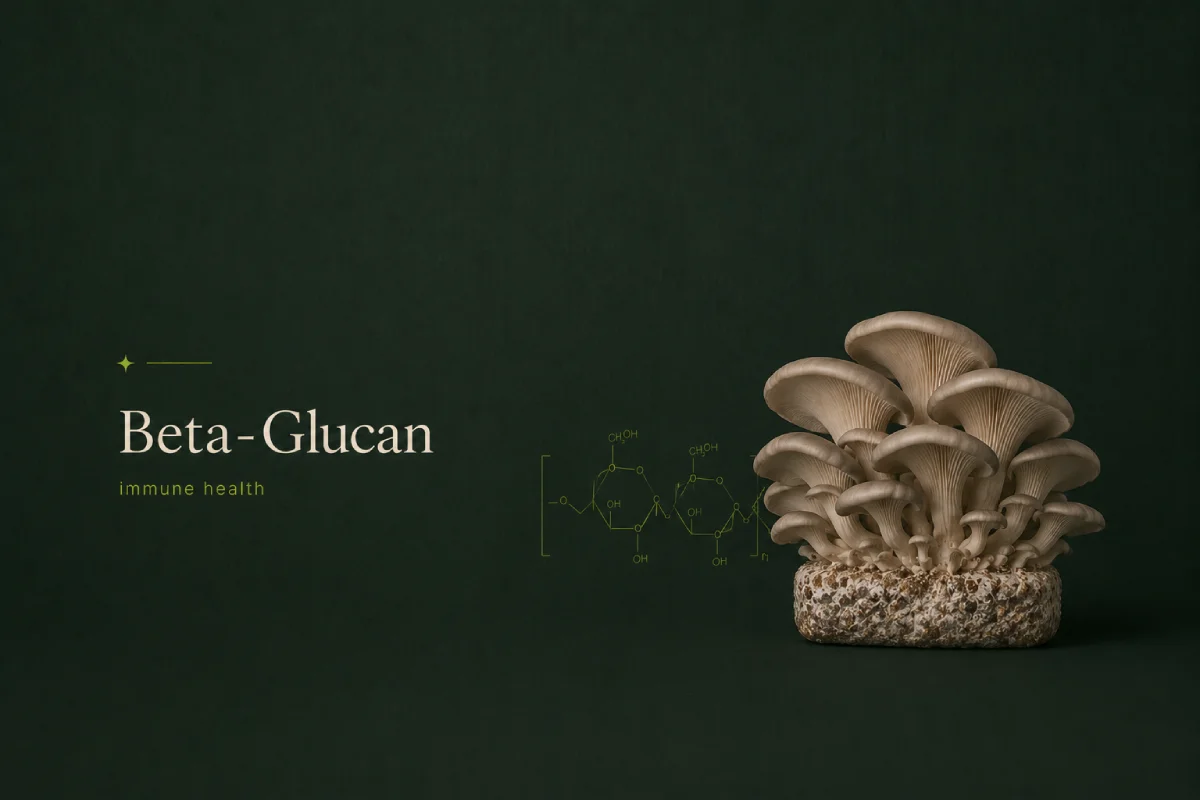
Beta-glucans are long-chain polysaccharide molecules found in the cell walls of fungi, oats, barley, and yeast. In mushrooms specifically, beta-1,3-glucans and beta-1,6-glucans are the forms most studied for their interactions with immune cell receptors — particularly the Dectin-1 receptor found on macrophages, dendritic cells, and natural killer (NK) cells. These compounds are one of the primary reasons functional mushrooms like Turkey Tail, Reishi, Lion’s Mane, and Shiitake have attracted sustained scientific interest over the past several decades.
At Foxfire Mushrooms in Longmont, Colorado, we think understanding the underlying science makes you a better grower and a more informed consumer. This guide walks through what beta-glucans actually are, where they come from inside the mushroom, how researchers understand their interaction with the immune system, and what to look for when evaluating the quality of mushroom products.
Beta-glucans are a family of naturally occurring polysaccharides — large molecules made up of long chains of glucose (sugar) units. The word “beta” refers to how those glucose units are linked together at the molecular level (specifically at the 1,3 or 1,4 carbon positions), which distinguishes them from other glucose polymers like starch or cellulose.
You’ll find beta-glucans in several food sources:
The structure isn’t just a molecular curiosity. It determines how the body recognizes and interacts with the molecule. Mushroom beta-glucans and oat beta-glucans have different structures, interact with different receptors, and have been studied for quite different physiological roles — a distinction we’ll cover in the next section.
In functional mushrooms, beta-glucans are concentrated primarily in the cell walls of the fruiting body and are among the compounds most associated with the immune-related research interest in species like Turkey Tail, Reishi, Shiitake, Lion’s Mane, and Oyster mushrooms.
The term “beta-glucan” is often used as if it describes a single compound. It doesn’t. The beta-glucan family includes structurally distinct molecules that behave differently in the body and have been studied for different reasons.
Mushroom beta-glucan (beta-1,3/1,6-glucan) features a backbone of glucose units linked at the 1,3 carbon position with branches extending from the 1,6 position. This branched structure is key to its interaction with immune cell receptors — specifically Dectin-1, a pattern-recognition receptor that evolved to detect fungal cell walls. This is the beta-glucan found in Turkey Tail, Reishi, Shiitake, Lion’s Mane, and other functional mushrooms.
Oat beta-glucan (beta-1,3/1,4-glucan) has a predominantly linear structure with 1,3 and 1,4 linkages. The FDA has authorized a qualified health claim for oat beta-glucan and cholesterol levels, based on its ability to form a gel in the digestive tract and affect how bile acids are reabsorbed. This is a completely different mechanism from mushroom beta-glucan’s immune receptor interaction.
The important takeaway: when you see “beta-glucan” on a product label, the source matters enormously. A supplement emphasizing its beta-glucan content from mushrooms is making an entirely different kind of claim — and describing a different kind of compound — than oat beta-glucan fiber products. They are not interchangeable, and conflating them can lead to significant misunderstanding.
When evaluating mushroom products, look specifically for beta-1,3-glucan or mushroom beta-glucan with a stated percentage of beta-glucan content from an identified mushroom source.
The immune system has a category of receptors called pattern recognition receptors (PRRs) — molecular sensors on the surface of immune cells that detect structural patterns associated with microbes, fungi, or other foreign material. One of the most important PRRs for mushroom beta-glucans is Dectin-1.
Dectin-1 is expressed on the surface of macrophages, dendritic cells, and natural killer (NK) cells — immune cell types involved in what’s called innate immunity, the body’s first-line, non-specific defense system. Dectin-1 evolved, in part, to recognize the beta-1,3-glucan structures in fungal cell walls — essentially, to detect the presence of fungi in the body.
When mushroom beta-1,3-glucans bind to Dectin-1, research has shown this triggers downstream signaling pathways that can influence immune cell activation and the expression of certain cytokines (chemical messengers used for immune communication). Research published in journals including Frontiers in Immunology, Carbohydrate Polymers, and the Journal of Biological Chemistry has explored these interactions in considerable depth.
Studies have explored the role of mushroom beta-glucans in supporting normal immune surveillance — the ongoing process by which the immune system monitors for foreign material and maintains readiness.
These statements have not been evaluated by the Food and Drug Administration. This product is not intended to diagnose, treat, cure, or prevent any disease.
It’s important to frame this accurately: researchers are studying how beta-glucans interact with immune signaling pathways, not making blanket claims that mushrooms “boost immunity.” The immune system is complex, and the research is ongoing. What the evidence does suggest is that the structural interaction between mushroom beta-glucans and Dectin-1 is real, reproducible, and an active area of scientific investigation.
Beta-glucan concentration varies significantly by species, growing conditions, and how the mushroom is processed. The figures below represent ranges reported in peer-reviewed research on dried fruiting body material — actual product content will vary.
| Species | Beta-Glucan (% dry weight, approx.) | Key Compound | Research Focus |
| Turkey Tail (Trametes versicolor) | ~35–45% | PSK (krestin), PSP | Immune function, gut health |
| Shiitake (Lentinula edodes) | ~30–40% | Lentinan | Immune modulation |
| Oyster (Pleurotus ostreatus) | ~25–30% | Beta-glucan complex | Immune function, cholesterol research |
| Reishi (Ganoderma lucidum) | ~20–30% | Beta-glucan + ganoderic acids | Immune support, adaptogenic properties |
| Lion’s Mane (Hericium erinaceus) | ~20–25% | Beta-glucan complex | Neuroprotective and immune research |
| Chaga (Inonotus obliquus) | ~10–20% (variable) | Beta-glucan + betulinic acid | Antioxidant, immune research |
Turkey Tail and Shiitake consistently rank among the highest beta-glucan-containing mushrooms by dry weight, which is one reason they have attracted the most research attention for immune-related applications. Reishi, while somewhat lower in beta-glucan concentration than Turkey Tail, is also rich in triterpenes (ganoderic acids) that contribute to its distinct research profile.
Beta-glucans are structural components of the fungal cell wall — the rigid outer layer that gives mushroom cells their shape and integrity. The fungal cell wall is primarily composed of chitin (the same material found in crustacean shells) and beta-glucans, which are interlinked in a matrix that provides both structural support and protection.
This chitin-glucan matrix is one of the distinguishing features of fungi as a kingdom — neither plant nor animal, fungi have a cell wall chemistry that’s unique to them. The beta-glucan component of this wall is what the Dectin-1 receptor on immune cells has evolved to recognize.
The fruiting body — the visible above-ground portion of the mushroom — is densely packed with this cell wall material across its cap, gills (or pores), and stem. This is why fruiting body products consistently show higher beta-glucan concentrations than products derived from mycelium, which has thinner, less-developed cell wall structures and may not have the same compound profile as the mature fruiting stage.
For cultivators, this underscores the importance of harvesting at the right stage. Mushrooms harvested at peak maturity (just before or as the veil breaks, for species that have one) typically have the highest cell wall density and therefore the highest beta-glucan content per gram.
This is one of the most practically important distinctions in the functional mushroom supplement market — and one of the most commonly misrepresented.
Whole fruiting body extracts are made from the mature mushroom cap and stem. They naturally contain high concentrations of beta-glucans within the chitin-glucan cell wall matrix. When hot water extracted (see next section), these beta-glucans become bioavailable.
Mycelium-on-grain (MOG) products are made by growing mushroom mycelium on a grain substrate — typically brown rice or oats — then drying and powdering the entire mass, grain included. The resulting powder contains a mixture of mushroom mycelium and undigested grain starch. Research has found that MOG products often contain significantly lower beta-glucan concentrations than fruiting body extracts, while polysaccharide readings may appear artificially elevated because starch (also a polysaccharide) is counted in some testing methods.
How to evaluate a mushroom supplement label:
When Foxfire’s functional mushroom supplements launch, we’ll publish full transparency on compound sourcing, extraction method, and beta-glucan percentage for each product.
Beta-glucans are water-soluble — but they’re locked inside the chitin matrix of the mushroom cell wall, and chitin is not digestible by humans. This means that simply eating raw or dried mushroom powder doesn’t guarantee your body can access the beta-glucans inside.
Hot water extraction solves this problem. By applying high-temperature water (typically simmering or near-boiling) to dried mushroom material over an extended period, the chitin matrix is broken down and beta-glucans are released into the water in a form that’s bioavailable. This is why traditional mushroom preparations — Reishi tea, broth-based preparations — have persisted across cultures: the cooking process accomplishes what your digestive system cannot.
Raw dried mushroom powder retains its nutritional content (protein, fiber, micronutrients) but may have significantly lower bioavailable beta-glucan than an equivalent dose of hot water extract.
Dual extraction takes this a step further for species like Reishi that contain both water-soluble compounds (beta-glucans) and alcohol-soluble compounds (ganoderic acid triterpenes). A true dual extract uses both hot water and ethanol extraction to capture the full range of bioactive compounds. A product labeled “Reishi extract” should specify whether it’s a water extract, alcohol extract, or dual extract — each captures a different compound profile.
For cultivators who brew their own teas or decoctions at home, this is good news: a proper hot water preparation of Reishi, Turkey Tail, or Shiitake is a genuinely effective way to access their beta-glucan content. See our mushroom colonization times chart for cultivation timing context, and our Turkey Tail mushroom guide for harvest-to-preparation guidance.
Two specific beta-glucan-derived compounds from mushrooms have accumulated particularly large research bodies:
PSK — also known by the brand name Krestin — is a protein-bound beta-glucan compound isolated from Trametes versicolor (Turkey Tail). It has been the subject of extensive research in Japan since the 1970s, where it became one of the most-researched natural compounds in the country’s biomedical literature.
Research has explored the role of PSK in immune modulation and its potential interactions with immune surveillance mechanisms. Studies published in journals including the Journal of Immunology and Biological & Pharmaceutical Bulletin have characterized its structure and the pathways it appears to influence. PSK research represents some of the most rigorous clinical-level investigation of any mushroom compound globally.
Research has explored the role of PSK in supporting normal immune function. These statements have not been evaluated by the Food and Drug Administration. This product is not intended to diagnose, treat, cure, or prevent any disease.
For more on Turkey Tail, see our Turkey Tail and immune support article (coming soon) and our full Turkey Tail mushroom guide.
Lentinan is a specific beta-1,3-glucan isolated from Lentinula edodes (Shiitake). It has a well-characterized molecular structure and has been studied extensively in Japan, where it has been used as a prescription agent in specific clinical contexts since the 1980s.
Research on lentinan has explored its interactions with Dectin-1 and downstream immune pathways, and it has been among the most structurally well-characterized of any mushroom polysaccharide. Cultivating your own Shiitake is one of the most accessible ways to incorporate this species into your diet. See our Shiitake mushroom cultivation to get started.
Research has explored the role of lentinan in immune function. These statements have not been evaluated by the Food and Drug Administration. This product is not intended to diagnose, treat, cure, or prevent any disease.
One of the most compelling arguments for home mushroom cultivation is that it gives you access to fresh, whole fruiting body material — exactly the material with the highest beta-glucan concentration, harvested at peak maturity, with no supply chain uncertainty about extraction methods or compound dilution.
Foxfire Mushrooms, based in Longmont, Colorado, carries spawn for the four functional species with the strongest beta-glucan research profiles:
When you grow your own, you also control the substrate, the harvest timing, and the post-harvest handling — all factors that influence final beta-glucan content in your material.
For those who want to go deeper into the functional health research behind these species, our functional mushrooms and health benefits hub is your starting point.
Understanding the science behind beta-glucans is one thing — growing the source yourself is another level entirely. Foxfire Mushrooms in Longmont, Colorado carries spawn for Turkey Tail, Reishi, Shiitake, Lion’s Mane, and Oyster mushrooms, so you can cultivate whole fruiting body material right at home.
Explore Functional Mushrooms →
The highest beta-glucan food sources are functional mushrooms (particularly Turkey Tail, Shiitake, and Oyster), oats, and barley. Baker’s yeast also contains beta-glucans. Note that mushroom beta-glucans (beta-1,3/1,6 structure) and oat beta-glucans (beta-1,3/1,4 structure) are molecularly distinct and studied for different applications — they are not interchangeable.
No. While both are classified as beta-glucans, they have different molecular structures (different carbon linkage patterns), interact with different receptors in the body, and have been studied for different physiological roles. Oat beta-glucan is primarily studied for its effects on cholesterol absorption via fiber effects in the gut. Mushroom beta-glucan is primarily studied for its interaction with immune cell receptors, particularly Dectin-1. Conflating the two leads to significant misunderstanding of the research.
Research on effective doses of mushroom beta-glucan is still evolving, and dosing varies by species, extract concentration, and individual factors. Because these are dietary supplements regulated under DSHEA — not drugs — no standard therapeutic dose has been established by regulatory agencies. Consult a qualified healthcare provider or integrative medicine practitioner for guidance appropriate to your situation. Our forthcoming functional mushroom dosing guide will explore the available research on this question.
Turkey Tail (Trametes versicolor) consistently ranks among the highest in beta-glucan concentration by dry weight, at approximately 35–45% in well-prepared fruiting body extracts. Shiitake also ranks very high, and both have substantial research bodies behind their specific beta-glucan compounds (PSK and lentinan, respectively). For those also interested in triterpene content alongside beta-glucans, Reishi offers a distinctive dual-compound profile.
Eating cooked culinary mushrooms — Shiitake, Oyster, or Maitake — does provide beta-glucans, and cooking (especially with water or broth) does help break down the chitin matrix. However, the beta-glucan concentrations in concentrated extracts are significantly higher than in an equivalent gram weight of cooked mushroom. For culinary enjoyment and moderate dietary intake, eating mushrooms is excellent. For people seeking targeted functional use, a properly extracted supplement or a potent home-brewed decoction may be more practical.
Mushroom beta-glucans from culinary and functional species with long histories of human use — Turkey Tail, Reishi, Shiitake, Lion’s Mane, Oyster — are generally considered safe at normal dietary and supplemental doses. Individuals with autoimmune conditions, organ transplants, or who are on immunosuppressive medications should consult a healthcare provider, as compounds with immune-modulating properties under study may interact with those contexts. As with any supplement, start conservatively and seek professional guidance if you have any underlying health conditions.
Share this article
Grab a beginner-friendly kit and apply what you just read —
or take the quiz and we’ll match you to the right
starting point.
