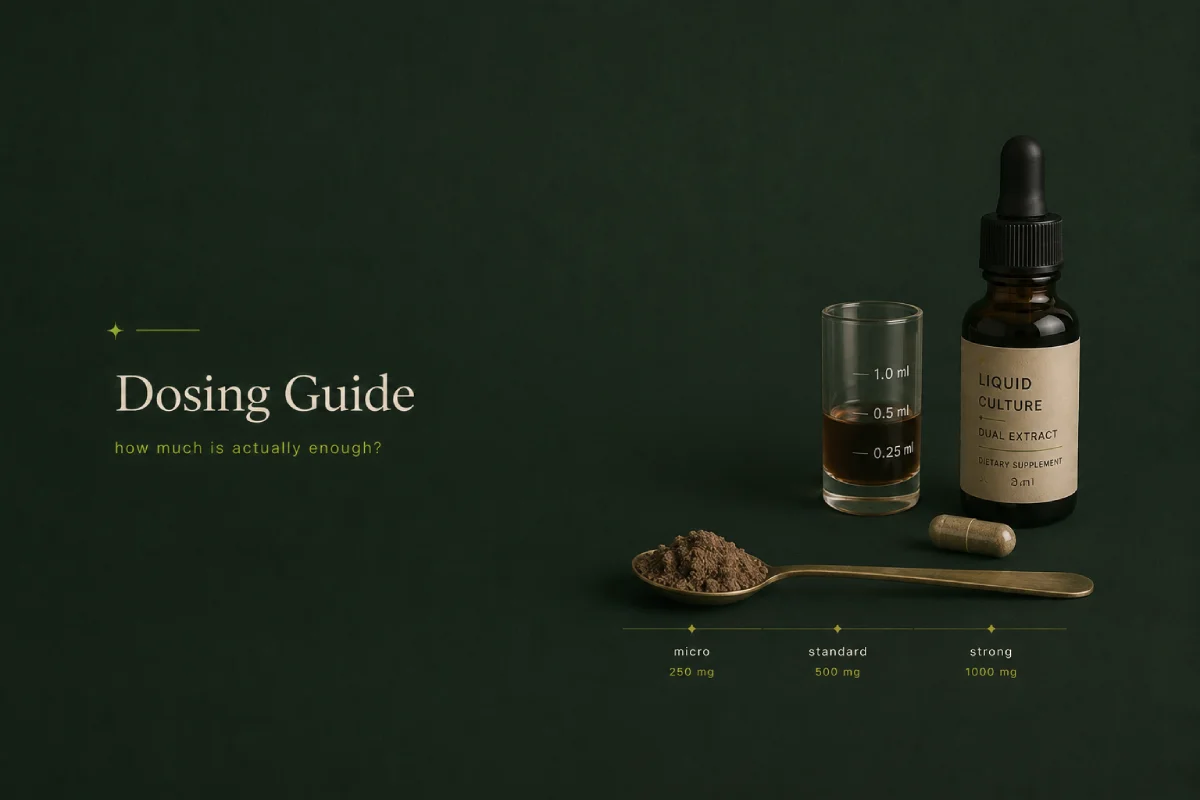
Functional mushroom dosing typically ranges from 500mg to 3g per day for dried mushroom equivalents, with tincture doses running 1–3ml (roughly 20–60 drops) once or twice daily. The exact amount depends on species, format, your body, and what you’re hoping to support. The most important principle isn’t hitting a precise number — it’s starting low, staying consistent, and giving your body several weeks to respond. Adaptogenic effects build gradually, not overnight.
Here at Foxfire Mushrooms in Longmont, Colorado, we get asked about dosing more than almost any other topic. This guide pulls together research-context doses, practical format comparisons, and honest guidance on what to expect — without the hype.
Important: This is a general reference guide based on published research literature. It is not medical advice and should not be treated as a prescription. Always consult a qualified healthcare provider before beginning any new supplement regimen, particularly if you are pregnant, nursing, immunocompromised, or taking prescription medications.
“These statements have not been evaluated by the Food and Drug Administration. This product is not intended to diagnose, treat, cure, or prevent any disease.”
General research-context doses for the most commonly used functional mushrooms fall in these ranges:
These figures reflect doses used in peer-reviewed human studies — they are not prescriptions. Your ideal starting point is the lower end of the range for your chosen species, used consistently for at least 2–4 weeks before assessing how you’re responding.
For a deeper look at what each species does and why people use them, see our overview of functional mushrooms and their health benefits.
Before diving into species-specific numbers, five principles apply across the board.
Begin at the lower end of the research-context range and stay there for 2–4 weeks before increasing. This gives your system time to acclimate and makes it easier to notice subtle effects — or any sensitivity.
A moderate daily dose taken every day outperforms a large dose taken sporadically. Functional mushrooms work as adaptogens, meaning their effects are cumulative. Missing one day is not a problem; a scattered routine is.
Taking mushroom supplements alongside a meal reduces the chance of GI sensitivity. For Reishi specifically, a small amount of healthy fat (avocado, nuts, olive oil) may improve absorption of its triterpene compounds.
Some wellness practitioners recommend cycling — for example, five days on and two days off, or three months on followed by one month off. The research base for cycling isn’t strong, but it’s a low-risk practice that may help some people stay attuned to subtle effects. It is entirely optional.
The following doses reflect research literature. They are general reference information, not medical prescriptions.
| Species | Dried Powder / Equivalent | Tincture (Dual-Extract) | Research Context Dose | Notes |
| Lion’s Mane | 500mg–3g/day | 1–3ml (20–60 drops) 1–2x/day | 1–3g/day in most human studies | Start low; rare users experience temporary fogginess at high initial doses |
| Reishi | 1–2g/day dried | 1–2ml 1–2x/day | 1.5–9g/day dried equiv. in studies | Wide range in literature; start at lower end; bitter at high doses |
| Turkey Tail | 1–3g/day dried | 1–3ml 1–2x/day | 3g/day PSK equivalent in Japanese studies | Very well tolerated; excellent starter species |
| Shiitake | 1–2g/day dried (supp. context) | N/A — tincture uncommon | 3–5g dried in studies | Often used as food; dose applies to supplement context |
| Chaga | 1–2g/day dried | 1–2ml 1–2x/day | Not yet standardized | High oxalate content — caution if you have a history of kidney stones |
| Cordyceps | 1–3g/day | 1–3ml 1–2x/day | 3g/day in most performance studies | Athletic performance and energy support context in most research |
The form your mushroom supplement takes affects the dose you need. Here’s why.
Dried Powder / Capsule
Dried mushroom powder (or the equivalent capsule) is essentially the whole mushroom, dehydrated and ground. Bioavailability depends on whether the cell walls have been broken down (hot water extraction significantly improves this). Doses are generally in the gram range.
Dual-Extract Tincture
A quality dual-extract tincture has been through both hot water extraction (for beta-glucans) and alcohol extraction (for triterpenes), concentrating the active compounds. This is why tincture doses are much smaller — 1–3ml delivers a meaningful amount of concentrated extract. If you’re curious about how this process works, our guide to making mushroom tinctures walks through it in detail.
Capsules
Capsules typically contain dried powder or a standardized extract. Read the label carefully — a 500mg capsule of whole dried mushroom is not equivalent to a 500mg capsule of standardized 10:1 extract. The extract capsule is considerably more concentrated.
Gummies
Gummies offer a fixed, consistent dose per piece and are convenient for people who dislike the taste of tinctures or can’t easily swallow capsules. The dose is baked into the formulation, so simply follow the product’s serving guidance.
For a side-by-side breakdown of how these forms compare, see our article on comparing mushroom supplement forms.
Lion’s Mane is the species most people reach for when cognitive support is their goal — focus, memory, and mental clarity are the most common reasons people start taking it. For more on what the research shows, see our in-depth piece on Lion’s Mane and cognitive function.
Starting dose: 500mg dried equivalent, or half a dropper of tincture (about 0.5ml).
Timing: Morning, with or just after breakfast.
One thing to know: A small number of people report a temporary “brain fog” sensation in the first week or two at higher doses. This appears to be an adaptation effect as neurons respond to nerve growth factor (NGF) stimulation. If it happens, reduce your dose — don’t abandon the species. Start even lower and work up slowly. It usually resolves within a week.
Reishi has one of the widest dose ranges in the literature — anywhere from 1.5g to 9g of dried equivalent per day appears in human studies. For most people starting out, beginning around 1g dried equivalent (or 1ml tincture) is sensible. There’s no need to rush to the high end.
Timing: Evening. Most people take Reishi 30–60 minutes before bed.
About the taste: Reishi is genuinely bitter at higher doses in dried form. A tincture blended into warm water or herbal tea is far more palatable for most people. Pairing it with a small amount of fat (a drizzle of coconut oil in your evening tea, for example) may improve absorption of its triterpene content.
For more on Reishi’s properties and how people use it, see our article on Reishi for stress and sleep.
Turkey Tail is arguably the most forgiving species to dose. It’s very well tolerated, even at higher amounts, and tends to be neutral in terms of energy. The Japanese clinical research used PSK (a purified polysaccharide from Turkey Tail) at roughly 3g/day equivalents, which gives a reasonable upper reference point.
Starting dose: 1g dried equivalent, or 1ml tincture once daily.
Timing: Either morning or evening — it’s not particularly stimulating or sedating.
Turkey Tail is an excellent first functional mushroom for someone who’s new to this space. If you want to understand more about why it’s so popular for immune support, our Turkey Tail immune support guide covers the research.
One of the most important things we tell customers at Foxfire is this: manage your expectations honestly. Functional mushrooms are not stimulants. They don’t produce dramatic, immediate effects. The experience is much more like the difference between how you feel after a month of good sleep versus a month of poor sleep — subtle, cumulative, and often more noticeable when you stop than when you’re taking them.
Here’s a rough timeline based on what consistent users commonly report:
The people who give up in week two miss most of the benefit. Consistency is the real active ingredient.
Please speak with a qualified healthcare provider before starting functional mushrooms if any of the following apply:
This list is not exhaustive. When in doubt, ask your provider. Functional mushrooms are generally well tolerated, but interactions are possible and individual health contexts vary widely.
Here’s how our Phase 2 functional line translates into practical serving sizes.
Lion’s Mane Tincture
Our standard dropper delivers approximately 1ml per full squeeze. One dropper (1ml) once or twice daily is a typical starting point. Add to morning coffee, tea, or water.
Reishi Tincture
Same dropper format — 1ml per full squeeze. Start with one dropper in the evening, added to warm (not boiling) water or herbal team.
Brain Bears™ Gummies
Follow the serving size listed on the product label. Brain Bears™ gummies are formulated for adults. Store out of reach of children.
Harmonic Honey
One teaspoon (approximately 7g) is a standard serving suggestion — in tea, drizzled on food, or straight from the jar. Use it wherever you’d use regular honey.
Dried Reishi 2oz / Dried Lion’s Mane 2oz
For tea or broth: use 2–4g of dried mushroom per cup, steeped for at least 20–30 minutes in near-boiling water. For culinary use in cooked dishes, amounts can be higher since you’re eating the whole mushroom.
Foxfire Mushrooms carries a full line of functional mushroom products — tinctures, dried mushrooms, Harmonic Honey, and Brain Bears™ gummies (store out of reach of children) — grown and sourced with care right here in Longmont, Colorado.
Once you’ve landed on your doses, the next step is figuring out how to actually fit them into your day. Our practical article on building a daily functional mushroom routine makes it simple.
You might also find it useful to revisit our Lion’s Mane mushroom guide and Reishi mushroom growing guide for deeper context on the species you’re working with.
Lion’s Mane is generally well tolerated, and there are no reported serious adverse events from high doses in healthy adults. That said, some people experience temporary fogginess or mild GI discomfort when jumping to high doses immediately. Starting at 500mg and working up gradually is the practical approach. More isn’t automatically better — consistency at a moderate dose tends to serve people better than chasing the highest possible amount.
There’s no strong clinical evidence requiring breaks, but some wellness practitioners recommend cycling — such as five days on and two days off, or taking a one-month break after three months of use. If you want to experiment with cycling, it’s low-risk. If you prefer simplicity and daily consistency, that’s well-supported too.
Yes — combining functional mushrooms is common practice and there are no known interactions between Lion’s Mane and Reishi. Many people take Lion’s Mane in the morning and Reishi in the evening, which also aligns with the different timing recommendations for each species. If you’re new to both, consider starting them at different times so you can track how each one affects you individually before combining.
No. Functional mushrooms aren’t habit-forming and there’s no dependency. Many people use them during specific periods — high-stress seasons, big creative projects, times when sleep quality matters most — and take breaks in between. Others incorporate them as a long-term daily practice. Either approach is reasonable.
Most research on functional mushrooms has been conducted in adults. There isn’t enough data to make confident recommendations for teenagers, and the safety profile in younger populations simply hasn’t been studied the same way. If a parent or guardian is considering mushroom supplements for a teenager, that conversation should happen with their pediatrician or healthcare provider.
Nothing significant. Missing a single day doesn’t undo progress. Adaptogenic compounds work through cumulative effect over time — one skipped day isn’t a reset. Just pick back up the next morning.
Some people do increase their Turkey Tail or Reishi intake when they feel under the weather, reasoning that immune-supporting compounds are particularly relevant in that moment. This is a personal choice rather than a clinical recommendation. If you are acutely ill, managing medications, or immunocompromised, speak with your healthcare provider before adjusting your supplement routine.
Share this article
Grab a beginner-friendly kit and apply what you just read —
or take the quiz and we’ll match you to the right
starting point.
