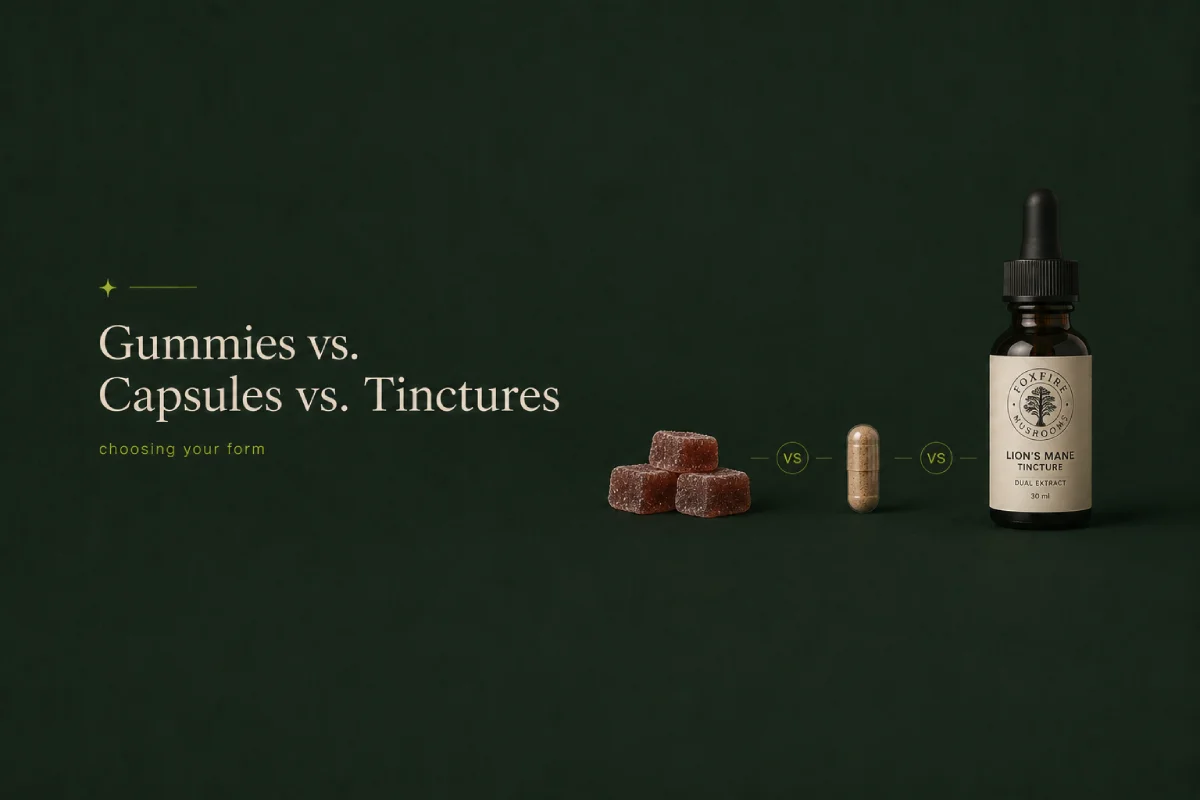
Functional mushroom supplements come in five main forms — tinctures, capsules, gummies, dried mushroom/tea, and infused honey — each with different bioavailability, onset time, taste profile, cost, and extraction quality. The best form depends on your lifestyle, the species you are targeting, and whether you prioritize maximum compound spectrum, everyday convenience, or a whole-food approach. At Foxfire Mushrooms in Longmont, Colorado, we carry products across the full spectrum of these formats — from our dual-extracted Lion’s Mane Tincture and Reishi Tincture to Brain Bears™ (store out of reach of children), Harmonic Honey, and whole dried mushroom — so we have a genuine interest in helping you understand the trade-offs honestly rather than steering you toward any one option.
This guide breaks down every form, tells you what the research context and practical experience show about each, and helps you make an informed choice.
Before diving into the details of each form, it helps to frame what you are actually choosing between. Functional mushroom supplements are not all created equal — and the differences are not just about taste or convenience. The form a supplement takes directly affects:
None of these considerations make one form universally “best.” A whole-dried mushroom broth is a beautiful, traditional preparation with its own merits. A gummy like Brain Bears™ (store out of reach of children) brings functional mushroom compounds into an approachable, daily-habit format. A dual-extract tincture is the right tool when you want complete-spectrum extraction and fast absorption. Understanding these differences is what lets you make a genuinely informed choice.
For a deeper exploration of the individual mushrooms behind these supplements, see our Functional Mushrooms and Health Benefits guide.
| Form | Bioavailability | Onset Time | Taste | Shelf Life | Best For | Foxfire Option |
| Tincture | High (sublingual) | 15–30 min | Earthy-bitter, slight alcohol | 2–5 years | Full-spectrum extraction, fast absorption | Lion’s Mane Tincture, Reishi Tincture |
| Capsules / Powder | Moderate | 60–90 min | None (capsule) / mild (powder) | 1–3 years | Tasteless convenience, on-the-go | Not currently in Foxfire lineup |
| Gummies | Moderate | 60–90 min | Sweet, flavored | 1–2 years | Accessible daily habit, familiar format | Brain Bears™ (store out of reach of children) |
| Dried Mushroom / Tea / Broth | Moderate (water-soluble compounds) | 45–90 min | Earthy, mild to umami | 1–2 years dried | Whole-food approach, culinary integration | Dried Reishi 2oz, Dried Lion’s Mane 2oz |
| Infused Honey | Moderate | 45–90 min | Sweet + earthy | 1–2 years | Versatile daily use in food and drink | Harmonic Honey |
These statements have not been evaluated by the Food and Drug Administration. This product is not intended to diagnose, treat, cure, or prevent any disease.
Tinctures are the most technically sophisticated functional mushroom supplement format, and in the hands of a quality producer, they offer distinct advantages that other forms cannot match.
When you take a tincture sublingually — holding it under your tongue for 30–60 seconds before swallowing — active compounds are absorbed directly through the sublingual mucosa into the bloodstream. This bypasses the first-pass metabolism in the liver and the slower digestive process that capsules and gummies go through. The practical result: onset in approximately 15–30 minutes versus the 60–90 minutes typical of digestive delivery. For compounds whose effects are subtle anyway, faster onset means you are more likely to experience them at all.
The deeper advantage of a quality tincture is not just delivery speed — it is what gets extracted in the first place. Functional mushrooms contain two major classes of bioactive compounds:
A single-process extract captures only one compound class. A dual-extract tincture — made by first macerating dried mushroom in high-proof alcohol for 4–8 weeks, then separately simmering the spent material in water for 2–3 hours, then combining both extracts — captures both. This is what separates a full-spectrum tincture from a partial extract, and it is what Foxfire’s Lion’s Mane Tincture and Reishi Tincture are built around.
For anyone interested in making their own, our complete step-by-step guide is here: How to Make a Dual-Extract Mushroom Tincture at Home.
Foxfire tinctures: Lion’s Mane Tincture, Reishi Tincture. Both dual-extracted from whole fruiting bodies.
Capsules and powders occupy the middle ground of the functional mushroom market: widely available, convenient, tasteless, and ranging enormously in quality.
Capsules are the format most people default to when they think “supplement.” They fit into existing pill routines, they travel easily, they have no taste, and they don’t require any preparation. For someone who already takes daily supplements in capsule form, adding a mushroom capsule is frictionless.
Powder — the same product in a different container — can be stirred into smoothies, coffee, oatmeal, or soups. For culinary integration without the DIY demands of whole dried mushroom, powder is a practical choice.
The capsule and powder market has a significant quality variance problem. Because labeling requirements for dietary supplements in the United States do not require manufacturers to verify beta-glucan content on the label (though reputable ones do), it is easy to sell a product that contains more grain starch than actual fungal bioactives.
What to look for on a capsule or powder label:
Foxfire note: Foxfire does not currently carry a mushroom capsule product. When evaluating other brands’ capsules, apply the quality markers above rigorously.
Gummies are the fastest-growing format in the functional supplement space, and it is easy to understand why. They are familiar, flavored, require no water, no dropper, no pill-swallowing, and no prep. For someone who has never taken a functional mushroom supplement before, a gummy removes almost every barrier to starting.
Brain Bears™ are Foxfire’s functional mushroom gummy offering. Store out of reach of children. Despite their approachable format, Brain Bears™ are a supplement intended for adults — the candy-like appearance and sweet flavor make proper storage especially important. Store out of reach of children.
Not all gummies are equal. As with capsules and powders, the range in quality is significant. Key things to evaluate:
Active compound content: The gummy matrix (sugar, gelatin or pectin, flavoring) adds volume and weight that has nothing to do with the mushroom extract. Look for the actual extract content per serving clearly listed — not just “mushroom blend” with no specified amount.
Extraction type: The best gummies use a real mushroom extract (hot water or dual) incorporated into the gummy base, not raw mushroom powder mixed in. Extract means the beta-glucans have been made bioavailable before the gummy is even formed.
Added sugars: Gummies necessarily contain sweeteners to be palatable. Check the sugar content per serving and factor this into your overall dietary picture. Some gummies use less refined sweeteners (tapioca syrup, cane sugar) while others use conventional corn syrup.
Fruiting body vs. mycelium: The same quality consideration that applies to capsules applies here. If the label does not specify fruiting body and an extraction method, it may be myceliated grain in gummy form.
Remember: Brain Bears™ — store out of reach of children. Always.
These statements have not been evaluated by the Food and Drug Administration. This product is not intended to diagnose, treat, cure, or prevent any disease.
All functional mushroom products discussed in this article — tinctures, capsules, gummies, dried mushroom, and infused honey — are dietary supplements. They are not medicines and are not intended to diagnose, treat, cure, or prevent any disease. This guide is for educational purposes only and does not constitute medical advice. Consult a qualified healthcare provider before starting any supplement regimen, particularly if you are pregnant, nursing, managing a health condition, or taking prescription medications.
Before the supplement industry existed, functional mushrooms were consumed the same way food has always been consumed: cooked, simmered, and eaten or drunk. This whole-food approach has real advantages that modern supplement forms cannot fully replicate — and some limitations worth acknowledging.
When you simmer dried mushroom in water for 30–60 minutes or longer, you are performing a hot water extraction in your kitchen. The heat and water release beta-glucan polysaccharides from the cell walls, making them soluble and bioavailable in the resulting liquid. This is essentially the same process a commercial water-extract supplement manufacturer uses — just in your pot, at home.
The resulting tea or broth delivers meaningful beta-glucan content in a whole-food form with no added ingredients, no capsule shells, no sweeteners, and no preservatives. It is also the most economical way to consume functional mushrooms, especially if you grow your own.
Dried mushroom tea and broth are primarily hot water extractions, which means they excel at delivering water-soluble beta-glucans but do not efficiently extract alcohol-soluble triterpenes. For Reishi — whose ganoderic acid triterpenes are a major part of its functional interest — a pure water preparation misses an important compound class. If triterpene delivery matters to you, a dual-extract tincture or a product that includes an ethanol extraction step is more complete.
Dried Reishi 2oz and Dried Lion’s Mane 2oz are Foxfire’s whole dried mushroom offerings — suitable for tea, broth, home tincture-making, and cooking applications.
Infused mushroom honey is a format that occupies its own pleasant category — it bridges the gap between a functional supplement and an everyday pantry ingredient, and it does it in a format that almost everyone already has a use for.
Foxfire’s Harmonic Honey combines raw honey with functional mushroom extract. The honey serves as both a carrier and a preservative, and its natural sweetness makes the earthy, sometimes bitter notes of functional mushroom extract genuinely enjoyable rather than something to be masked or pushed through.
The versatility of an infused honey is one of its defining characteristics:
Honey delivery means digestive absorption rather than sublingual — similar onset timing to capsules and gummies (45–90 minutes). The honey matrix is simple and clean, without the gelling agents and flavoring systems of a gummy. For people who dislike both the complexity of tincture preparation and the medicinal feel of capsules, infused honey offers a genuinely different and enjoyable experience.
This distinction appears in every supplement format — tinctures, capsules, gummies, powders — and it is the single most important quality marker to understand before purchasing any functional mushroom supplement.
Fruiting body is the actual mushroom: the cap, stem, brackets, or coral-like structure that is the mature, spore-producing form of the fungus. Fruiting bodies are where the highest concentrations of beta-glucans and triterpenes are found. They contain no grain starch.
Mycelium is the root-network stage of the fungus — the white, thread-like vegetative growth. When grown in laboratory conditions on grain substrate (oats, rice, or similar), the final dried product — often called “mycelium biomass” or “full spectrum mycelium” — contains a significant portion of grain starch that was never colonized by the fungus. Research has found that some myceliated grain products contain more starch than actual fungal material.
Mycelium grown on grain is not inherently worthless, but a label that says “myceliated oats” or “full spectrum” without further specifics should prompt questions. For the highest beta-glucan content and the most meaningful functional mushroom experience, look for products that specify whole fruiting body.
For a deeper look at the research behind beta-glucan content and quality markers across supplement forms, see our guide: What Is Beta-Glucan? Mushroom Immune Support Explained.
Whether you’re evaluating a tincture, capsule, gummy, or powder, here is a practical checklist for the label:
1. Beta-glucan percentage — look for a specific number.
A quality extract will list beta-glucan content as a percentage of the product. “25% beta-glucans” is meaningful. “Contains beta-glucans” without a percentage is vague. No mention of beta-glucans at all is a red flag.
2. Extraction type — “extract” vs. “powder.”
“Hot water extract,” “aqueous extract,” or “dual extract” means the manufacturer performed an extraction to make beta-glucans bioavailable. “Mushroom powder” without an extraction qualifier means raw dried mushroom was ground up — much lower bioavailable beta-glucan content.
3. “Fruiting body” vs. “mycelium.”
As covered above — fruiting body is the quality standard. “Mycelium” without further context may mean myceliated grain.
4. Serving size and servings per container.
Calculate the actual amount of mushroom extract per serving and per container. Some products appear inexpensive until you realize the serving size is very small or the bottle contains only 15 servings.
5. Other ingredients.
For gummies and capsules, check what fillers, binders, sweeteners, and preservatives are included. For tinctures, the “other ingredients” should be essentially nothing beyond the alcohol and water.
6. Third-party testing.
Reputable supplement brands will list third-party laboratory testing for heavy metals, pesticide residue, and beta-glucan content. Look for a certificate of analysis (COA) available on the manufacturer’s website.
For a comprehensive look at how to evaluate and compare specific mushroom species for supplementation, see our Functional Mushroom Dosing Guide and our Functional Mushrooms in Your Daily Routine guide.
At Foxfire Mushrooms in Longmont, Colorado, we have built our Phase 2 functional product line to cover the full range of formats — so whatever form works best for your life, we have a quality option.
Tinctures — Dual-extracted, full-spectrum:
Gummies — Accessible and daily-habit-ready:
Infused Honey — Versatile and delicious:
Whole Dried Mushroom — For tea, broth, and DIY extraction:
Shop All Functional Mushrooms →
These statements have not been evaluated by the Food and Drug Administration. This product is not intended to diagnose, treat, cure, or prevent any disease.
“Stronger” depends on what you mean. Tinctures have higher bioavailability per milligram of extract because of sublingual absorption and the absence of a digestive barrier. They also, when dual-extracted, contain both major compound classes (triterpenes and beta-glucans). However, the absolute dose of active extract in a tincture serving, capsule serving, or gummy serving varies product to product. A well-formulated gummy with a meaningful extract dose may deliver more active compounds per serving than a poorly made tincture. Compare beta-glucan percentages and extract content, not just format.
Gummies can work — if they contain a real mushroom extract at a meaningful dose. The gummy format itself does not make a product ineffective. What matters is what is inside the gummy: extract vs. raw powder, fruiting body vs. myceliated grain, and how much active compound is in each serving. Brain Bears™ (store out of reach of children) use mushroom extract — not raw powder — in their formulation. The key question to ask of any gummy is: what extraction method was used, and how much beta-glucan is per serving?
Raw mushroom powder is dried mushroom that has been ground up. It contains beta-glucans, but they are largely locked inside chitin cell walls that the human digestive system cannot efficiently break down. Extract — whether hot water, alcohol, or dual — has used a solvent and/or heat to break through the chitin and dissolve the bioactive compounds into a soluble, absorbable form. For functional purposes, extract is meaningfully superior to raw powder, with measurably higher bioavailable beta-glucan content.
Yes — many people combine forms intentionally. A common approach is using a dual-extract tincture for fast-acting delivery and a Harmonic Honey in your morning tea for a gentler daily baseline. There is no documented interaction between different mushroom supplement formats, and combining them generally increases your total daily dose of functional compounds rather than causing any conflict.
Functional mushroom supplements are formulated and intended for adult use. Brain Bears™ should be stored out of reach of children at all times. If you are interested in functional foods for children, please consult a pediatrician before introducing any supplement. Culinary mushrooms prepared as food — such as fresh Lion’s Mane or Shiitake cooked in a meal — are a different matter and are generally appropriate as part of a balanced diet for children, though any new food should be introduced thoughtfully.
Four key markers: (1) whole fruiting body specified on the label, (2) an extraction method listed (hot water or dual), (3) beta-glucan percentage disclosed, (4) third-party lab testing with a COA available. A brand that can answer clearly on all four points is operating at a quality standard. A brand that is vague or evasive on any of them deserves skepticism. See our section on reading labels above for the full checklist.
Yes — dried mushroom tea and broth are effective home preparations for water-soluble beta-glucans. Dual-extract tinctures can also be made at home with the right equipment and a 6–10 week process. Our How to Make a Dual-Extract Mushroom Tincture at Home guide covers everything you need. Foxfire’s Dried Reishi 2oz and Dried Lion’s Mane 2oz are excellent starting materials for home extraction.
Share this article
Grab a beginner-friendly kit and apply what you just read —
or take the quiz and we’ll match you to the right
starting point.
