

- Scott Brenton
- 3 min read
What it is Ganoderma lucidum, called reishi in Japan and lingzhi in China. It fruits either as a fan-shaped bracket with a glossy, lacquered red-brown
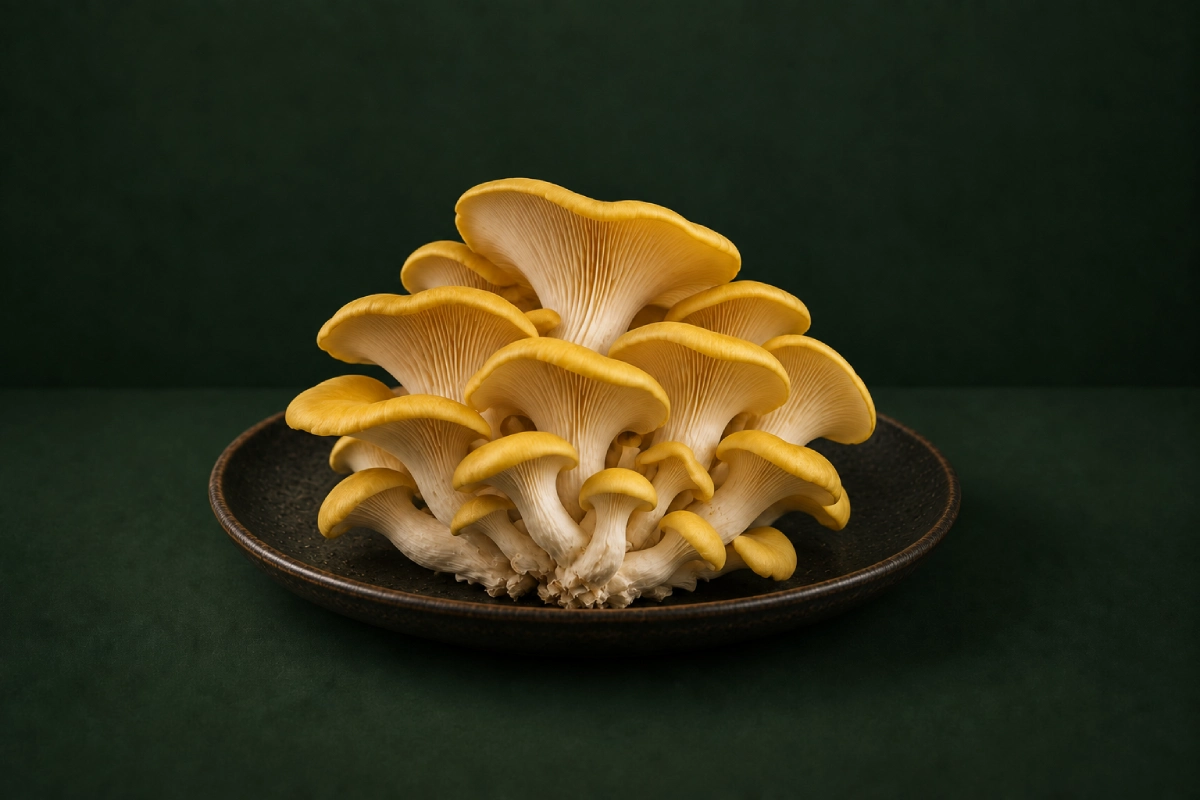
Pleurotus citrinopileatus, the yellow oyster. It fruits in bouquets of thin, funnel-shaped caps on long slender stems, in a yellow so saturated it looks artificial. Like pink oyster it is a warm-weather, fast-growing species with a short life — two to three days — and like pink oyster, that makes it a local-only proposition.
It is also the species that sells a market stall. A tray of golden oysters next to a tray of blue stops people mid-stride, and it is the most common reason a first-time customer buys anything at all.
The most distinctive flavour of the oyster family: nutty, close to cashew or toasted sunflower seed, with a slight tang the others do not have. The flesh is thinner than blue oyster, so it crisps in a fraction of the time and can go from golden to bitter if you push it.
Fast and attentive is the method. Hot dry pan, single layer, ninety seconds to two minutes a side, butter at the end, salt off the heat. It is the one oyster where walking away is a mistake.
The yellow fades as it cooks and fades further as it ages. If the colour is why you bought it, use them the same day and let the plating do the work.
Saturated yellow, caps still slightly funnelled rather than fully flat, no browning at the tips of the thin caps. Because the flesh is so thin, age shows here first — a cluster with brown, papery cap edges is done. It should feel almost weightless and completely dry.
Trim the base, pull the bouquet into individual caps with their stems attached. Trim loss around 5%. Cooked yield is the lowest of the oysters — the thin flesh means significant shrink — so treat golden oyster as an accent or a garnish species rather than the volume in a dish.
Two to three days in paper, coldest shelf, never sealed. The clusters bruise easily, so keep them in a single layer with nothing on top; weight from a container above will mark them within a day.
Summer and early autumn, in limited runs. Golden and pink oysters both show up on the harvest board as short-notice lines, and both are the reason the Share exists: members get whatever is at its peak that week rather than a fixed list.
Nutty and cashew-like with a slight tang — the most distinctive flavour of the oyster family, and noticeably less earthy than shiitake or chestnut.
Overcooked. Thin flesh crisps in under two minutes a side, and past that point the nuttiness turns bitter. Pull them the moment the edges colour.
Two to three days refrigerated in paper, in a single layer. They bruise and dry out faster than blue oyster because the caps are so thin.
Escaped golden oysters have naturalised in parts of the upper Midwest and are watched as a non-native species there. Grown indoors on contained substrate — which is how ours are produced — it is not an issue, and spent substrate is composted hot.
Share this article
What it is Ganoderma lucidum, called reishi in Japan and lingzhi in China. It fruits either as a fan-shaped bracket with a glossy, lacquered red-brown

What it is Hypsizygus tessulatus — beech mushroom, shimeji, buna-shimeji in its brown form and bunapi in the white. Grown in tight bouquets of fifty

What it is Black pearl is a Pleurotus hybrid — usually credited as a cross of ostreatus and eryngii — grown for the best traits
Grab a beginner-friendly kit and apply what you just read —
or start with our beginner’s guide to find the right first grow.