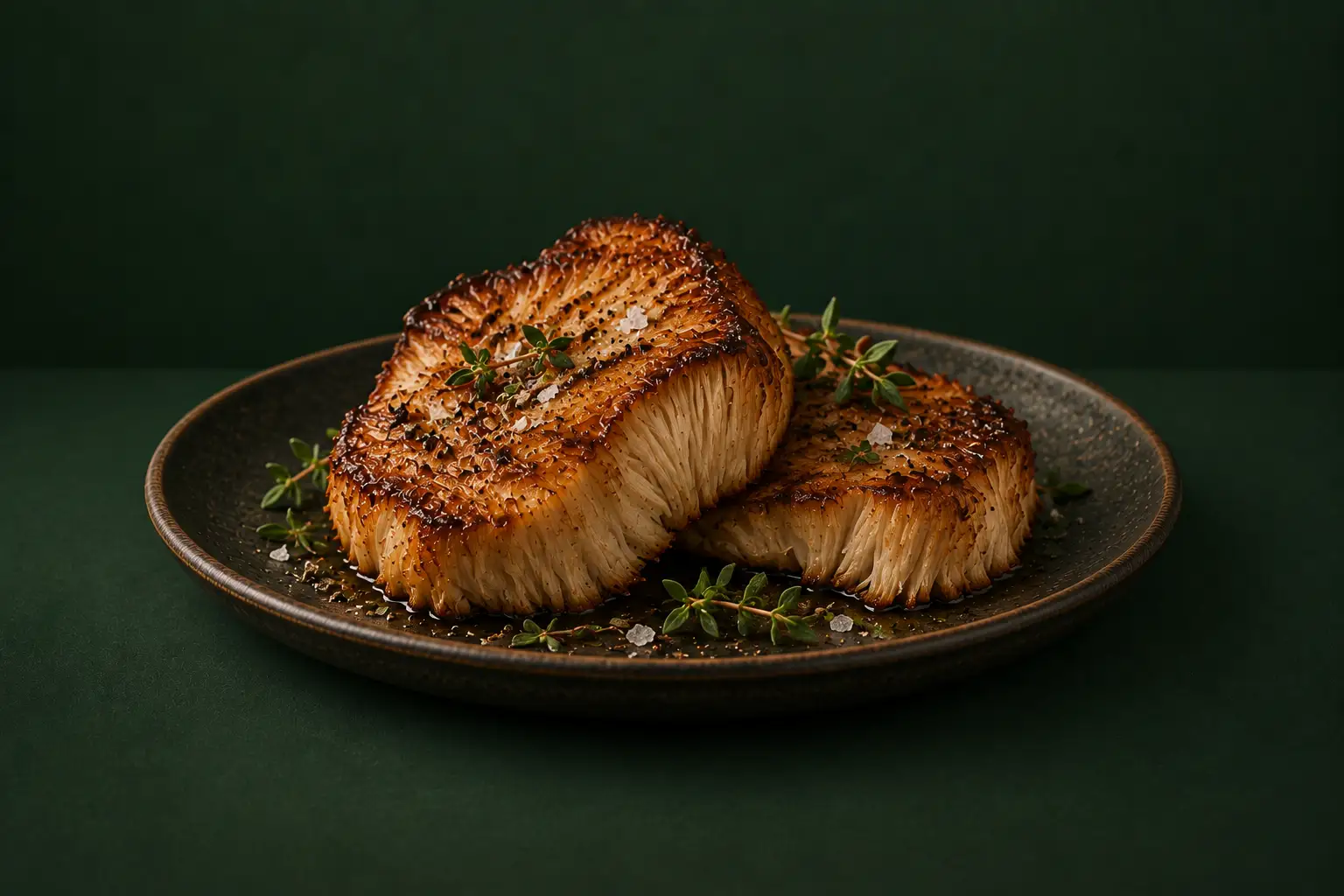
This is the simplest way to understand what lion’s mane is. Two thick slabs, a hot dry pan, a weight on top, and eight minutes. The press forces water out and the surface goes properly golden rather than pale and squeaky.
The finish — lemon, butter, capers — is deliberately close to a piccata, because that is what the flavour wants.
Without the weight you get a mushroom that is cooked but pale, spongy and faintly squeaky — the complaint almost everyone has the first time they cook lion’s mane. The press is doing what a paper towel does for tofu, except with heat, so the water leaves as steam and the surface can brown.
Cook it past the squeak. If the slab still squeaks against your teeth, it holds water and needs another two minutes a side.
On a purée — white bean, celeriac or potato — with the pan butter spooned over and something sharp alongside: a dressed rocket salad, or fennel and lemon. It has enough presence to be the centre of the plate without any support.
Pressed and seared slabs are the starting point for a sandwich, and pressed-then-shredded is the base of crab cakes. This is the parent recipe for the species.
Cut thick slabs and press them in a hot dry pan for three or four minutes a side to force out the water, then sear in a little oil. Rubberiness is undercooked, waterlogged mushroom.
Because it is still full of water. A properly cooked slab is dense and golden and does not squeak. Keep going.
No — water is absorbed straight into the spines and makes the sponge problem worse. Brush or wipe it.
Share this article
Grab a beginner-friendly kit and apply what you just read —
or take the quiz and we’ll match you to the right
starting point.
