

- Scott Brenton
- 5 min read
The honest framing We grow mushrooms indoors for a living and we do not sell anything foraged. So this page has no commercial interest in
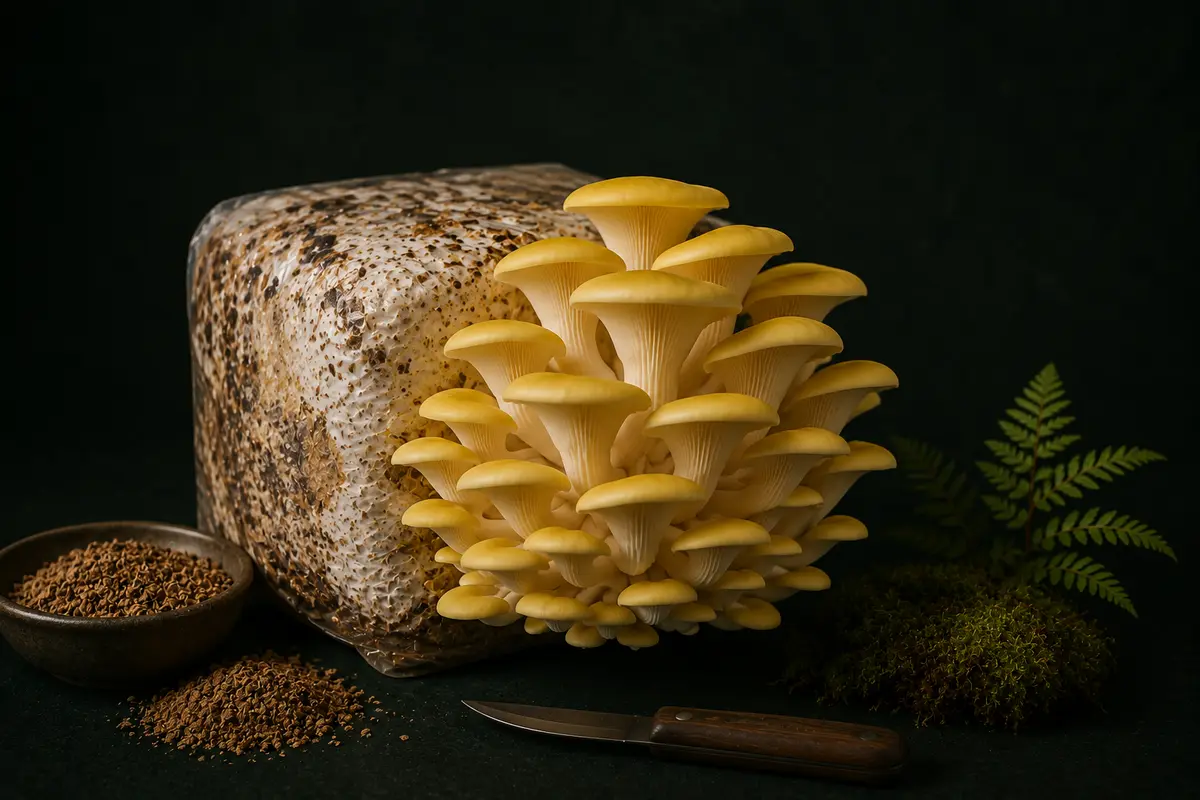
A first golden oyster cluster often looks like something that shouldn’t exist indoors, a tight fan of buttery yellow caps pushing out of a plastic bag on a kitchen counter, glowing under a grow light like it has its own power source. That’s usually the moment growers decide they need to know how to grow golden oyster mushrooms themselves, and the short answer is a colonized block, steady humidity, a little fresh air, and about two to three weeks from opening a kit to slicing the harvest into a pan. Foxfire Mushrooms, a small batch mushroom lab in Longmont, Colorado, hears this question constantly, because golden oysters are one of the fastest, most visually dramatic mushrooms a first time grower can try, and also one of the most misunderstood.
Golden oysters, or Pleurotus citrinopileatus if you want the Latin, are not forgiving in the way many beginner guides imply. What makes them approachable is speed, not tolerance for mistakes, since a colonized block will fruit or fail within roughly the same short window regardless of experience level. Caring for golden oysters comes down to three variables in sequence, warmth during colonization, airflow during fruiting, and restraint with the mister.
Quick Facts — Species: Pleurotus citrinopileatus – Colonization time: 10-14 days – First flush after fruiting conditions begin: 7-10 days – Ideal fruiting temperature: 65-75°F – Humidity range: 85-95% – Fridge life after harvest: 3-5 days
Most people asking this have already grown a pearl or blue oyster kit and want to know if golden oysters behave the same way. Mostly, yes, with a few real differences. Golden oysters tend to colonize faster, a difference many cultivators associate with vigorous mycelial growth. They’re more sensitive to cold, and they produce a much heavier spore load once fruiting starts, covered later in this guide.
They also fruit in tighter, more upright clusters than pearl oysters, which tend to shelf out sideways. Growers who work with both species across multiple flushes tend to notice this pattern hold consistently.
If a kit is the starting point, colonization already happened in the lab before it shipped, so this mostly applies to growers working from grain spawn or liquid culture. Golden oyster mycelium generally colonizes fastest with warmth, around 75 to 80°F, a clean substrate, and darkness. Growers often report more contamination when bags are kept too cool, likely because slower colonization gives mold more time to establish.
Foxfire checks each liquid culture batch under a microscope before it ships, looking for bacterial or fungal contaminants that are hard to spot with the naked eye until a bag is already a week into colonizing. That screening step is a large part of why kits and fresh cultures tend to behave predictably once they reach a grower’s kitchen.
A fully colonized bag should be solid white all the way through, with no green, black, or pink patches. Golden oyster mycelium commonly shows a faint yellowish tint even when healthy, which throws off new growers who expect stark white every time. That tint is typically normal, not a sign of contamination.
Once the substrate is fully colonized, fruiting is generally triggered by a drop in temperature, an increase in humidity, and fresh air exchange. In practice, that means moving the block to around 65 to 75°F, misting it two to three times a day so the surface stays damp but not soaked, and giving it real airflow rather than sealing it in a closed tote. Growers in drier climates, including much of Colorado’s Front Range, commonly need to mist somewhat more often than growers in humid states just to hold that range.
Golden oysters punish impatience faster than other species. Skip the fresh air exchange and the result is often long, thin, antler shaped stems instead of properly formed caps, a pattern growers commonly associate with high carbon dioxide buildup in the growing space. Growers call this antlering, and it’s one of the most common complaints from first time growers of this species. The typical fix is more airflow, not more water.
Both species are common starting points for new growers comparing their first kit.
| Factor | Golden Oyster | Pearl Oyster |
| Colonization speed | Faster, often 10 to 14 days | Slightly slower, 12 to 16 days |
| Cold tolerance | Low, needs warmth to colonize | More forgiving of cooler rooms |
| Contamination resistance | Moderate | Slightly more resistant |
| Spore production | Heavy | Moderate |
| Flavor | Mild, slightly nutty, delicate | Earthier, more savory |
| Second flush strength | Often weaker than first | Usually more consistent |
| Best for | A dramatic, fast first harvest | Steady, repeat flushes |
A golden oyster kit tends to deliver the more visually striking first grow. A pearl oyster kit tends to deliver several solid flushes off one block with comparatively less fuss, a pattern many repeat growers report. The right choice depends on which outcome matters more to a given grower.
From a fully colonized kit, expect pins within three to five days of starting fruiting conditions, small golden nubs that can double in size within a day once they get going, and a full harvestable flush seven to ten days after that. Opening the box to first harvest usually runs 10 to 14 days. Growers building their own substrate should add another 10 to 14 days of colonization first.
Overmisting. Golden oysters look delicate, so new growers tend to soak the block constantly, which suffocates the surface and invites bacterial wet spots, especially on caps still forming. A light mist that leaves the surface damp to the touch is enough. If water is pooling on the block, that’s too much.
The flip side deserves honesty too, since generic guides tend to oversell this mushroom. Golden oyster second flushes are often disappointing compared to the first, smaller and less impressive, sometimes not worth the wait. That’s how the species behaves, not a sign of grower error.
Yes, golden oysters are a well established edible species valued in restaurant kitchens for a mild, slightly nutty flavor that holds up well in a hot pan. But here’s the detail most grow guides skip. This species is known for producing a notably heavy spore load once it fruits. Some growers, particularly in commercial settings with repeated exposure, have reported flu-like symptoms, including chills, coughing, or shortness of breath, after inhaling airborne spores indoors. Occupational health literature describes a related hypersensitivity reaction, sometimes called mushroom worker’s lung, documented mainly among long term commercial growers rather than home cultivators. For a single home kit, this reaction appears uncommon, though home scale data is limited.
The practical fix is straightforward, and it’s built into how Foxfire’s Longmont fruiting rooms operate. Misting gently right before harvest helps knock spores out of the air, harvesting with some airflow rather than in a sealed closet is generally advisable, and anyone with a known mold sensitivity, asthma, or a history of spore allergies may want to wear a simple dust mask on flush day.
Twist the whole cluster off at the base rather than cutting individual caps, which keeps the substrate cleaner for a second flush. Golden oysters are best eaten within a day or two of picking, since their thin caps hold less structural moisture than firmer species like shiitake and lose texture faster as a result. Stored loose in a paper bag rather than sealed plastic, they hold three to five days in the fridge before texture suffers.
A ready to fruit grow kit for golden oysters removes the colonization step entirely, generally recommended for a first attempt. Growers building their own substrate typically use straw or a mixed hardwood sawdust and soy hull blend, both of which this species colonizes quickly given adequate warmth. From a liquid culture syringe, the usual next step is inoculating fresh grain jars before bulk substrate.
Every Foxfire order over $75 ships free, and every grow kit carries Foxfire’s live arrival guarantee, so a block that arrives damaged or contaminated in transit gets replaced. Foxfire has shipped grow kits, spawn, and cultures to home growers nationwide since 2021, and restaurants or markets scaling past a single kit can work through the wholesale program or book a grower consultation.
Golden oysters reward growers who respect two things, fresh air during fruiting and a light hand with the mister, and there’s a particular satisfaction in watching a block of white mycelium turn into a fan of yellow caps in the space of two weeks. Foxfire’s Golden Oyster grow kits are ready to ship for anyone who wants to see that first cluster in person, and spawn or liquid culture options are available for growers who prefer to start from scratch. Foxfire’s Longmont lab ships both fresh every week.
Yes, indirect light for a few hours a day helps the caps form properly and encourages growth toward the light source. Full darkness during fruiting tends to produce pale, misshapen mushrooms.
This is most often linked to age, low humidity, or direct heat rather than disease. Golden oysters have thin flesh and dry out fast, so a drop in ambient humidity after they’ve formed can cause wilting within hours.
They can, though outdoor cultivation is far less predictable than an indoor kit since it depends on local temperature and humidity swings. Most home growers get more consistent results indoors, at least for a first attempt.
A mild, slightly sweet, mushroomy smell is normal. A sour, ammonia like, or rotten odor is not, and usually signals bacterial contamination that means the block should be discarded.
Most kits produce two usable flushes, occasionally a small third, though the first flush is almost always the largest by a wide margin.
Yes, golden oyster and yellow oyster are common names for the same species, Pleurotus citrinopileatus. It’s also labeled Tamogitake, its Japanese name, on some suppliers’ sites.
A spent golden oyster block still has value as garden mulch or compost, since it’s already broken down organic material that can continue feeding soil microbes even after fruiting slows.
Share this article
The honest framing We grow mushrooms indoors for a living and we do not sell anything foraged. So this page has no commercial interest in

The farm tour Forty-five minutes, walking the whole cycle in the order it happens: substrate mixing, the sterilisation and inoculation side, the dark incubation room,

Why this county is unusual Boulder County has an established open-space and agricultural-land programme, a population that will pay a premium for provenance, a dense
Grab a beginner-friendly kit and apply what you just read —
or start with our beginner’s guide to find the right first grow.