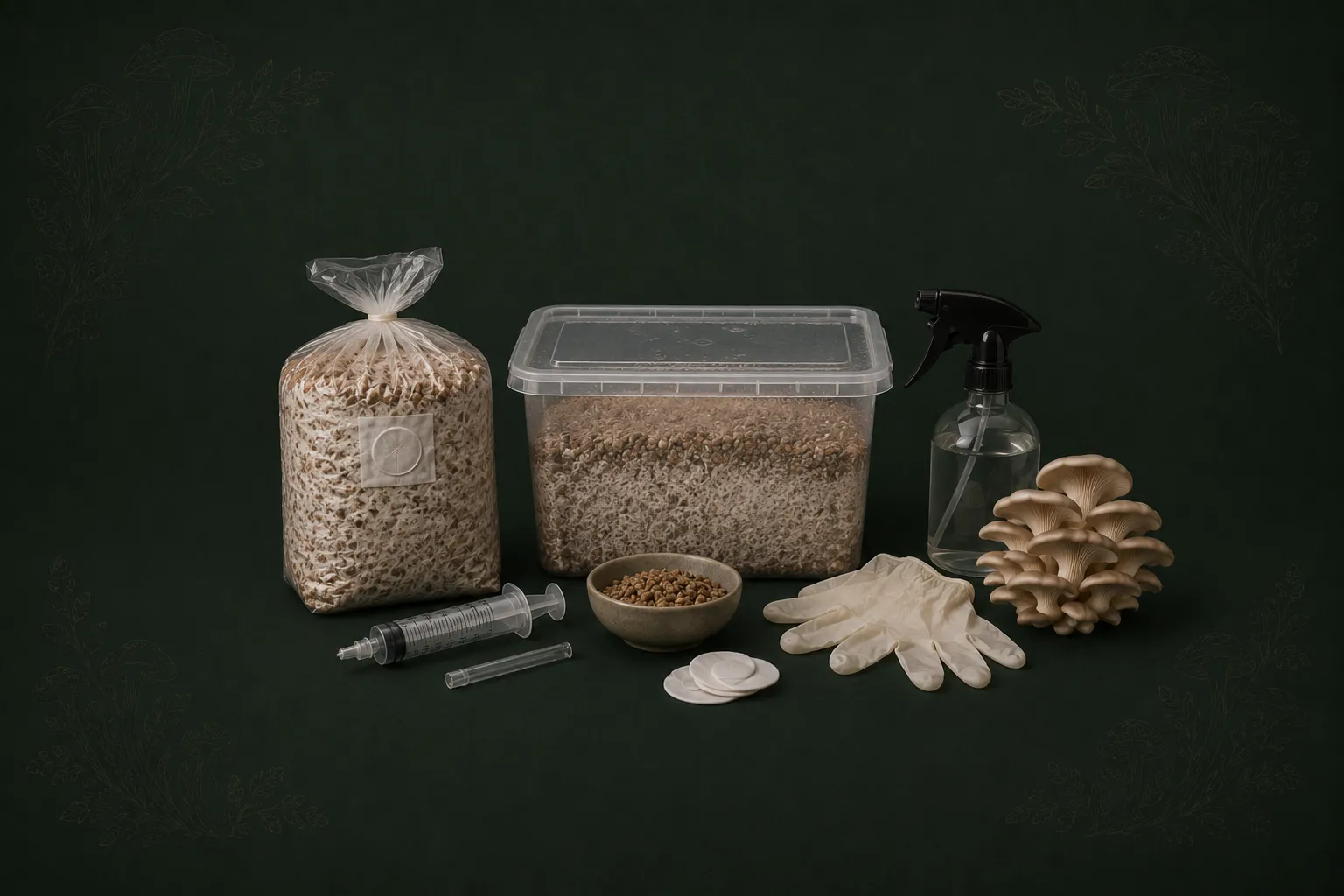
To grow mushrooms at home, you need three things: spawn (mushroom “seed”), a substrate (the material the mycelium eats), and a humid environment to trigger fruiting. Everything else is optional — and this guide will help you figure out exactly what to buy, what to skip, and where to start based on your experience level.
At Foxfire Mushrooms in Longmont, Colorado, we hear the same question every week: *”I want to start growing — what do I actually need?”* This is our complete answer. Whether you’re buying your first grow kit or scaling up to bulk cultivation, we’ve laid out every category of mushroom cultivation supplies with honest, practical guidance. No fluff, no upselling — just the information you need to grow confidently.
Mushroom cultivation comes down to simple biology: mycelium (the fungal “root system”) needs to colonize a food source, then be triggered into producing fruiting bodies — the mushrooms you eat. The supplies you need match those two critical stages.
That’s the entire system. Everything else — pressure cookers, flow hoods, automated chambers — is either for sterilization (when you’re working with unsterilized materials) or for scaling up your operation. A beginner can safely skip most of it.
Our Beginner’s Guide to Growing Mushrooms covers the full process from inoculation to harvest. This guide focuses specifically on what supplies to buy.
A mushroom grow kit is the simplest possible entry point. You get a fully colonized substrate block — mycelium already established and ready to fruit — in a bag with a filter patch. Your only job is to open it, keep it humid, and harvest your gourmet mushrooms.
Grow kits require no sterilization, no spawn handling, and no substrate prep. You won’t need a pressure cooker or agar equipment. You simply open the box, follow four or five simple steps, and mushrooms appear within 7 to 14 days.
At Foxfire, we offer three beginner-friendly grow kits:
| Kit | Best For | Fruiting Temp | First Pins (Days) |
| Lion’s Mane | Beginners, culinary growers | 65–75°F | 7–14 Days |
| Blue Oyster | Fast results, prolific yields | 55–65°F | 5–10 Days |
| Pink Oyster | Warm climates, visual impact | 70–85°F | 5–10 Days |
Each kit yields multiple flushes — typically 2 to 4 — from a single block. After each harvest, rehydrate the block by soaking it in cold water for 4 to 8 hours, then return it to its designated fruiting conditions.
For a full breakdown of which kit is right for your home environment, see our Grow Kit Buyer’s Guide.
Once you’ve harvested your first grow kit and caught the cultivation bug, bulk growing is the logical next step. Instead of buying pre-colonized blocks, you inoculate your own substrate with spawn — giving you complete control over species selection, batch size, and cost per pound of mushrooms.
The learning curve is real but manageable. Here is how the three main decisions break down.
Spawn is mushroom mycelium growing on a carrier. The two main types are grain spawn and sawdust/wood spawn, and they have meaningfully different applications.
For a detailed comparison of how these two formats compare across colonization speed, contamination risk, and beginner-friendliness, read our Grain Spawn vs. Sawdust Spawn guide.
Not sure whether to buy colonized or sterilized grain? Our Colonized vs. Sterilized Grain Spawn breakdown answers that question directly.
Substrate is what your mycelium eats. The right choice depends on which species you’re growing.
Rule of Thumb: If you’re growing Oysters, CVG works beautifully. If you’re growing anything that naturally grows on hardwood trees (like Lion’s Mane or Shiitake), go with Oak Soy Hull.
Grow bags are the protective container for your substrate during colonization and often during fruiting. They maintain high humidity, allow safe gas exchange through filter patches, and keep contaminants out.
At Foxfire, we carry industry-standard Unicorn Bags in two filter sizes:
For a complete guide to picking the right bag for your setup, see our Unicorn Bags guide.
Liquid culture (LC) syringes are one of the most useful tools in a grower’s kit — and one of the most underused by beginners. A liquid culture syringe contains live mushroom mycelium suspended in a sterile nutrient solution, ready to inject directly into sterilized grain or substrate.
The advantage over traditional grain-to-grain transfer is that you get a fresh, fast start every time. Liquid cultures colonize sterilized grain in 10 to 18 days at 70°F, and because you’re injecting a small volume into a sealed bag, the contamination risk is incredibly low when your technique is sound.
At Foxfire, we offer 10ml liquid culture syringes in multiple gourmet species. Each syringe contains enough culture to inoculate 3 to 6 sterilized grain bags, depending on your inoculation volume.
LC syringes pair naturally with our sterilized grain spawn bags — you get the sterile substrate and the live culture in one order, ready to go.
For everything you need to know about working with liquid culture, see our Liquid Culture Syringes guide and our Liquid Culture explainer for beginners.
If you have logs, garden beds, or a wooded yard, plug spawn opens up a completely different style of cultivation — outdoor, low-maintenance, and active for multiple years.
Plug spawn consists of hardwood dowels pre-colonized with mushroom mycelium. You drill holes in fresh-cut hardwood logs, tap the plugs in with a mallet, seal with food-grade cheese wax, and wait. Shiitake logs, for example, start producing after 6 to 18 months and can fruit for 4 to 6 years from a single log.
At Foxfire, we carry plug spawn in 100-count bags in six outstanding species:
Outdoor log cultivation requires almost no ongoing labor, no humidity equipment, and zero sterilization setup. It’s one of the most sustainable, satisfying ways to grow your own food.
For species comparisons, drilling guides, and log selection tips, see our Plug Spawn Buying Guide.
Beyond spawn and substrate, a handful of inexpensive tools make your cultivation journey significantly easier.
That’s it. Just six simple items, most under $20. You do not need a professional laminar flow hood, a complex martha tent, or an automated fruiting chamber to get great results.
Save your money. Here is what you should skip until you are producing 10+ lbs of fresh mushrooms per month:
Start simple. Buy one grow kit, or two bags of colonized grain spawn with a bag of sterilized substrate. Get your first harvest under your belt, and then decide what tools you want to add.
If you’re growing consistently — even just one or two bags a week — a regular supply relationship makes sense. Fresh colonized grain spawn has a shelf life of 4 to 8 weeks when refrigerated, so ordering on an as-needed schedule keeps your cultures at peak vitality.
We’re building subscription and regular-order options for Foxfire customers who grow on a set schedule. Check our Subscription Guide for current availability, or reach out directly — we love working with serious home growers and small commercial operations to keep their shelves stocked.
Foxfire Mushrooms is based in Longmont, Colorado — a town sitting at 4,979 feet elevation where we deal with low humidity, intense UV, and wide temperature swings. We grow and test our products in these exact conditions, which means our spawn and substrates are dialed for real-world home performance, not just perfect lab metrics.
Every batch of colonized grain spawn we ship is guaranteed to be fully colonized — you can see the vibrant white mycelium throughout the bag — and thoroughly checked before it leaves our facility. Our sterilized bags are autoclaved at 15 PSI for a full sterilization cycle, sealed, and shipped in contamination-resistant packaging.
We stand behind every product with a 30-day money-back guarantee. If something arrives contaminated, damaged, or doesn’t perform as expected, we make it right. No complex forms, no hassle.
We’re a small operation that takes quality seriously. Our goal is simple: give you the best possible starting point so that your cultivation results are about your technique, not your supplies.
You have everything you need to make a confident first purchase. Whether you’re starting with a single grow kit or setting up your first bulk grow, Foxfire Mushrooms has you covered — with spawn, substrate, and bags grown and tested at altitude in Longmont, Colorado.
Every order is backed by our signature 30-day money-back guarantee.
At minimum, you need spawn (colonized grain or a grow kit) and a humid environment. If starting with a grow kit, you need nothing else — the substrate is already colonized. For bulk growing, you’ll also need substrate (CVG or Oak Soy Hull), grow bags, and basic sanitation supplies (isopropyl alcohol, gloves).
Foxfire Mushrooms in Longmont, Colorado sells colonized grain spawn, sterilized grain spawn, liquid culture syringes, and plug spawn both online and locally. We ship throughout the U.S. and offer pickup for Colorado customers.
Properly stored colonized grain spawn stays viable for 4 to 8 weeks refrigerated at 35–40°F. Use it sooner for best results — the mycelium is most vigorous in the first 2 to 3 weeks after colonization.
Yes. If you purchase pre-sterilized substrate bags (like our Oak Soy Hull bags) or fully colonized grain spawn, you don’t need to sterilize anything. Grow kits also require no sterilization. A pressure cooker is only necessary if you want to sterilize your own bulk grain or substrate from scratch.
The Lion’s Mane grow kit is our top recommendation for beginners — it’s forgiving across a wide temperature range (65–75°F), produces large, impressive flushes, and is culinarily rewarding. The Blue Oyster kit is excellent for those who want the fastest results possible.
Most grow kits produce 2 to 4 flushes. The first flush is typically the largest. Between flushes, soak the spent block in cold water for 4 to 8 hours, then return it to fruiting conditions. Expect diminishing returns after the third flush.
Grain spawn is for indoor bulk cultivation — colonizing bags or tubs of substrate. Plug spawn is for outdoor log inoculation — drilling holes in hardwood logs and inoculating them for multi-year outdoor production. They’re different formats for different growing environments.
Yes. Foxfire Mushrooms ships colonized grain spawn, sterilized bags, grow kits, substrates, liquid culture syringes, and plug spawn throughout the continental United States.
Share this article
Grab a beginner-friendly kit and apply what you just read —
or take the quiz and we’ll match you to the right
starting point.
