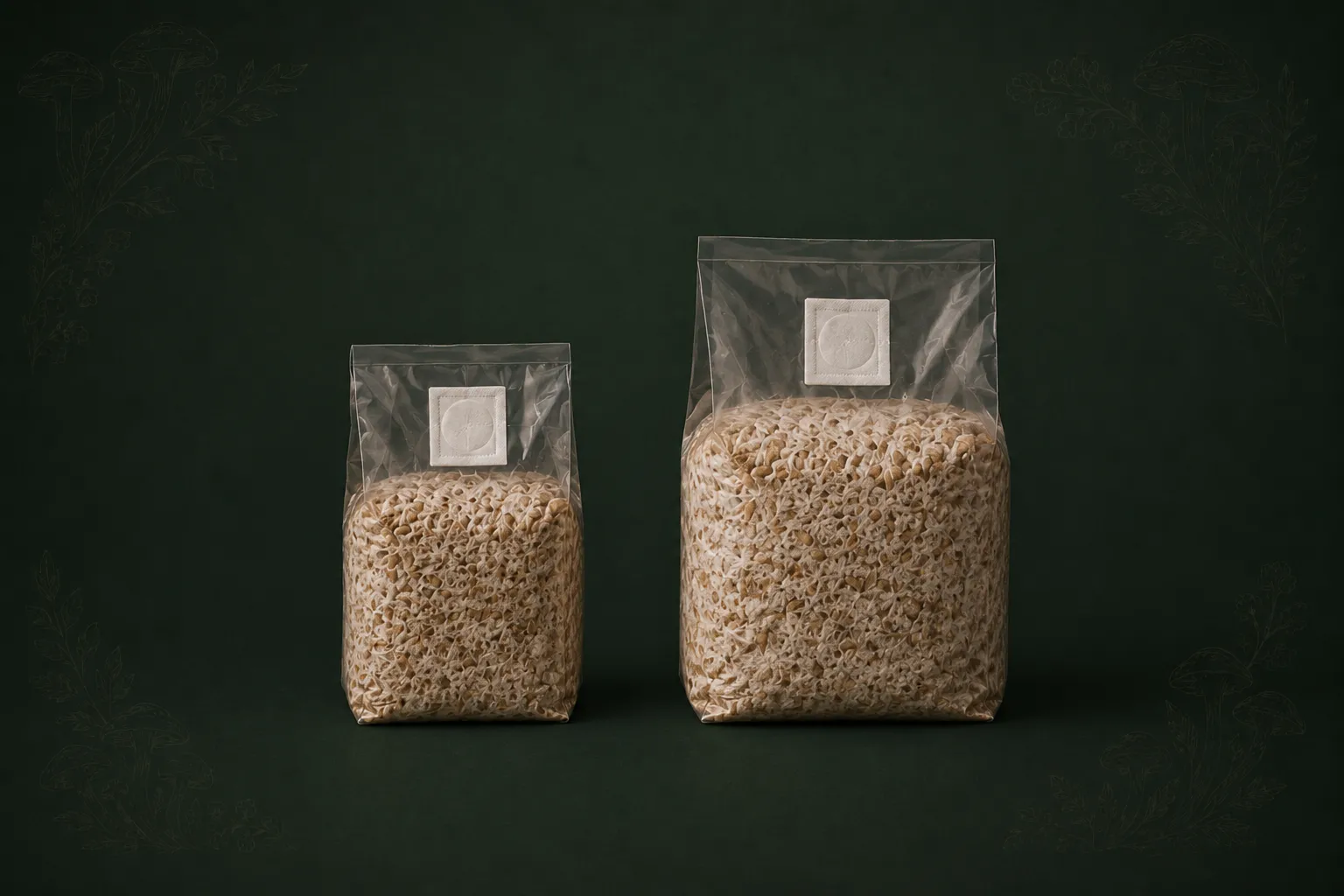
Unicorn Bags are polypropylene mushroom cultivation bags with a built-in filter patch, and they are the industry standard for home and commercial cultivators because they withstand autoclave sterilization at 15 PSI / 250°F while allowing continuous gas exchange. The difference between 3T and 4T comes down to wall thickness: 3T bags are 3 mil thick and work well for grain spawn and lighter substrate loads, while 4T bags are 4 mil thick and are the right call for dense substrate blocks, heavier loads, and grows that require repeated handling.
At Foxfire Mushrooms in Longmont, Colorado, we stock both 3T and 4T Unicorn Bags in 10-pack and 50-pack quantities. Here’s exactly how to choose.
Unicorn Bags is a brand name from Unicorn Bags Inc., and it has become so synonymous with quality polypropylene (PP) grow bags that “Unicorn Bag” is how most cultivators refer to any PP mushroom cultivation bag. The brand earned that status because the bags are consistent, autoclave-safe, and designed specifically for the demands of mushroom cultivation.
The two features that set Unicorn Bags apart from cheaper alternatives:
Unicorn Bags can also be pasteurized (160–185°F) rather than autoclaved if you’re working with a substrate like CVG (coco coir/vermiculite/gypsum) that doesn’t require full sterilization. They hold up to either method. See our mushroom substrate guide for a full breakdown of which substrates need sterilization vs. pasteurization.
The “T” in 3T and 4T stands for the bag’s wall thickness measured in mils — thousandths of an inch. A 3T bag has 3-mil walls; a 4T bag has 4-mil walls. That single additional mil of thickness creates a meaningful difference in practical use:
Neither bag is universally better — the right choice depends on what you’re growing and how you’re working.
| Feature | 3T Bags | 4T Bags |
| Wall Thickness | 3 mil | 4 mil |
| Best For | Grain spawn, CVG blocks, lighter substrate | Dense substrate blocks, OSH, Shiitake, Lion’s Mane, Reishi |
| Typical Load Capacity | 3–5 lbs | 5–8 lbs |
| Handling Durability | Good | Excellent |
| Tear/Puncture Resistance | Moderate | High |
| Autoclave Safe | Yes (15 PSI) | Yes (15 PSI) |
| Pasteurization Safe | Yes | Yes |
| Foxfire Pack Sizes | 10-pack, 50-pack | 10-pack, 50-pack |
| Best Buyer Profile | Beginners, grain spawn users, budget-conscious growers | Intermediate to advanced, bulk substrate growers |
The 3T bag is the workhorse of grain spawn production and lighter substrate grows. It’s the right call when:
For your first few grows, especially if you’re starting with our colonized grain spawn rather than building your own grain bags, a 10-pack of 3T bags is plenty to get started.
The 4T bag earns its place when you’re working with heavier, denser materials and expect to handle the bags repeatedly. Choose 4T when:
Recommendation: We recommend 4T bags to anyone growing on Oak Soy Hull substrate — the combination of substrate density, moisture content, and incubation duration makes the extra thickness worth every cent.
The filter patch is easy to overlook because it looks like a small beige square stuck to the side of the bag. It is, in fact, doing critical biological work throughout your entire grow.
Mycelium is an aerobic organism — it needs oxygen to metabolize substrate and produce the energy it needs to colonize and eventually fruit. As mycelium works, it consumes O2 and releases CO2. Without a way for that CO2 to escape and fresh O2 to enter, you create an anaerobic environment. Anaerobic conditions stall colonization, stress mycelium, and encourage bacterial contamination.
The filter patch allows this gas exchange to happen continuously while its microporous structure blocks particles as small as bacteria and most mold spores. It’s essentially a one-way valve for gas but a barrier for biology.
What if the filter patch looks yellow or discolored? Some discoloration of the filter patch is normal — mycelium metabolites can stain it. This doesn’t impair function. What you don’t want is the filter patch to become wet or physically clogged, which can happen if you overmist a fruiting bag or if condensation pools against the patch. Keep the patch dry and unobstructed throughout incubation and fruiting.
For a deeper dive into how contamination finds its way in despite precautions, see our guide to mushroom contamination prevention.
The math is simple: at 50-pack scale, the per-bag cost drops to the point where bags are essentially a trivial expense in your overall grow economics. If you’re growing seriously, buy the 50-pack and keep your extras sealed in a cool, dry place — polypropylene bags store indefinitely.
At Foxfire, our 30-day money-back guarantee applies to all purchases, so you can try a 10-pack with confidence before scaling up.
Sealing your bags correctly is the final step between a clean inoculation and contamination finding its way in. There are two practical methods:
An impulse sealer creates a permanent fused seal across the bag. This is the correct method for any bag that has been pressure sterilized. The seal is airtight except for the filter patch, which handles all gas exchange. Entry-level impulse sealers run $20–35 and are worth every dollar. Fold the bag over once before sealing to give yourself a clean surface to work with.
For CVG or other pasteurized substrates that don’t require pressure sterilization, folding the top of the bag over twice and securing with micropore tape works acceptably. This creates a loose seal that still allows the filter patch to do its job. Do not use this method for autoclaved substrate — the pressure cycle will force the fold open.
Bags with Self-Sealing Injection Ports: These specialty bags allow you to inject liquid culture or add spawn without opening the bag at all. The port self-seals after the needle is withdrawn. This is the gold standard for inoculation cleanliness and is especially valuable if you don’t yet have a still air box or flow hood. See our how to inoculate grain spawn guide for the full injection process.
Whether you’re packing your first grain jars or scaling up to a weekly production run, we have the right bags in the right quantities.
All purchases at Foxfire Mushrooms are backed by our 30-day money-back guarantee. Questions about what to buy? Reach out — we’ve filled a lot of these bags ourselves and we’re happy to point you in the right direction.
Also useful: our buyer’s guide to mushroom supplies covers everything else you’ll need alongside your bags.
Technically yes, but we don’t recommend it for sterilized substrate. Each autoclave cycle degrades the polypropylene slightly, and the filter patch can become compromised after repeated heat exposure. At 50-pack pricing, new bags cost very little. The cost savings from re-use aren’t worth the increased contamination risk from micro-tears or a compromised filter patch. For pasteurized substrate, re-using once is lower-risk — inspect the bag carefully for any small holes before loading.
A 5lb block sits right at the overlap between 3T and 4T territory. If your substrate is light (CVG, grain), a 3T bag is fine. If you’re working with a dense substrate like Oak Soy Hull, choose the 4T — you’ll have less stress on the bag walls and more room for the block to breathe through the filter patch.
Not required, but highly recommended if you’re inoculating with liquid culture syringes. The self-sealing injection port lets you inject directly into the sealed bag — no opening, no exposure to ambient air. Without it, you need to briefly open the bag to add spawn, which requires a still air box or flow hood to minimize contamination risk.
Yes — Unicorn Bags handle pasteurization (160–185°F) easily. For substrates that only require pasteurization (CVG, plain straw), you don’t need to run the pressure cooker. Load your substrate, fold or heat-seal the bag, and pasteurize in a pot or steam cooker. Just make sure your substrate is the right one for pasteurization — see our mushroom substrate guide to confirm.
Normal. Mycelium metabolites (including some liquid secretions) can stain the filter patch as colonization progresses. This doesn’t impair the filter’s function. What would be a problem is the filter becoming wet or physically blocked — keep it dry and unobstructed. If you see green or black on or near the filter patch, that’s more likely to be contamination and warrants a closer look.
Without an impulse sealer, fold the top of the bag down tightly (at least two folds) and secure with multiple strips of micropore tape. This works adequately for pasteurized substrate. For autoclaved substrate, the pressure cycle will undo a folded seal — in that case, you need either an impulse sealer or to tie the bag off very tightly with autoclave-safe wire twist ties. An impulse sealer is a worthwhile $25 investment if you plan to grow regularly.
Share this article
Grab a beginner-friendly kit and apply what you just read —
or take the quiz and we’ll match you to the right
starting point.
