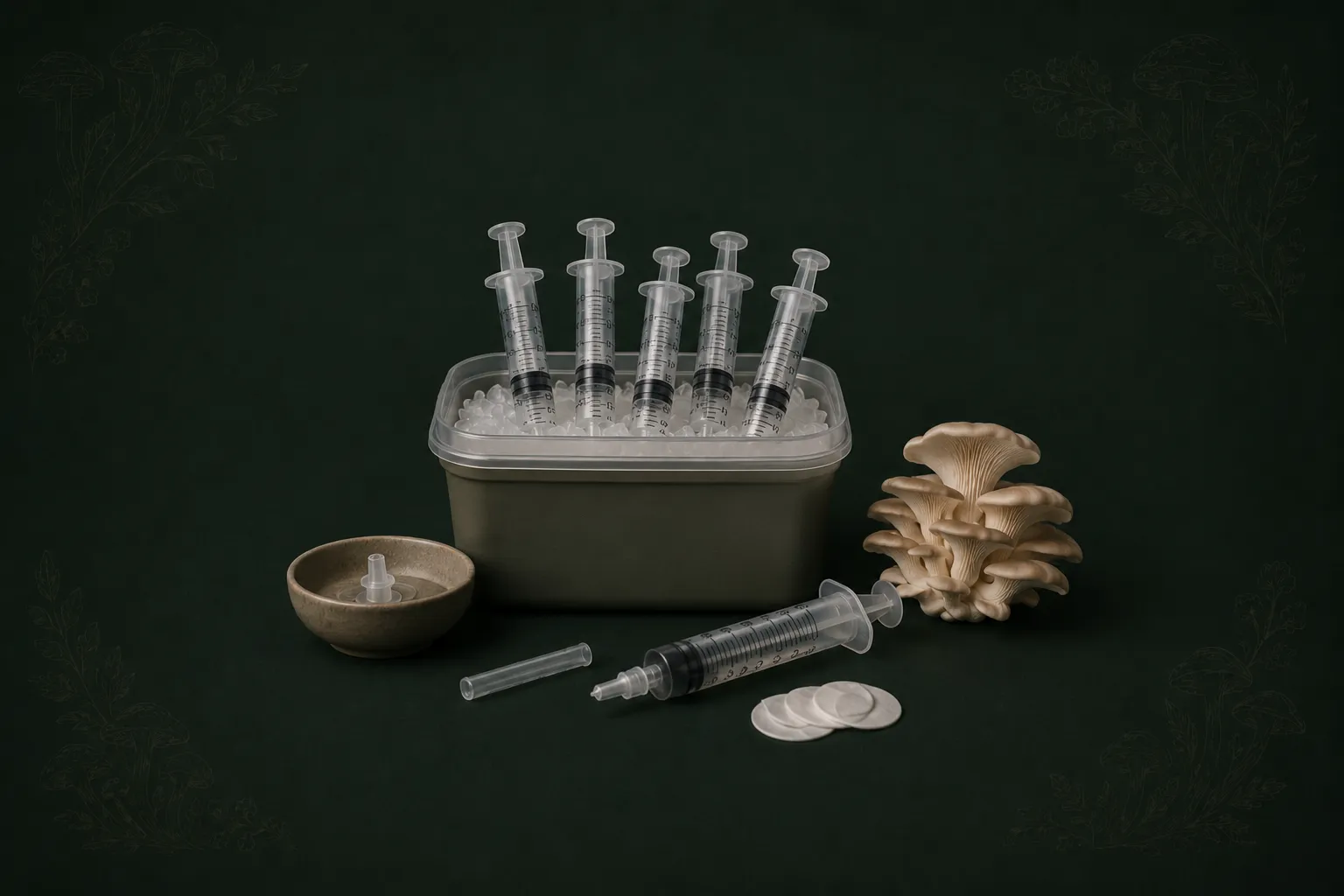
A liquid culture syringe contains living mushroom mycelium already suspended and growing in a nutrient solution — unlike a spore syringe, which still has to germinate, LC is actively alive and ready to colonize grain the moment you inject it. At Foxfire Mushrooms in Longmont, Colorado, we carry 10ml LC syringes in multiple species, each prepared fresh so you get viable, vigorous mycelium from the first inoculation to the last.
This guide focuses on what to look for when you’re buying liquid culture: how to evaluate quality, which species to choose, how to calculate how many syringes you actually need, and how to store them so none goes to waste. If you want the step-by-step on how LC works and how to use it in your grows, head to our detailed LC explainer — this article is specifically about making the right purchasing decision.
When you order a liquid culture syringe, you’re purchasing living mycelium — the root-like network that mushrooms grow from — already germinated and suspended in a sterile nutrient solution. That’s the key distinction that makes LC so useful: the mycelium has already done the hard work of germinating from spores. You’re skipping that stage entirely.
This matters for two practical reasons:
Foxfire’s LC syringes are 10ml each. That’s a generous volume — a single syringe can inoculate between 10 and 20 grain jars or bags depending on how you work. At Foxfire, we also carry colonized grain spawn for growers who want to skip inoculation entirely, but for anyone building scale or wanting more control over their genetics, LC is where the value is.
Knowing what healthy LC looks like — and what to watch out for — saves you from wasting an entire grow cycle on compromised culture. Here is what to check when your syringe arrives.
At Foxfire, we prepare our LC fresh and ship it promptly, but if anything looks off when your order arrives, reach out — we stand behind every syringe with our 30-day money-back guarantee.
Different species exhibit unique growth habits as liquid cultures. Here’s a quick reference for the LC species we carry at Foxfire, along with what to expect from each.
| Species | Difficulty | Colonization Speed | Best Substrate | Notes |
| Blue Oyster | Beginner | Fast | Straw, hardwood | Great first LC; aggressive colonizer |
| Pink Oyster | Beginner | Very Fast | Straw, coco coir | Loves warmth; shorter shelf life |
| Lion’s Mane | Intermediate | Moderate | Hardwood, soy hulls | LC strongly preferred over spores |
| Shiitake | Beginner–Intermediate | Moderate | Oak, hardwood pellets | Reliable and consistent via LC |
| Reishi | Intermediate | Slow | Hardwood | LC recommended over spores for reishi |
| Snow Oyster | Beginner | Moderate–Fast | Straw, hardwood | Cold-tolerant; excellent for Colorado grows |
| Hen of the Woods | Advanced | Slow | Oak | For experienced cultivators; rewarding |
Blue Oyster is one of the most forgiving species you can work with as an LC. It colonizes grain quickly, handles minor temperature fluctuations well, and produces reliably. If you’re new to using liquid culture, this is the species to start with — you’ll see results fast and build confidence in your lab technique.
Pink Oyster colonizes even faster than Blue Oyster, but it’s highly temperature-sensitive — it prefers warmer conditions (above 65°F) and stalls out in the cold. Because it grows so aggressively, Pink Oyster LC is a great option when you want rapid turnaround. Just plan to use it relatively soon after it arrives, as it is a shorter-shelf-life culture.
Lion’s Mane is where LC really earns its keep. Spore germination for Lion’s Mane is notoriously unreliable — germination rates can be low and highly inconsistent. LC bypasses that problem entirely, giving you a known, viable culture that colonizes predictably. If you’re growing Lion’s Mane, LC is the better route by a significant margin.
Shiitake is a true workhorse via liquid culture — delivering consistent colonization, solid yields, and reliable results across a range of conditions. It’s a bit slower than oysters, but the predictability makes it a favorite for growers building a steady production rotation.
Reishi colonizes slowly no matter what inoculant you use, but LC gives you a head start that matters. As with Lion’s Mane, spore germination for Reishi can be highly inconsistent, so LC is the recommended starting point. Plan for a longer colonization window and don’t rush it.
Snow Oyster is particularly well-suited to Colorado growers. It handles cooler ambient temperatures that would stress Pink Oyster, making it a highly practical choice if your grow space isn’t climate-controlled through our colder months.
Maitake is for cultivators who’ve got the basics down and want a challenge. Colonization is slow and the species has specific, sensitive preferences, but the results are distinctive and rewarding. We recommend building experience with faster species first before working with Maitake LC.
Here’s the practical math. Each 10ml Foxfire LC syringe gives you roughly:
That means a single 10ml syringe can inoculate:
Planning 10 bags or fewer? One syringe is plenty. Planning 50 or more bags? Get 3–5 syringes so you have a comfortable safety buffer — you’d rather have slightly more LC on hand than run short mid-inoculation session. For growers who want to scale up significantly, review our how to inoculate grain spawn guide for workflow tips that help you get maximum coverage per syringe.
Rule of Thumb: Order slightly more LC than you think you’ll use. It stores beautifully in the fridge, and having a backup syringe on hand is far less painful than running out mid-project.
LC is perishable. Handle it accordingly.
Temperature: Refrigerate your LC syringes at 35–40°F as soon as they arrive. This slows mycelium metabolism and extends viability. Do not freeze — freezing kills the mycelium.
Light: Store in a dark location. Light isn’t as immediately damaging as heat, but sustained light exposure can degrade the culture over time. A refrigerator shelf away from the door light works well.
Shelf life: Properly stored, Foxfire LC syringes remain viable for 4–6 months from the preparation date. That said, fresher is better — LC inoculated within the first 4–6 weeks of preparation tends to colonize faster and more aggressively than LC approaching the end of its shelf life.
How to tell if LC has gone bad: Discoloration (yellow, brown, green, black), a sour or off smell when opened, or complete loss of visible mycelium structure are all signs that LC may no longer be viable. When in doubt, don’t use it on a fresh batch — the contamination risk isn’t worth it.
A little technique goes a long way toward stretching your liquid culture investment:
For a complete walk-through of advanced inoculation technique, see our inoculation guide.
LC and colonized grain spawn both get you to the same end point — colonized blocks ready to fruit — but via completely different paths.
The economics shift as you scale. A single $20 LC syringe can produce 10–20 jars of colonized grain, which then seed your bulk fruiting blocks — at that multiplication factor, LC becomes significantly more cost-effective than buying pre-colonized spawn for every block. Our buyer’s guide to mushroom supplies covers how these products fit together across the full grow workflow.
Each Foxfire LC syringe is:
We currently carry LC in Blue Oyster, Pink Oyster, Lion’s Mane, Shiitake, Reishi, Snow Oyster, and Hen of the Woods. If you want to grow a species rotation, you can order multiple species in the same shipment.
Foxfire’s liquid culture syringes are prepared fresh in Longmont, Colorado and ship ready to use — labeled by species, packaged with a sterile needle, and backed by our signature 30-day money-back guarantee.
Shop Liquid Culture Syringes by Species →
New to growing and want to understand the full picture before you buy? Start with our beginner’s guide to growing mushrooms or pick up a free Grow Guide to plan your first cultivation project from start to finish.
Properly refrigerated at 35–40°F in a dark location, Foxfire’s LC syringes remain viable for 4–6 months. For best results, use within the first 4–6 weeks — freshness correlates with colonization vigor.
Yes. Many cultivators use a small amount of LC to inoculate a liquid culture jar (a mason jar with a nutrient solution), effectively propagating the culture. This is a common technique for scaling a single syringe into much larger volumes of LC. It requires sterile technique, but it’s a natural next step for growers building out production.
A spore syringe contains mushroom spores suspended in water — spores still need to germinate before they become mycelium. An LC syringe contains living mycelium already growing and ready to colonize grain immediately. LC is faster, more consistent, and generally more reliable than spores, especially for species like Lion’s Mane and Reishi where spore germination rates can be low.
Check for: clear to lightly cloudy liquid with visible white mycelium strands, no discoloration (no yellow, brown, green, or black), and a faint earthy or sweet smell when opened. If the liquid looks murky, discolored, or smells off, err on the side of caution and don’t use it on fresh grain.
No. Room temperature accelerates mycelium metabolism and dramatically shortens shelf life. LC stored at room temperature may remain viable for only a few days to a couple of weeks. Refrigerate immediately on arrival.
Light cloudiness is normal — it’s just the density of mycelium in solution. What you’re watching for is uniform opacity or unusual color, which would suggest bacterial contamination. A lightly hazy syringe with visible white mycelium strands is healthy. A syringe that looks like murky water with no structure is concerning.
Share this article
Grab a beginner-friendly kit and apply what you just read —
or take the quiz and we’ll match you to the right
starting point.
