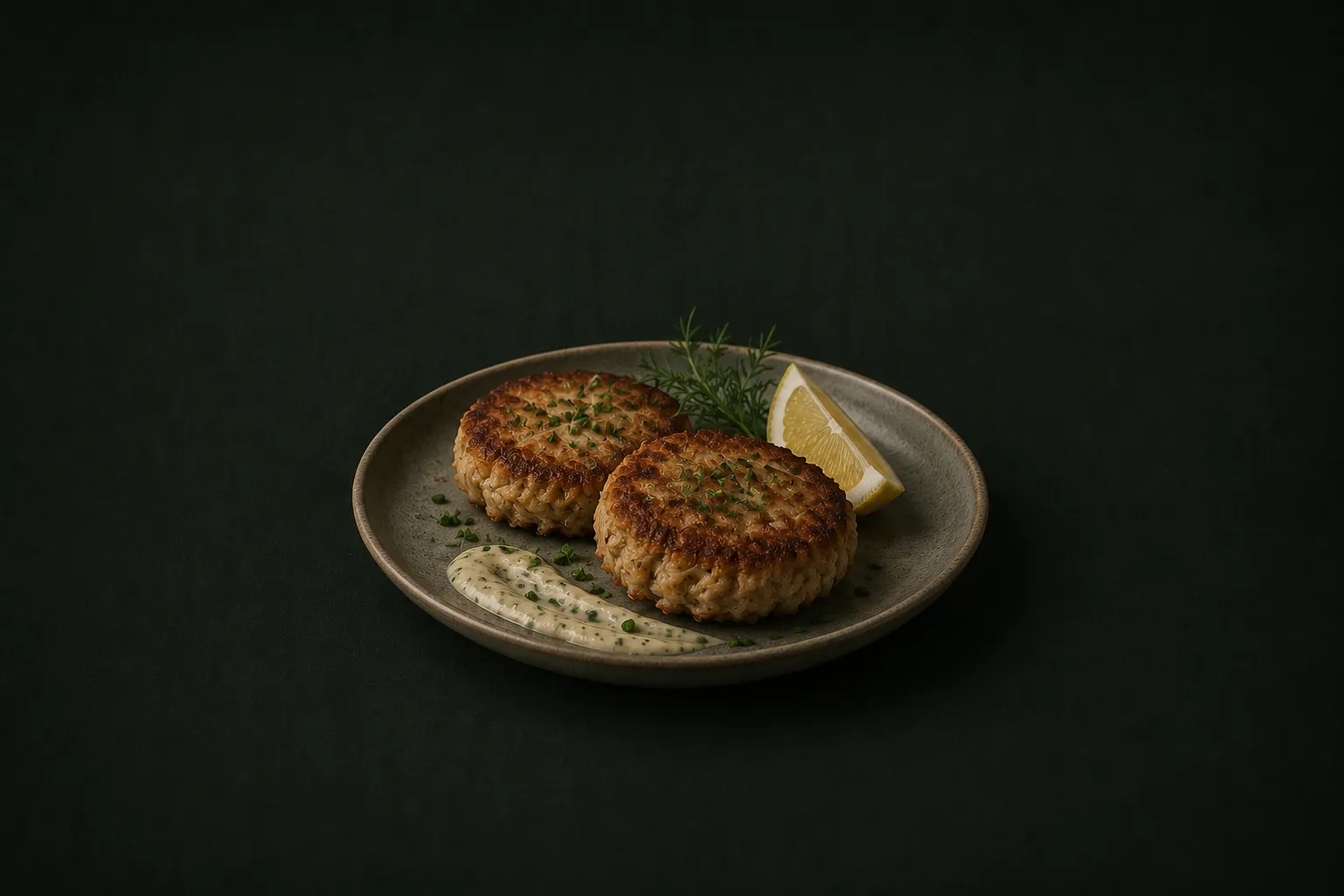
A lion’s mane crab cake recipe works because of a biological accident of the best kind: Lion’s Mane mushroom (Hericium erinaceus), when hand-shredded and dry-seared, produces a stringy, flaky texture that is remarkably similar to lump crab or lobster. It absorbs Old Bay and lemon beautifully, it firms up exactly like a crab cake when chilled, and it crisps into a deep golden crust in a hot pan. These cakes have fooled people who weren’t told what they were eating — and that’s not a trick, it’s just what Lion’s Mane does when you let it.
Here at Foxfire Mushrooms in Longmont, Colorado, Lion’s Mane is one of our favorite species to grow and cook. This recipe is the one we come back to most.
Yields: 6 cakes (serves 3)
Prep time: 15 minutes | Chill time: 20 minutes | Cook time: 15 minutes | Total: ~50 minutes
Most plant-based crab cake recipes rely on hearts of palm or jackfruit — both good options, but neither quite gets the flake right. Lion’s Mane does, and the reason is structural.
The mushroom grows in interlocking bundles of mycelial fibers that run lengthwise through the fruiting body. When you tear it by hand, you follow those fibers naturally, creating long, thin strands that look and behave like picked crab meat. Those strands hold moisture (just like real crab), bind well with egg and breadcrumbs, and create a layered texture inside the cake that knife-cut cubes simply can’t replicate.
The flavor completes the illusion. Lion’s Mane has a mild, slightly sweet taste with a faint oceanic quality — it’s not fishy, but it occupies the same soft, clean flavor space as shellfish. Old Bay, lemon zest, and Dijon push it further in that direction without overwhelming the mushroom itself.
The result is something you can serve to people who eat crab cakes every weekend and watch them reach for a second one.
We’re going to say this clearly: do not slice Lion’s Mane with a knife for this recipe. Not even close cuts. Not rough chops. Hand shredding only.
Here’s why. A knife blade cuts across the mycelial fibers, severing those long strands into short chunks. You lose the stringy, pull-apart texture that makes this recipe work. Short-cut pieces compress into something more like a dense mushroom patty — edible, but not a crab cake.
Hand shredding follows the natural direction of the fibers. Tear the mushroom into rough 1–2″ pieces, pulling along the grain the way you’d pull apart a piece of cooked chicken breast. The strands will separate easily and naturally, leaving you with a pile that looks genuinely similar to picked crab meat before you’ve done anything else to it.
Take a moment to appreciate it before it goes in the pan. It’s one of those things in the kitchen that feels a little miraculous.
Lion’s Mane mushrooms are roughly 90% water by weight. If you mix them raw into your cake batter, all that water will cook out during frying — and it has nowhere to go. The cakes will steam from the inside, collapse, and fall apart. You’ll end up with something closer to a mushroom scramble than a crab cake.
The solution is a dry pre-sear before you mix anything. A hot, completely dry skillet — cast iron is ideal, stainless works fine — drives off most of that moisture before the mushroom ever meets the binder. You’re left with a concentrated, flavorful mushroom that holds its shape under pressure and browns hard during the final cook.
The pre-sear also develops Maillard browning on the mushroom itself, which adds a layer of flavor that carries through the finished cake. Don’t skip this step. It takes 5–7 minutes and it’s the reason these work.
These cakes are best served hot, straight from the pan. A few ways we love to plate them:
The recipe is fully vegan with two easy swaps:
The cakes may be very slightly more fragile with a flax egg, so handle them gently and make sure you don’t skip the chill step.
Fresh Lion’s Mane is the key ingredient here — and fresh really does mean fresh. Lion’s Mane mushrooms begin to degrade in texture and flavor within 24–48 hours of harvest, which means the grocery store version (even if it looks beautiful) has already lost something by the time it reaches your pan.
Growing your own with a Foxfire Lion’s Mane Grow Kit puts you in control of that timeline. You harvest when the mushroom is at its peak — tight, white, dense — and cook it the same day. The difference in the pan is immediately obvious: stronger aroma, better browning, more pronounced flavor. For a recipe where the mushroom is the star, it matters.
Our Lion’s Mane mushroom guide covers everything about the species — how it grows, what it needs, and what to expect from your first harvest. If you’re new to cultivation, the beginner’s guide to growing mushrooms is the right starting point.
Love what Lion’s Mane can do? Explore the full collection at Foxfire Mushrooms. From Shiitake mushroom ramen to pink oyster tacos, there’s a recipe for every species we grow — and every one is built around the same principle: understand the mushroom, cook it correctly, and it will surprise you.
Browse all gourmet mushroom recipes →
Foxfire Mushrooms Lion’s Mane Grow Kits are made in Longmont, Colorado, inoculated with quality grain spawn, and backed by our 30-day guarantee. If your kit doesn’t fruit, we’ll make it right.
Share this article
Grab a beginner-friendly kit and apply what you just read —
or take the quiz and we’ll match you to the right
starting point.
