

- Scott Brenton
- 3 min read
What it is Ganoderma lucidum, called reishi in Japan and lingzhi in China. It fruits either as a fan-shaped bracket with a glossy, lacquered red-brown
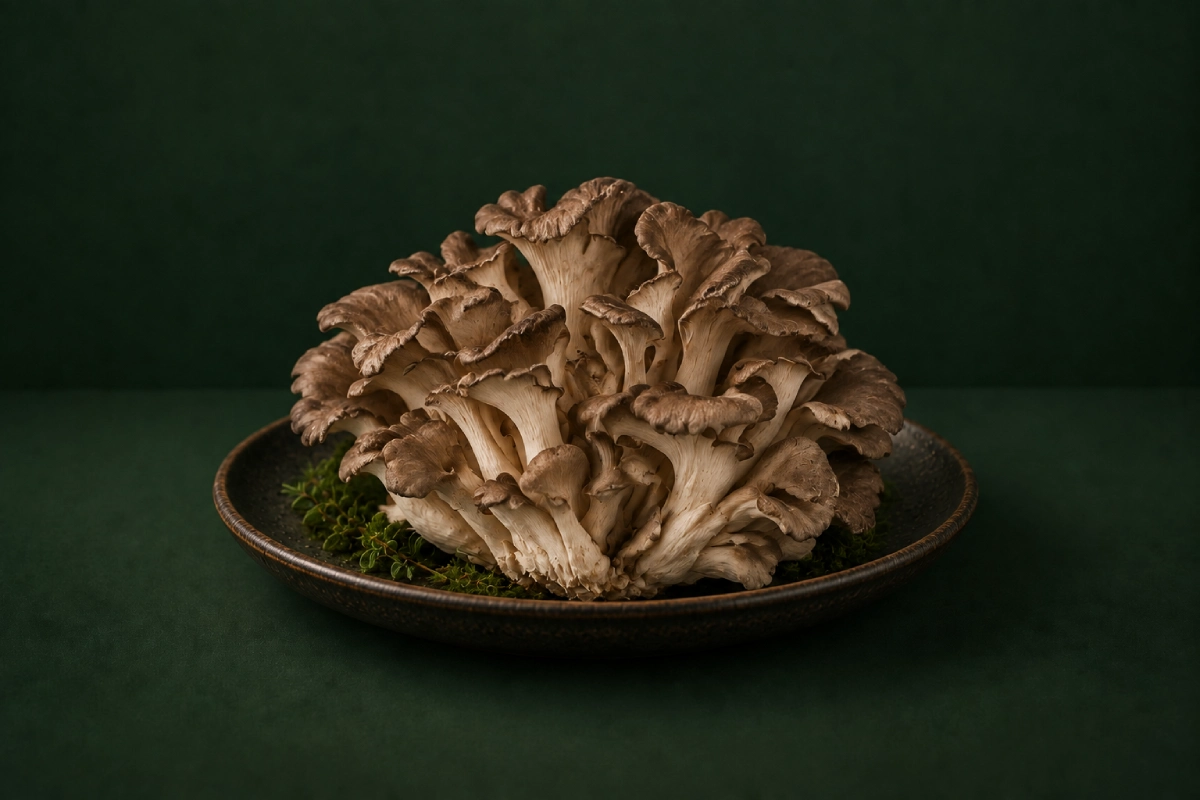
Grifola frondosa — maitake in Japanese, hen of the woods in English, named for the resemblance to a hen’s ruffled back. In the wild it grows at the base of old oaks in autumn; cultivated, it fruits as a dense rosette of overlapping fronds, usually a pound or more at a time.
It is a slower, more difficult species to grow than the oysters, which is why it costs more and why it appears in smaller quantity. It is also the one people who already know mushrooms ask for by name.
Rich, peppery and distinctly woodsy — more assertive than lion’s mane, less smoky than shiitake, and with a savoury depth that carries a dish on its own. The texture is the real event: the thin frond edges crisp to a shatter while the base stays dense and chewy.
Cook it in wedges, not pieces. Cut the rosette into fist-sized wedges through the base so the fronds stay attached, oil them, roast at 450°F for fifteen to twenty minutes, or press them cut-side down in a hot pan. Break it into small pieces and you lose the crisp-and-dense contrast entirely.
Do not crowd the pan and do not stir it. Maitake needs contact time on one face to build the crisp; every stir resets it.
Fronds should be firm and slightly leathery with defined grey-brown banding, and the whole cluster should feel dense for its size. Softness at the base, a sour smell, or fronds that flop when the cluster is lifted all mean age. Cultivated maitake is cleaner than wild — no need to hunt for grit in the layers.
Trim the tough core at the very base; everything else is usable. Trim loss 5–8% depending on how much base came with the cluster. Roasting drives off a lot of water — a pound of fresh yields roughly nine ounces roasted, but the intensity goes up as the weight goes down.
Five to seven days at 34–38°F. It is more robust than the oysters because the fronds are relatively dry, and slightly dehydrated maitake roasts particularly well.
Limited runs rather than every week — the grow cycle is long. When maitake is on the board it goes quickly, and Share members and standing wholesale accounts get first allocation.
Cut the rosette into large wedges with the fronds still attached, oil and salt them, and roast at 450°F for 15–20 minutes without stirring, or press them cut-face down in a hot pan. Contact time and space are everything.
No. Chicken of the woods is Laetiporus, a bright orange bracket fungus with a completely different texture. Hen of the woods is Grifola frondosa, grey-brown and frilled.
It takes far longer to fruit and yields less per block. The grow cycle, not the demand, sets the price.
Share this article
What it is Ganoderma lucidum, called reishi in Japan and lingzhi in China. It fruits either as a fan-shaped bracket with a glossy, lacquered red-brown

What it is Hypsizygus tessulatus — beech mushroom, shimeji, buna-shimeji in its brown form and bunapi in the white. Grown in tight bouquets of fifty

What it is Black pearl is a Pleurotus hybrid — usually credited as a cross of ostreatus and eryngii — grown for the best traits
Grab a beginner-friendly kit and apply what you just read —
or start with our beginner’s guide to find the right first grow.