

- Scott Brenton
- 5 min read
The honest framing We grow mushrooms indoors for a living and we do not sell anything foraged. So this page has no commercial interest in
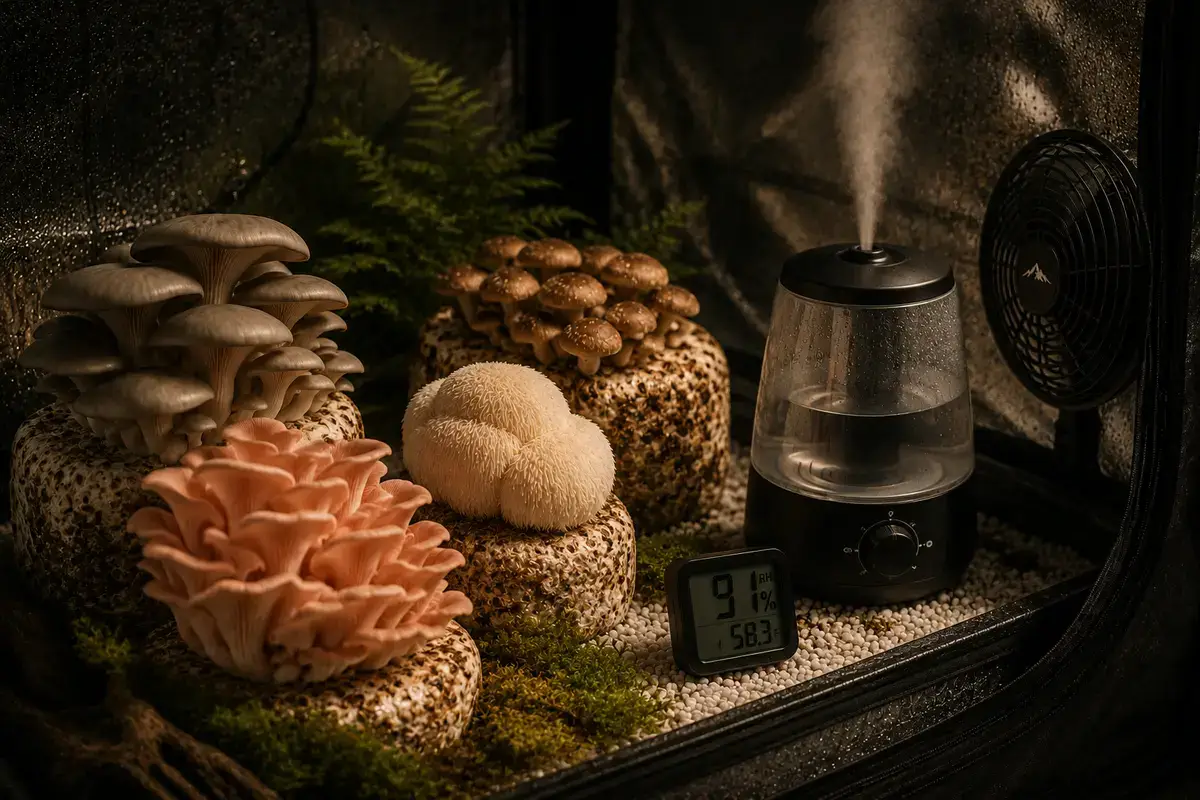
Walk into a mushroom fruiting chamber on the first cold morning after the furnace switches on and a Blue Oyster block that flushed perfectly three weeks earlier can look stalled and dry, with no pins forming at all. Indoor heating can push relative humidity much lower during winter, especially in already dry climates, creating a sharp contrast with the humid conditions mushrooms need to fruit. That swing is the real challenge behind any fall fruiting chamber setup, and it’s the exact shift Foxfire Mushrooms sees affect growers running Blue Oyster, Lion’s Mane, and Shiitake kits once heating season starts.
Quick Facts — Typical fruiting humidity: 85-95%, depending on species and airflow – Fruiting temperature: species specific, many oysters prefer cooler conditions than Lion’s Mane – Fresh air needs: adjust to chamber size and how the mushrooms are responding – Main fall challenge: lower indoor humidity once home heating starts – Key adjustments: monitor humidity, temperature, airflow, and surface moisture rather than following a fixed schedule
The mushrooms haven’t changed, your indoor climate has. Furnaces heat air without adding moisture, so relative humidity can fall sharply even when the actual amount of water vapor in the room hasn’t changed much. A chamber that held humidity easily in July with a couple of daily mistings can lose that same moisture in hours once the furnace cycles on overnight. On top of that, days get shorter, and light exposure is commonly cited as one environmental cue that can influence pinning, so a chamber that relies on natural light near a window may see less consistent results as that window narrows.
Cooler ambient temperatures can also slow evaporation from a humidity tray or reservoir, which sounds like it should help retain moisture but often just means less water vapor is entering the air than before. These shifts tend to happen together, which is part of why growing mushrooms indoors through fall often catches growers off guard within a day or two of the season turning, rather than gradually over weeks.
Three things tend to shift together. Relative humidity drops because furnaces heat air without adding moisture, so the same water vapor content reads as a lower percentage once the air is warmer. Temperature swings often become wider overnight, since many homes let the thermostat fall a few degrees while people sleep. And carbon dioxide can build up more quickly once windows stay closed, since that used to provide passive fresh air exchange without any extra effort. Pins that were forming into full caps in August can start growing into long, thin stems with underdeveloped caps by October, a pattern commonly linked to reduced fresh air exchange and elevated CO2 in cultivation literature, often layered on top of a humidity problem rather than a flaw in how pinning started. Fall is when both tend to show up at the same time.
Managing humidity inside your fruiting chamber through furnace season usually comes down to one of two approaches, and which one fits depends on how hands on you want to be. A perlite or hydroton humidity tray sits under your grow container and releases moisture passively as it evaporates, which is simple and cheap but needs refilling more often once the furnace is running. A small ultrasonic humidifier running inside your grow tent gives you more consistent, adjustable humidity, but it costs more up front and needs distilled water so it doesn’t coat your blocks in mineral dust.
Whichever method you use, a cheap digital hygrometer inside the chamber matters more in fall than any other season, since the room can feel dry to you well before your chamber’s actual humidity has dropped enough to stall pinning, and guessing at the number instead of reading it is how most fall setups fall behind. It also helps to keep the chamber away from heating vents and return air ducts, since a direct blast of forced air will dry out a tent or tote far faster than the same room’s ambient conditions would suggest.
| Feature | Perlite/Hydroton Tray | Ultrasonic Humidifier |
| Setup cost | Low, under $15 | Moderate, $25 to $60 |
| Humidity consistency in fall | Fair, needs daily attention | Strong, holds steady overnight |
| Maintenance | Refill and rinse weekly | Refill tank, clean weekly, use distilled water |
| Best for | Casual growers with 1 or 2 kits | Growers running several blocks or a full tent |
If you’re only running a single grow kit under a humidity dome on a countertop, a tray plus a couple extra daily mistings usually gets you through fall fine. If you’ve got a tent with multiple grain spawn blocks going, the humidifier earns its cost back in fewer failed flushes.
Yes, and this is the step people skip most often. In summer, a cracked window or a leaky door frame often gives you enough passive air exchange without thinking about it. Once you seal the house up for winter, that free exchange disappears, and CO2 can build up noticeably inside a closed tote or tent, sometimes within a day, depending on the size of the enclosure and how tightly it’s sealed. Fan your chamber as needed to refresh the air, using mushroom shape and how the chamber is behaving as your guide rather than sticking to a fixed schedule, even if that just means opening the tent flap and waving a paper plate around for thirty seconds when stems start looking long or CO2 buildup seems likely. If you’re using a tote, swap the lid for one with more or larger holes for the fall and winter months, then switch back once your windows are open again in spring.
Controlling temperature inside your fruiting chamber matters more once fall swings get wider, and cooler conditions can actually work in your favor for some species while working against others. Blue Oyster is well suited to cooler fruiting temperatures, generally in the 55 to 65°F range, and often produces dense, meaty caps once the room dips into the mid to upper fifties. Pink Oyster is a different story: it’s a warm, loving, tropical species that fruits best closer to 70 to 85°F and can stall or refuse to pin if the room gets too cold, so it’s a poor match for an unheated fall grow space.
Lion’s Mane sits in a moderate range around 65 to 75°F, so if your grow space is losing warmth as the season turns, that species may need supplemental heat to stay in range. Shiitake varies more by strain, and many strains fruit well in typical fall room temperatures as long as humidity is managed. Cold air also has a lower capacity to hold water vapor than warm air, and as surfaces inside a chamber cool down, condensation becomes easier to trigger, so adding humidity in a cold room without monitoring conditions can create standing water or persistently wet surfaces rather than the humidity you’re actually after, a problem covered in more detail below. Knowing which mushroom you’re growing changes how urgently you need to intervene once the temperature starts sliding.
Longmont sits in a genuinely dry climate compared to most of the country, and that gap matters more once outdoor air starts mixing into your grow space through doors and vents. Average outdoor relative humidity in Longmont sits in the low to mid 40 percent range across September and October, well below the 85 to 95 percent commonly used as a fruiting target. That’s already a meaningful gap in summer, but once indoor heating starts pulling additional moisture out of the air, the distance between outdoor conditions and what your chamber needs only grows.
If you’re growing somewhere with a similarly dry climate, whether that’s the Front Range, the high plains, or another region where heat runs constantly through winter, a hygrometer inside the chamber becomes less of a nice extra and more of a basic requirement, since regional averages only tell you what’s happening outside the tent, not inside it.
Controlling contamination risk gets trickier in fall because cooler, damper conditions from an overcorrected humidity setup can favor certain molds, especially Trichoderma, commonly identified by a fast spreading green patch. If you’ve cranked your humidifier to compensate for the dry furnace air and ended up with standing water pooling at the bottom of your tent, that stagnant moisture can end up being more of a contamination risk than the dry air was in the first place. In many cases the more effective fix isn’t more water, it’s better air movement. Running a small fan for a few minutes during each fresh air exchange can help keep the surface of your substrate from staying wet long enough for mold to take hold, even while your ambient humidity numbers look fine on paper.
Getting your chamber through the fall transition doesn’t usually require new equipment, most growers just need to catch the humidity drop earlier, add a manual fanning routine, and check conditions with a hygrometer instead of guessing. If a block has stalled and it’s not clear whether the mushrooms or the environment is the problem, Foxfire’s grower consultations are built for exactly that kind of troubleshooting.
If you’d rather just get moving again, the Cultivator’s Starter Bundle bundles grain spawn, a liquid culture syringe, and sterilized substrate for $79.99, ships free since it clears our $75 threshold, and carries the same live arrival guarantee as every grow kit even as temperatures drop during shipping. Book a consultation or shop the bundle and get your fall grow back on track before the season gets away from you.
The most common cause is a sudden humidity drop from your furnace turning on, not the temperature itself. Check your chamber’s humidity first before assuming the cold is the problem.
Yes, plenty of growers fruit successfully all winter. It just takes more active humidity management once passive moisture from open windows disappears.
You’ll likely need to mist more often once indoor heating starts, but let your chamber’s actual humidity reading and the substrate surface guide the frequency rather than following a fixed schedule.
For one kit sitting on a counter, consistent misting plus a humidity tray underneath is usually enough. A humidifier becomes more worthwhile with multiple blocks or a full tent.
That stretched look is commonly linked to low fresh air exchange, often because windows have been closed for the season. Increase manual fanning until you see stems shortening and caps filling out normally again.
Distilled water is generally the safer choice, especially in hard water regions, since tap water minerals can build up on your blocks over time and may reduce gas exchange at the surface.
Many cool weather oyster varieties, including Blue Oyster, fruit well around 55 to 65°F and often produce denser caps in cooler fall conditions. Pink Oyster is the exception and needs a much warmer room, closer to 70 to 85°F, so the right target depends on which variety you’re growing.
Share this article
The honest framing We grow mushrooms indoors for a living and we do not sell anything foraged. So this page has no commercial interest in

The farm tour Forty-five minutes, walking the whole cycle in the order it happens: substrate mixing, the sterilisation and inoculation side, the dark incubation room,

Why this county is unusual Boulder County has an established open-space and agricultural-land programme, a population that will pay a premium for provenance, a dense
Grab a beginner-friendly kit and apply what you just read —
or start with our beginner’s guide to find the right first grow.