

- Scott Brenton
- 5 min read
The honest framing We grow mushrooms indoors for a living and we do not sell anything foraged. So this page has no commercial interest in
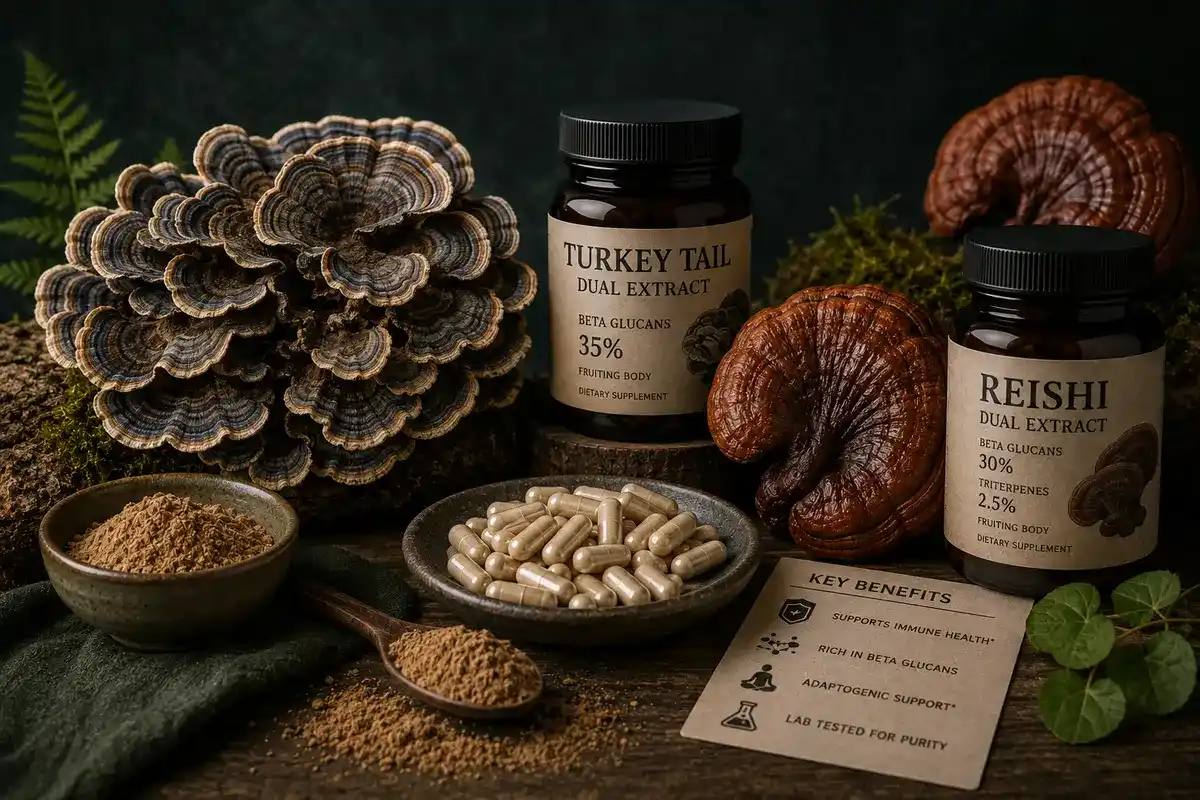
Pulling a slab of turkey tail off a fallen cottonwood near Longmont, the first thing most beginner foragers notice is how tough and almost woody it feels compared to the oyster mushrooms sold in a typical grow kit. That toughness is central to understanding turkey tail and reishi for immune support. Both mushrooms are valued not for flavor or texture on a plate, but for the beta glucans locked inside their dense, fibrous structure, compounds that need real extraction work to become usable. Research points to both mushrooms offering meaningful, though somewhat different, immune related activity, which is why Foxfire Mushrooms offers guidance on both rather than pushing one over the other.
Quick Facts — Beta glucan range in standardized dual extracts: 25-45% by weight – Whole raw powder beta glucan content: 5-15% – Turkey tail primary compounds: PSK and PSP polysaccharides – Reishi primary compounds: triterpenes and beta glucans – Typical daily serving: 1000-2000 mg – Extraction method: hot water and alcohol dual extraction
Beta glucans are branched sugar chains built along a beta 1,3 backbone with beta 1,6 side chains, a structure specific to fungal cell walls. Research indicates this branching allows beta glucans to fold into a triple helix shape in water, a structure that is believed to play a role in how they interact with immune cells along the digestive tract, although the precise biological pathways are still being studied. Raw, ground mushroom does not give easy access to these compounds, since they sit locked inside a chitin cell wall that resists ordinary digestion. This is one reason plain dried turkey tail or reishi powder, however good it looks on a label, is generally considered to deliver only a fraction of the beta glucan content available in a properly made extract.
Turkey tail is mostly a one compound story: beta glucans and the related PSK and PSP fractions. Reishi is more complex, since it also carries triterpenes, specifically ganoderic acids, which are not water soluble. A reishi product extracted only in hot water delivers the beta glucans and leaves the triterpenes behind entirely. That distinction matters if reishi was chosen for its traditional association with calm and sleep rather than immune activity alone, since the compounds linked to that traditional use are the ones a water only extraction misses.
The most common question when comparing these two comes down to what a person is actually looking for day to day. Research on turkey tail has concentrated most heavily on immune related activity through its PSK and PSP polysaccharide fractions. PSK was isolated by a Japanese pharmaceutical company in the 1970s, sold under the name Krestin, and has been used for decades in Japan as an approved adjunct alongside standard cancer treatment, which is part of why it carries one of the more extensive clinical research histories among medicinal mushrooms.
Reishi has a different profile. Traditional use and a smaller body of modern research associate it with stress response, sleep quality, and general balance, a pattern often attributed to its triterpene content, though the exact mechanisms involved are not fully mapped out. Many people use both, often in the same blend, since the two research profiles complement rather than duplicate each other.
| Feature | Turkey Tail | Reishi |
| Primary compounds | PSK, PSP polysaccharides | Triterpenes, beta glucans |
| Most studied for | Immune cell activity | Stress response and calm |
| Taste | Earthy, mild | Bitter, woody |
| Traditional use | Gut and immune support | Longevity and adaptogen |
| Research depth | Extensive clinical history in Japan | Strong traditional use, growing clinical base |
| Pairs well with | Reishi, chaga | Turkey tail, lion’s mane |
Many mushroom powders on the market fall short here. Hot water extraction pulls out the beta glucans, since they dissolve in water, but does nothing for the triterpenes in reishi, which only release in alcohol. A true dual extract runs the mushroom material through both processes and recombines them, which costs more and takes longer to produce, but is the method most consistently associated with capturing a full spectrum of the mushroom’s compounds. A label that only mentions hot water extraction is a sign the triterpene content, and much of what reishi is traditionally used for around stress and sleep, has likely been left out.
This is one of the more overlooked factors in mushroom supplement quality. Mycelium is the root like network mushrooms grow from, and when it is cultivated on grain such as rice or oats, the finished product often still contains a large share of that grain material by weight. Products labeled simply as turkey tail or reishi “mycelium,” without specifying fruiting body, may be delivering mostly starch rather than the mushroom’s active compounds, since available testing data shows beta glucan and triterpene concentrations are consistently highest in the fruiting body, the part that forms the visible mushroom. A label reading “fruiting body extract” or “100 percent fruiting body” is a stronger indicator of potency than a mycelium based product, and checking for that wording is one of the simplest steps before buying.
This is the number most brands either bury or inflate, so it is worth being specific. Whole, unprocessed mushroom powder typically tests in the 5 to 15 percent beta glucan range, since most of the material remains locked behind intact cell walls. A properly standardized fruiting body extract, turkey tail or reishi, commonly lands between 25 and 45 percent beta glucan content by weight, and a reishi extract worth buying will list a separate triterpene percentage as well, usually in the low single digits, since triterpenes make up a much smaller share of the mushroom’s total weight than beta glucans do.
A product that only advertises a blended polysaccharide number instead of a specific beta glucan figure is worth questioning, since some testing methods count starches and other sugars alongside beta glucans, inflating the number without reflecting the compound most associated with immune activity. Third party lab testing, sometimes shown as a Certificate of Analysis, is the clearest available way to confirm a stated percentage rather than relying on a marketing claim.
Most quality dual extract products for turkey tail and reishi are dosed between 1000 and 2000 milligrams daily, typically split into a morning and evening dose. There is a documented gap between that consumer range and the doses used in Japanese clinical research, where pharmaceutical grade PSK has historically been dosed up to 3 grams a day as part of cancer treatment protocols under close medical supervision, a use case entirely separate from daily supplementation and not something the available consumer research supports replicating at home.
Reishi is generally reported to work better when taken consistently over weeks rather than occasionally, consistent with its traditional use as a slow building tonic rather than an immediate acting one. Turkey tail is more flexible in how people use it, and some take it seasonally, especially heading into fall and winter. Neither mushroom produces a noticeable immediate effect the way caffeine might, so expecting a result within an hour sets the wrong expectation from the start.
Both can be grown at home, though they are slower and more demanding than the oyster and lion’s mane kits most beginners start with. Turkey tail grows well on hardwood logs or supplemented sawdust and tends to be forgiving about temperature swings, but takes longer to colonize than a standard grow kit, often six to eight weeks before the first fan shaped brackets appear. Grain spawn is a more realistic starting point than a beginner kit for either species, and Foxfire’s grower consultations cover substrate ratios before committing to a full batch.
Reishi needs higher humidity than turkey tail and a distinct fruiting trigger, and the antler stage it goes through before forming the familiar shiny cap confuses a lot of first timers who assume something has gone wrong. Nothing has. That antler phase is a normal part of reishi’s growth pattern before it flattens into the recognizable lacquered cap.
Turkey tail has one of the more substantial clinical research bases among medicinal mushrooms, largely through PSK research conducted in Japan over several decades, where it has been used as an adjunct alongside chemotherapy and radiation in documented treatment settings. Reishi has thousands of years of documented traditional use in Chinese medicine and a growing body of smaller human studies examining stress markers, sleep, and immune cell activity, though this evidence base is less extensive and less standardized than turkey tail’s. Neither mushroom replaces medical care, and any functional mushroom product should be treated as a daily wellness habit rather than a treatment for a diagnosed condition, particularly where the underlying mechanisms are still an active area of research.
These statements have not been evaluated by the Food and Drug Administration. This product is not intended to diagnose, treat, cure, or prevent any disease.A plain mushroom powder that has not produced a noticeable result is often a sourcing issue rather than a dosing issue. Checking for a fruiting body only label, a specific beta glucan percentage backed by third party testing, and a dual extraction method covers most of what separates a well substantiated product from one that only looks the part on a shelf. Foxfire’s wellness lineup and grower consultations are built around that same standard, and anyone unsure which functional mushroom fits their routine can book a quick consultation to talk through the options.
Many people combine the two, since research on each mushroom points to different areas of support, immune activity for turkey tail and stress or sleep related benefits for reishi. A blend that lists beta glucan and triterpene content separately makes it easier to see what is actually being delivered from each mushroom.
Simmering fresh or dried mushrooms in water for at least thirty minutes does extract some beta glucans, similar to making a strong tea, but will not pull the triterpenes from reishi, which require alcohol extraction. This is why a true dual extract product is generally more potent than a homemade decoction.
Available research and common usage patterns suggest gradual changes over four to eight weeks of consistent daily use rather than a sudden effect. Reishi in particular is often reported to show its influence on sleep and stress response slowly rather than all at once.
For most healthy adults, daily use is generally considered safe, though anyone on blood thinning medication or with a scheduled surgery should talk to a doctor first, since reishi has been associated with mild anticoagulant activity in some research. Checking with a doctor is also worthwhile during pregnancy or while nursing.
Mild and earthy, closer to a weak black tea than anything unpleasant, which is why it blends easily into coffee or a smoothie. Reishi is the more bitter of the two, and capsule form is generally preferred for that reason.
A beginner turkey tail kit is not currently part of the lineup, since it is a slower, log based grow better suited to intermediate cultivators, but grain spawn is available and consultations can walk through the setup.
Powder is dried, ground mushroom material without any processing to break down the cell walls, so most of the beta glucan content stays locked away and unusable, often testing under 15 percent. Extract has gone through hot water or dual extraction specifically to make those compounds more bioavailable, which testing data shows delivers meaningfully more active compound per gram than powder alone.
Share this article
The honest framing We grow mushrooms indoors for a living and we do not sell anything foraged. So this page has no commercial interest in

The farm tour Forty-five minutes, walking the whole cycle in the order it happens: substrate mixing, the sterilisation and inoculation side, the dark incubation room,

Why this county is unusual Boulder County has an established open-space and agricultural-land programme, a population that will pay a premium for provenance, a dense
Grab a beginner-friendly kit and apply what you just read —
or start with our beginner’s guide to find the right first grow.