

- Scott Brenton
- 5 min read
The honest framing We grow mushrooms indoors for a living and we do not sell anything foraged. So this page has no commercial interest in
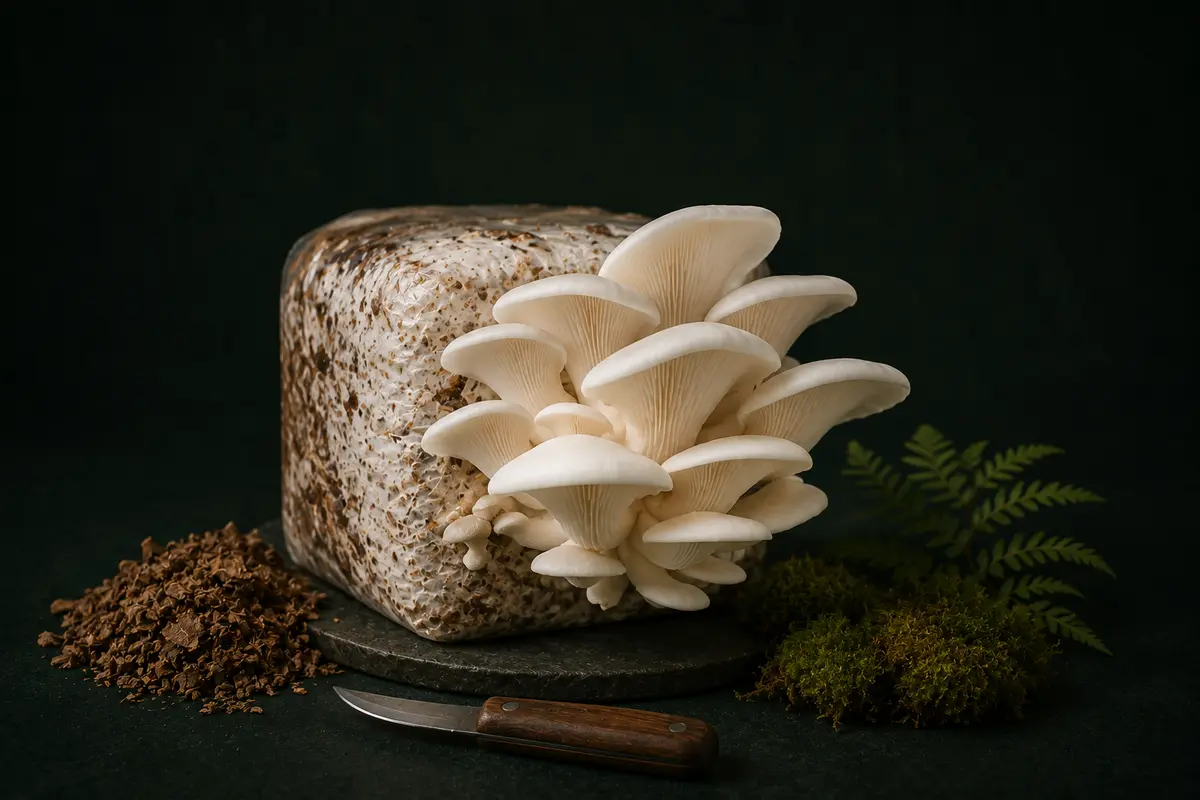
A first snow oyster block can sit quietly on a shelf for four or five days with seemingly nothing happening, then almost overnight a cluster of tiny white shells appears along the surface. That jump from nothing to everything is typical of growing snow oysters, and for anyone using this snow oyster mushroom growing guide while researching growing snow oyster mushrooms at home for the first time, here is the short answer: keep the block warm and humid, allow fresh air exchange a few times a day, and expect the first pinheads within one to two weeks once colonization finishes. Foxfire Mushrooms cultivates this variety in its Longmont, Colorado lab, and it is generally considered one of the more forgiving oyster varieties for growers working with something other than the standard blue oyster.
Quick Facts — Species: Pleurotus ostreatus var. florida – Colonization time: 10-18 days at 70-75°F – First flush after colonization: 5-10 days – Ideal fruiting humidity: 85-95 percent – Fruiting temperature: 55-65°F – Typical yield per 3 lb block: 1-1.5 lbs across two flushes
Snow oyster, known botanically as Pleurotus ostreatus florida, is a cold tolerant, pure white strain of the same species behind the more common blue and grey oysters, selected for a bright white cap and a firmer texture. It differs from golden oyster, a separate species, and from the more delicate pink oyster, which fruits faster and bruises easily. The caps hold their shape well after harvest, the flavor is mild with a hint of sweetness, and the mushroom tolerates a wider fruiting temperature range than some color sensitive oyster varieties, making it a practical option for growers without precise climate control.
Two starting points work for a snow oyster grow, and this is where first time growers often get stuck deciding.
| Starting Point | Best For | Time to Colonized Block | Skill Level |
| Grain Spawn | Beginners who want a shorter path to fruiting | Ready to fruit once mixed into substrate and recolonized, about 10 to 14 days | Low, minimal equipment needed |
| Liquid Culture Syringe | Growers who want to make their own grain spawn or run multiple projects from one source | Longer overall, since you inoculate grain first, then wait for full colonization | Moderate, needs basic sterile technique |
If this is a first grow, colonized grain spawn is the more straightforward starting point. It mixes directly into a pasteurized bulk substrate like coco coir and vermiculite, or straw, and the mycelium takes over from there without requiring a still air box or any injection technique. For growers who already have a grain spawn workflow going, a snow oyster liquid culture syringe allows production of additional spawn at a lower cost per grow once the process feels familiar. Foxfire Mushrooms carries both, colonized snow oyster spawn in 3 and 6 pound bags and liquid culture in 10 ml syringes, and which one to choose typically comes down to whether a pressure cooker for sterilizing jars is already on hand. Without one, grain spawn remains the easier route.
Snow oyster is not particularly demanding about substrate compared to some gourmet species. It grows well on straw, hardwood sawdust blends, and the coco coir and vermiculite mix commonly shortened to CVG, which many home growers favor since it pasteurizes easily in a five gallon bucket of hot water instead of requiring a full autoclave. Foxfire Mushrooms uses pasteurized CVG for much of its production, largely because it holds moisture evenly. Oyster mushrooms as a group generally fruit more reliably on a substrate that stays consistently damp rather than one that swings between soaked and dry. At a larger scale, straw offers a lower cost per pound of finished mushroom, but it needs a longer pasteurization soak, roughly ninety minutes at 160 to 170°F, compared to the 45 minutes CVG typically requires.
At a steady room temperature between 70 and 75°F, full colonization typically takes between 10 and 18 days. White mycelium spreads outward from wherever the spawn was introduced until the bag or tub looks solid white with no substrate visible. Rooms under 65°F can stretch that timeline past three weeks, a common reason growers mistake a slow, cold block for a dead one.
A block still showing patches of unclaimed material is not yet fully colonized and should not move to fruiting conditions. Snow oyster tolerates cooler colonization better than pink oyster, but it still slows noticeably below 65°F.
Once the block reaches fully colonized substrate status, with no uncolonized patches left, it is ready to shift into fruiting conditions, which for snow oyster means dropping the temperature slightly, to between 55 and 65°F, while raising humidity to 85 to 95 percent and introducing fresh air exchange several times a day. Skipping this step is a common reason a colonized block appears stalled.
Oysters generally need that temperature drop and fresh air trigger to switch from vegetative growth into pin formation. A clear tote with holes drilled around the sides works as a simple humidity tent for a single block. Mist the tent walls rather than the block directly, two or three times a day, and crack the lid or fan it briefly each time to clear accumulated carbon dioxide.
Long, thin stems paired with small, underdeveloped caps are a recognized issue in oyster mushroom cultivation, and snow oyster shows this pattern fairly often. Two factors are typically involved. Insufficient fresh air exchange allows carbon dioxide to accumulate inside a fruiting chamber, and elevated CO2 during pinning is associated with stem elongation and reduced cap size across Pleurotus species, a response generally linked to the fungus growing toward fresher, oxygen richer air.
The second factor, often overlooked, is light. Pleurotus species need some indirect light, even ordinary ambient room light, to develop caps normally, and blocks fruited in full darkness tend to produce long, pale stems stretching toward whatever light is available. Increasing fresh air exchange and placing the fruiting chamber near a window or under a basic light source are both commonly reported to correct the imbalance within a flush or two.
Snow oyster caps start out curled tightly downward like a small cup and gradually flatten as they mature. The best harvest window is right as caps flatten but before the edges curl upward, a sign they are past peak and releasing spores heavily, at which point texture turns tougher. Twisting and pulling the whole cluster at the base, rather than cutting individual caps, helps avoid leaving stem tissue behind that can rot and invite contamination into the next flush.
Most growers see their first flush 5 to 10 days after pins appear, depending on how consistent humidity has been. Harvested snow oyster mushrooms store best unwashed in a paper bag in the refrigerator, typically holding quality for three to five days before texture and flavor begin to decline.
Yes, and for snow oyster the second flush is often nearly as strong as the first when the block is treated correctly in between. After harvesting, letting it rest a day or two without misting directly on the harvest sites, then resuming the normal schedule, tends to work well. A short dunk in cool water before resuming fruiting conditions can help trigger the second flush faster, though it is not strictly necessary. The second flush is typically smaller, usually 60 to 75 percent the size of the first, with total yield across both flushes from a 3 pound block landing around 1 to 1.5 pounds.
The two issues that come up most often are green mold contamination and aborted pins. Green mold, usually Trichoderma, appears as a patch of green fuzz and almost always traces back to an unsterilized substrate or a break in the bag’s filter patch. Catching it early and isolating or discarding that section is generally safer than trying to save it, since Trichoderma spreads quickly in the same warm, humid conditions the mushroom needs.
Aborted pins, where tiny pinheads form and then stop and dry up, usually point to a humidity crash, often a tent lid left open too long or a room drier than it feels. Snow oyster’s early fruit formation tends to be more sensitive to humidity swings that first week than the mycelium itself, so misting should not be scaled back once pin formation begins.
A 3 pound bag of snow oyster colonized grain spawn runs $24.99, and the 6 pound size is $39.99 for a larger batch. A liquid culture syringe is $12.99 for growers who want to produce their own grain spawn going forward. Adding a bag of pasteurized substrate, a full first grow setup lands well under $75, though pairing substrate with spawn often pushes the order over that mark, triggering free shipping. Shipping typically takes two to three days within the continental US, and spawn and culture shipments are generally timed for cooler parts of the week during summer heat to protect viability in transit.
For anyone ready to start a first snow oyster block, the grain spawn route is the more straightforward way in, and it pairs well with a bag of pasteurized substrate so everything is ready to mix as soon as it arrives. Snow oyster grain spawn and liquid culture options are available in the Foxfire Mushrooms shop, and for growers who run into trouble partway through, Foxfire Mushrooms offers one on one consultations for exactly that kind of troubleshooting. Watching that block closely around day ten tends to pay off. That first cluster appearing seemingly overnight is typically worth the wait.
No. Snow oyster is a white strain of Pleurotus ostreatus, while golden oyster is Pleurotus citrinopileatus, a different species with a yellow cap and a stronger tendency to fruit at warmer temperatures.
Yes, on hardwood logs or stumps in a shaded, humid spot, though outdoor log culture takes months longer to establish than an indoor bulk substrate grow.
No. Mixing colonized grain spawn into pasteurized bulk substrate does not require sterile technique the way liquid culture or agar work does, which is why grain spawn suits beginners.
Most growers get two solid flushes and sometimes a smaller third, though yield drops after the second. Once a block stops responding to rehydration and rest, it has likely exhausted its nutrients.
Some browning of older mycelium is normal, not a sign of contamination on its own. It becomes a concern only alongside a strong sour or ammonia smell, or fuzzy colored growth rather than flat discoloration.
Above roughly 70°F during fruiting, snow oyster tends to produce smaller, more clustered caps with shorter stems, and contamination risk climbs since molds thrive in that same warm range.
Yes, their humidity and temperature needs overlap closely enough that most growers run both side by side without issue, though snow oyster tends to pin slightly faster.
Share this article
The honest framing We grow mushrooms indoors for a living and we do not sell anything foraged. So this page has no commercial interest in

The farm tour Forty-five minutes, walking the whole cycle in the order it happens: substrate mixing, the sterilisation and inoculation side, the dark incubation room,

Why this county is unusual Boulder County has an established open-space and agricultural-land programme, a population that will pay a premium for provenance, a dense
Grab a beginner-friendly kit and apply what you just read —
or start with our beginner’s guide to find the right first grow.