

- Scott Brenton
- 5 min read
The honest framing We grow mushrooms indoors for a living and we do not sell anything foraged. So this page has no commercial interest in
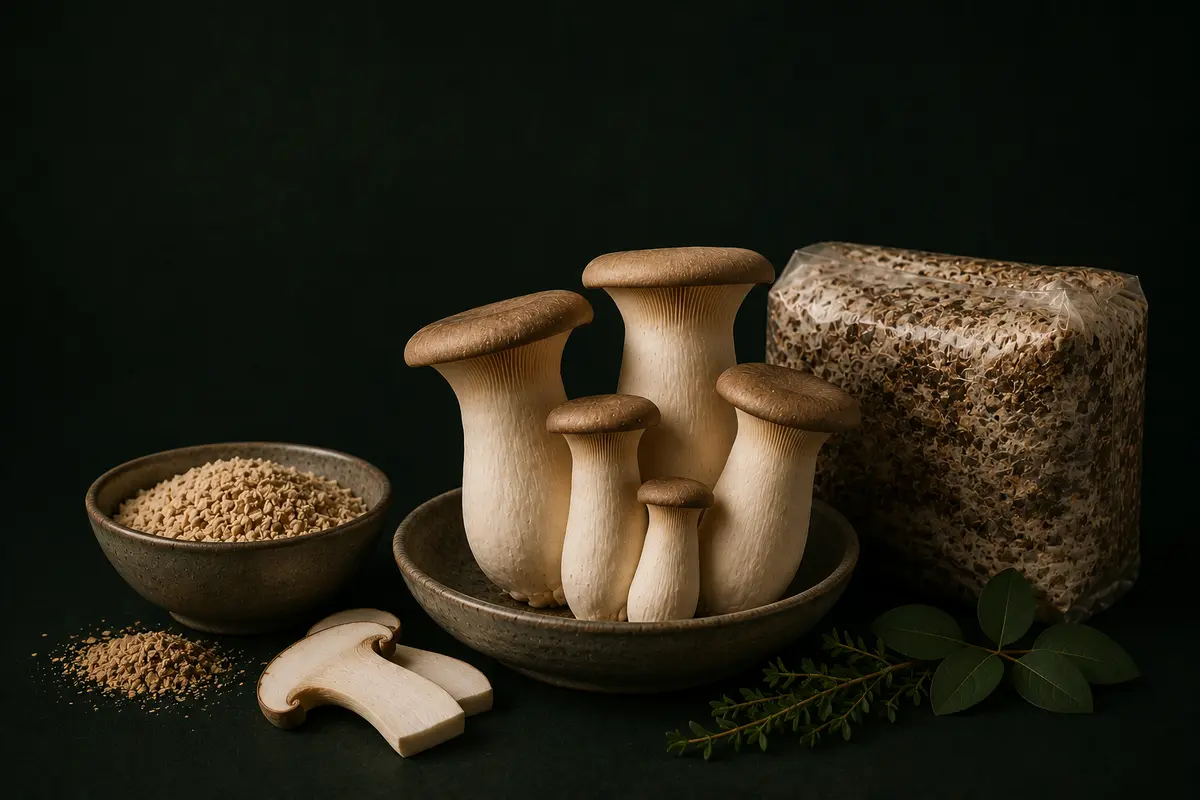
The first time I mixed a bag of King Trumpet grain spawn from Foxfire Mushrooms into a bulk substrate, I almost gave up on the block a week early. The surface still looked mostly bare while my Blue Oyster block from the same batch was already snow white. Turns out that slower pace is normal for this species.
If you are wondering how to grow king trumpet mushrooms at home, the short answer is that you need fully colonized grain spawn or a liquid culture, a dense hardwood based substrate rather than straw, cooler fruiting temperatures than most oyster varieties, and a fair amount of patience, because this species moves slower than its cousins at nearly every stage.
Quick Facts — Species: Pleurotus eryngii – Colonization time: 14-21 days – Fruiting temperature: 50-65°F – Humidity: 95-100% during pinning, 85-95% once mushrooms form – Time from pinning to harvest: 10-16 days – Price at Foxfire: $27.99 for 3 lb grain spawn, $12.99 for a 10 ml liquid culture syringe
Most home growers start with oyster mushrooms because they fruit fast and forgive mistakes. Anyone researching growing king oyster mushrooms at home tends to assume that same easy oyster logic carries over, but King Trumpet breaks that assumption even though it belongs to the same genus. The mycelium runs noticeably slower through grain, the mushroom wants a denser substrate to support that thick signature stem, and it is far pickier about air quality once pins start forming. Where a Blue Oyster block will throw dozens of small mushrooms in a tight cluster, a properly grown King Trumpet block should only be allowed to keep a handful of pins so each one can put its energy into growing a single substantial stem instead of a crowd of thin ones.
The other difference beginners miss is substrate choice. King Trumpet fruits best on supplemented hardwood sawdust rather than the straw or coco coir blends that work fine for oyster varieties. Foxfire sells a Sterilized Oak and Soy Hull Substrate specifically because that hardwood base suits species like King Trumpet and Shiitake far better than the lighter substrates used for faster fruiting oysters.
Both routes work, but they suit different growers. Grain spawn arrives already colonized and ready to mix into bulk substrate, which shaves real time off your grow. Liquid culture is cheaper up front and lets you generate your own grain spawn or inoculate multiple substrate containers from a single syringe, but it adds a colonization step and asks more of your sterile technique.
| Factor | Grain Spawn | Liquid Culture |
| Best for | Beginners who want a head start | Growers who want to multiply a single culture |
| Price at Foxfire | $27.99 for 3 lb | $12.99 for a 10 ml syringe |
| Time before use | Ready to mix in immediately | 10 to 14 days to colonize grain first |
| Shelf life | A few weeks refrigerated | Several months unopened |
| Contamination risk | Lower, arrives ready to use | Slightly higher, depends on your injection technique |
If this is your first time trying Pleurotus eryngii cultivation, starting with spawn removes one variable from an already slow species. Once you have grown a successful flush or two, a culture syringe becomes the more economical way to keep the project going.
King Trumpet behaves almost backward from what oyster growers expect when it comes to air exchange. During colonization and through primordia formation, the earliest stage where tiny pins first appear, this mushroom actually wants to stay enclosed, since keeping carbon dioxide levels higher inside the bag supports strong pinning. But once those pins start developing into fruit bodies, that need flips hard. Fresh air exchange has to increase quickly, with carbon dioxide ideally dropping below roughly 2,000 ppm, or the mushroom keeps stretching its stem in search of oxygen instead of filling out its cap.
I learned this the hard way. My first King Trumpet flush from a Foxfire spawn block came out looking like a set of bowling pins, stems six or seven inches long with caps the size of a marble. I had humidity dialed in perfectly and assumed that alone was enough, so I barely opened the tent once pins appeared. The next batch, with two to three short bursts of fanning added each day after pinning, produced the plump, torpedo shaped mushrooms King Trumpet is actually known for. It was a useful reminder that this species punishes shortcuts more than the oyster varieties do.
The requirements shift as the mushroom develops, which is part of why beginners get inconsistent results. During colonization, keep the block around 70 to 75°F in the dark. Once you move it to fruiting conditions, drop the temperature to 50 to 65°F, with many growers finding 55 to 60°F produces the densest, meatiest stems. Humidity needs to stay especially high while pins are forming, close to 95 to 100 percent, then can ease slightly to 85 to 95 percent once the fruit bodies are visibly growing. Watch your misting technique during this stretch too, since King Trumpet is prone to dark blotching on the cap when water sits directly on the surface instead of evaporating into the air.
From a fully colonized 3 lb block of Foxfire grain spawn mixed into substrate, expect first pins within a week of hitting fruiting conditions and a harvestable flush 10 to 16 days after that. A well managed block can produce two to three flushes total, though the second and third flushes are usually smaller and slower than the first. A single flush from a block this size commonly yields somewhere between half a pound and two pounds, with the first flush almost always outperforming later ones since King Trumpet channels most of its stored energy into that initial round of mushrooms.
If you already have substrate ready to go, the King Trumpet grain spawn is the faster path to your first flush and ships from the Longmont lab with the same live arrival guarantee that covers every Foxfire order. If you would rather build your own supply and inoculate multiple containers over time, a King Trumpet liquid culture syringe is the more economical starting point and colonizes reliably as long as your technique stays clean. If you need substrate too, Foxfire’s Sterilized Oak and Soy Hull Substrate pairs naturally with this species, and orders over $75 ship free, so bundling spawn with substrate is worth doing in one order. Shop the current King Trumpet spawn and liquid culture listings and you will have everything you need to get a block colonizing this week.
Plan on 14 to 21 days for colonization followed by 10 to 16 days from pinning to harvest, so a realistic timeline from inoculation to your first flush is about four to five weeks.
Yes, though it is a better second or third project than a first one. The colonization stage is forgiving, but the fruiting stage rewards attention to fresh air and temperature in a way that trips up people used to easier oyster varieties.
This almost always points to low fresh air exchange after pinning. Increase fanning frequency once pins appear so carbon dioxide can drop, since staying enclosed too long is what pushes the mushroom toward thin, elongated growth instead of a full cap.
A supplemented hardwood sawdust blend, such as an oak and soy hull mix, outperforms straw or coco coir substrates for this species. Foxfire sells this exact blend as a standalone product for growers who already have spawn or culture on hand.
Most blocks give two to three usable flushes, with yield dropping noticeably after the first. Some growers choose to compost the block after the second flush rather than waiting for a smaller third one.
Going with spawn is the easier starting point for a first attempt since it arrives already colonized. A culture syringe makes more sense once you want to scale up or supply your own future grows at a lower cost per project.
This is usually blotching caused by water sitting directly on the surface instead of evaporating. Mist so the air stays humid rather than soaking the caps, and make sure your fanning schedule is giving the surface a chance to dry between mistings.
Share this article
The honest framing We grow mushrooms indoors for a living and we do not sell anything foraged. So this page has no commercial interest in

The farm tour Forty-five minutes, walking the whole cycle in the order it happens: substrate mixing, the sterilisation and inoculation side, the dark incubation room,

Why this county is unusual Boulder County has an established open-space and agricultural-land programme, a population that will pay a premium for provenance, a dense
Grab a beginner-friendly kit and apply what you just read —
or start with our beginner’s guide to find the right first grow.